How AI Search Changed What We Actually Do for Clients
By Todd Boak, Partner, Harris & Ward
I’ve been doing SEO for dental and orthodontic practices long enough to remember when a well-optimized Google Business Profile and some decent backlinks could move the needle reliably. That playbook still matters, but it’s not the whole game anymore. Over the last eighteen months or so, the way patients find providers has shifted in ways that took me a while to fully understand, and even longer to figure out how to address practically.
Here’s what I mean. We had a client, a two-location orthodontic practice in central Texas, ranking well by every traditional metric. Good domain authority, clean technical setup, strong local presence. But when you asked ChatGPT or Perplexity who the best orthodontists were in their area, this practice didn’t come up. A competitor with weaker traditional SEO signals did. That gap is what pushed me to take AI search and AI SEO seriously as their own discipline rather than an extension of what we were already doing. Since we started addressing it, their AI search visibility has been gradually and measurably increasing. It’s not overnight, but the direction is clear.
Ranking and Being Cited Are Two Different Problems
This is the thing most SEO and AI SEO content glosses over. Ranking in Google and being cited by an AI system are related but they are not the same. Google ranks pages. AI systems synthesize information from sources they find credible, structured, and relevant to a specific query. The signals that drive one don’t automatically drive the other.
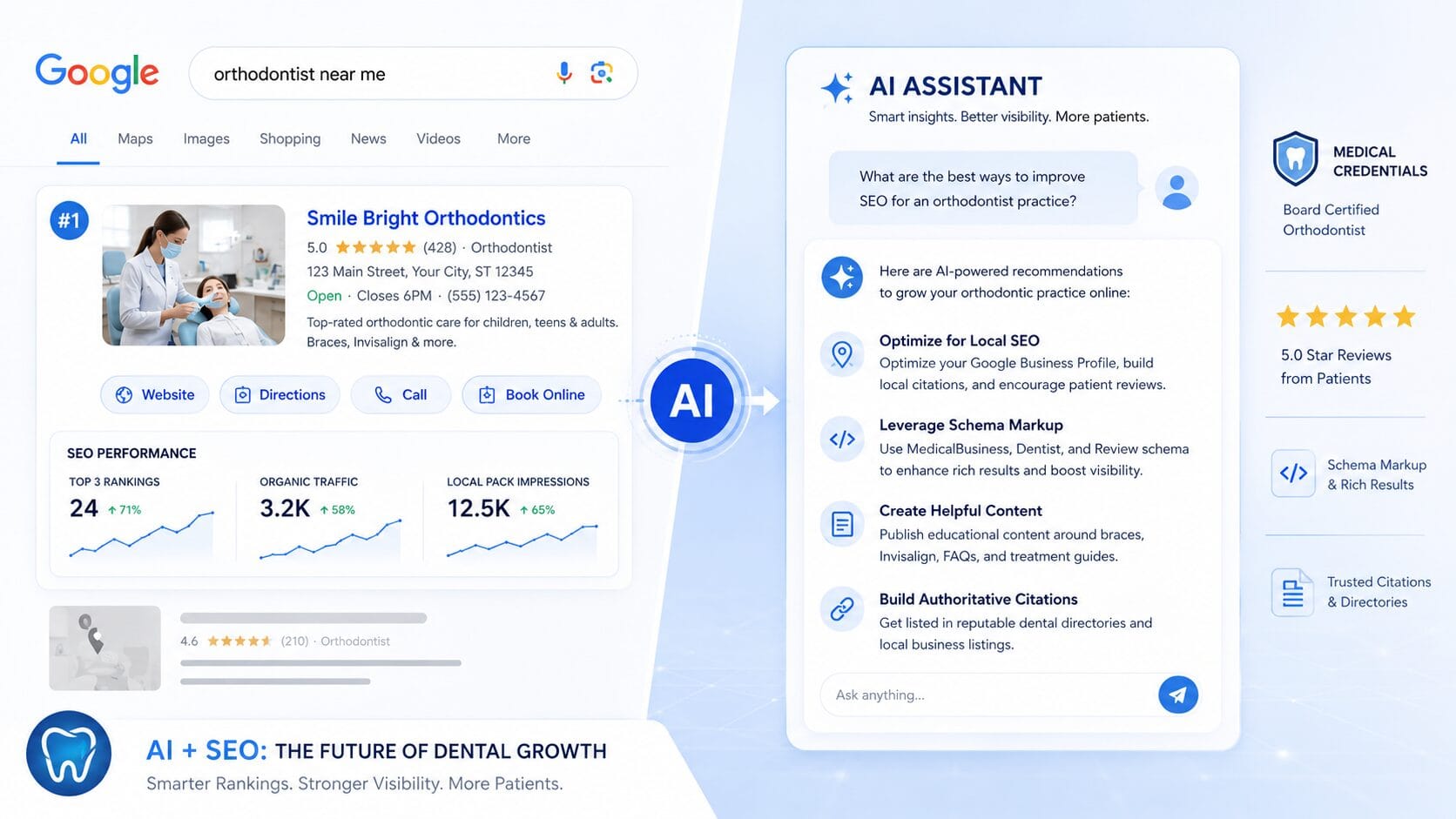
What seems to drive AI citation, based on what we’ve observed across clients, is a combination of things. Structured data implemented correctly and in depth. Content that answers specific questions at a level of detail that goes beyond surface coverage. Clear authorship signals, meaning real author pages with credentials, not just a byline slapped on a post. Consistency of information across directories, the practice website, and third-party sources. And topical coverage that actually makes sense for the practice, not just keywords mapped to service pages.
That last point matters more than people realize. An orthodontic practice that has thorough, well-written content about Invisalign, traditional braces, early intervention treatment, retention, and the clinical reasoning behind different treatment approaches is going to perform differently in AI search than one that has five identical-sounding service pages. AI systems are pulling from sources that demonstrate genuine expertise. Thin content doesn’t cut it the same way it used to.
Schema Markup Is More Important Than Most People Realize
If there’s one technical element that has become disproportionately important in AI search and AI SEO, it’s schema markup, and not just the basics. Most practices we audit have some version of LocalBusiness or MedicalBusiness schema in place. A lot of it is incomplete, inconsistent, or implemented in a way that made sense a few years ago but doesn’t reflect how AI systems are currently reading and processing structured data.
What we’ve moved toward is a much more layered and customized approach. That means building out Physician or Dentist entity markup with real credential data, including medical school, specialty training, board certifications, and professional affiliations. It means using Person schema linked to author pages so that when a doctor contributes to a blog post or FAQ, the authorship is attributable and structured, not just text on a page. It means implementing Service schema at a granular level, not just “orthodontics” as a catch-all but specific services with descriptions, associated providers, and location data attached.
We also pay close attention to how structured data handles multiple locations. A practice with two or three offices needs schema that correctly represents each location as a distinct entity with its own address, phone number, hours, and geographic coordinates, all connected back to the parent organization. When that’s done sloppily, AI systems encounter conflicting signals and either surface incomplete information or default to a competitor whose data is cleaner.
Review schema is another area that gets underestimated. Aggregate rating markup, implemented correctly and kept current, is a credibility signal that AI systems weight. We’ve seen cases where cleaning up and properly structuring review data had a visible effect on how a practice was described in AI-generated responses, shifting from a generic mention to a citation that included reputation context.
The broader point is that schema in the AI search era isn’t a checkbox. It’s a way of communicating to AI systems exactly who you are, what you do, where you do it, who does it, and why you’re credible. The more precise and complete that communication is, the better positioned you are to be cited accurately and prominently.
What We Actually Changed in Our AI SEO Process
When I started building out what we now call AI Search Optimization, or AI SEO, as a formal service…I had to figure out what was actually worth doing versus what was just theoretical. That took real testing.
Schema was the first priority, for the reasons above. The second was content depth. We started auditing existing content not just for keyword coverage but for whether it would actually satisfy a patient with a real question. Would a parent reading a page about early orthodontic treatment understand what Phase 1 treatment is, why it’s sometimes recommended, and what the alternatives are? If not, the page needed work regardless of where it was ranking.
First-hand expertise signals were the third area. This is where EEAT, which Google has discussed for years, finally started feeling urgent and practical rather than abstract. We started building real author profiles, getting client doctors to contribute actual clinical perspective to content rather than just having someone write in their name, and making sure that expertise was visible and attributable throughout the site.
Traffic Measurement Got More Complicated
One thing nobody warned me about when AI search started scaling was that the metrics would get harder to interpret. We have clients where organic traffic from Google is down around 10% but inbound calls are up 15%. That disconnect didn’t used to happen this way. What appears to be occurring is that AI systems are surfacing these practices in responses, patients are arriving at the website already fairly informed and fairly convinced, and the conversion rate is higher even if the raw session count looks unimpressive.
That’s genuinely good for the client, but it creates a reporting challenge. If you’re only looking at sessions and ranking positions, you might conclude that SEO is underperforming when it’s actually working differently. We’ve had to get more deliberate about tracking call volume, form fills, and new patient inquiries alongside traditional metrics, and having honest conversations with clients about why traffic and revenue don’t move in lockstep the way they used to.
What I Think Is Coming
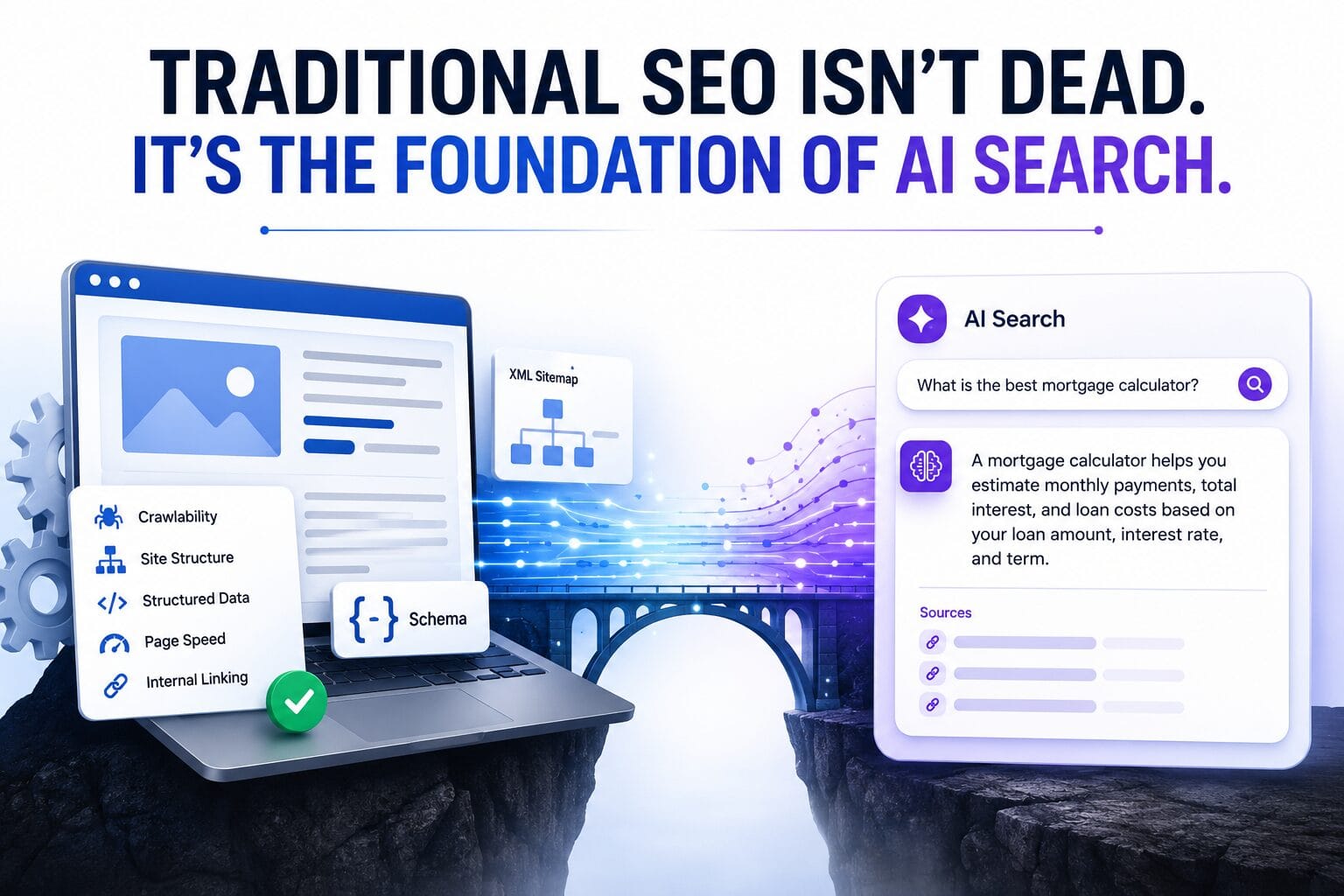
I don’t think traditional SEO is going away. Google still processes an enormous volume of searches and ranking matters. But the share of discovery that happens through AI-generated answers is going to keep growing, making AI SEO an increasingly important part of digital visibility. Businesses that treat it as a separate consideration rather than an integrated part of their content and technical strategy are going to feel that gap widen.
The practices and businesses that will be in the best position are the ones that have invested in genuine depth and credibility over time. Not keyword volume, not link schemes, not AI-generated content farms. Actual expertise, clearly attributed, well-structured, and consistently present across every surface where a patient or customer might encounter them. That’s what gets cited. That’s what builds the kind of presence that holds up regardless of which AI system or search product gains traction next.
We’re still learning. Anyone who tells you they have AI search completely figured out is probably oversimplifying it. But the fundamentals, real expertise, honest content, and clean structured data, are holding up better than a lot of people expected. That’s been the most reassuring part of the last year and a half.
Author Bio
Todd Boak is a Partner at Harris & Ward, a digital marketing agency based in Lexington, Kentucky, specializing in SEO and AI search for professional services like dental practices.
Related Reading:
Want to understand how AI search works and what businesses can do to improve visibility in ChatGPT, Gemini, and AI Overviews? Read: What Is AI SEO? A Beginner’s Guide to Ranking in AI Search