When AI Becomes Part of the Buying Process: How B2B Brands Can Build Authority
Share this article:
For years, B2B brands have focused on building authority with human buyers. We create content, earn media mentions, collect reviews, build backlinks, and demonstrate our expertise.
But the buying journey is changing.
A recent G2 study of more than 1,000 B2B software buyers and decision-makers found that 51% now start their software research with an AI chatbot more often than Google, while 71% use AI chatbots somewhere in the research process. Even more interestingly, 69% said an AI chatbot led them to choose a different vendor than they had originally planned, and 33% purchased from a vendor they had not previously heard of. Learn G2
That made me think about a question that B2B marketers need to consider:
How does a B2B brand establish authority when AI becomes part of the buying process?
The human buyer hasn’t disappeared. But before that buyer ever visits your website or speaks to your sales team, an AI tool may already have helped shape their shortlist.
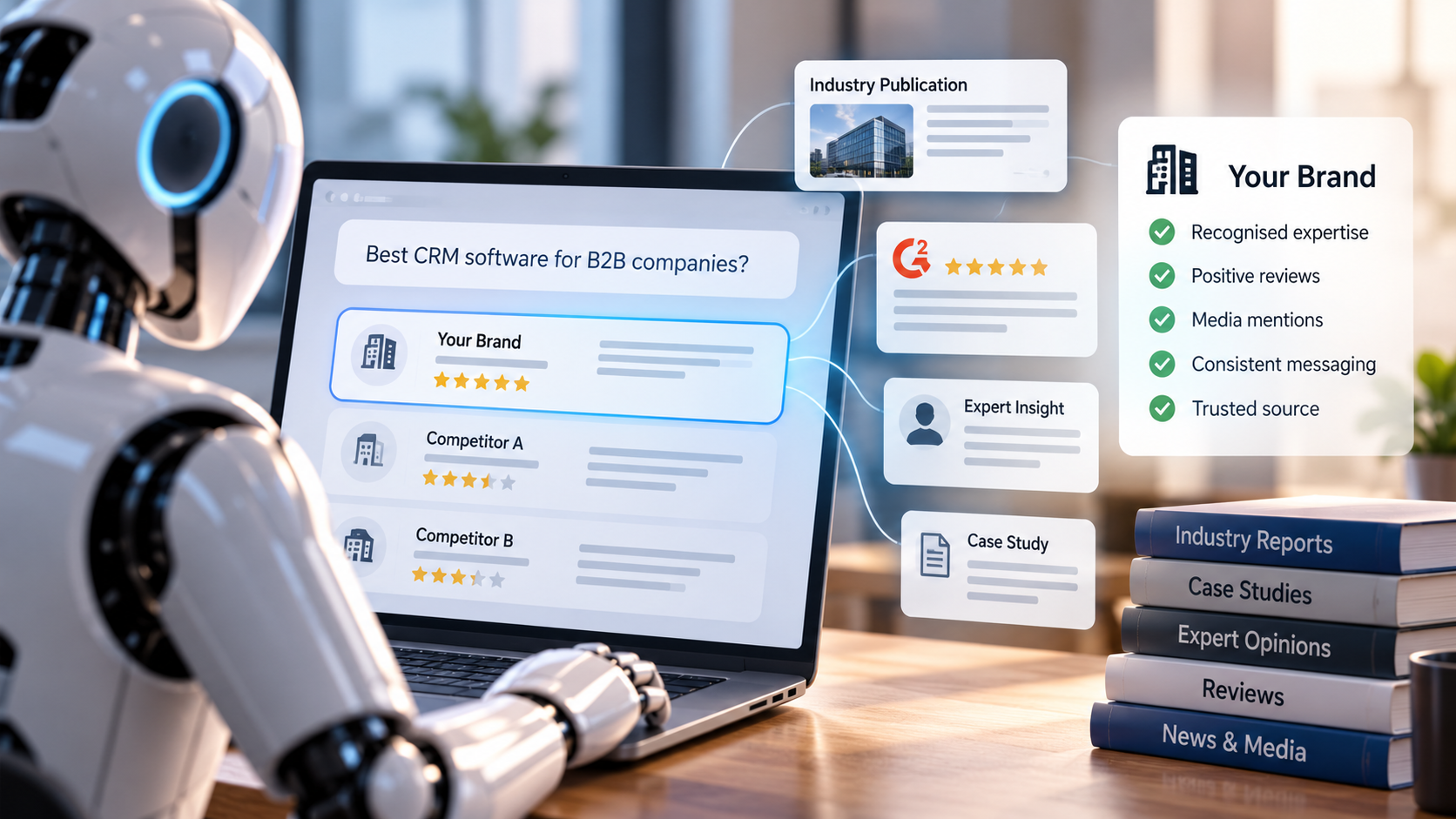
So, what does your brand need to look like to AI?
And more importantly, what information does AI need to find before it can understand and recommend your business?
AI Needs to Know Who You Are
When a person visits your website, they can spend time figuring out who you are and what you do.
AI doesn’t experience your brand in quite the same way.
It has to make sense of the information it can find.
Who is this company?
What does it offer?
Who does it serve?
Does it have expertise in this area?
Is there anything else on the web that supports what the company is saying?
This is why I think clarity and consistency are becoming even more important for B2B brands.
Your company name, services, expertise, leadership, website, and other important information should make sense wherever people find you.
Case Study: HubSpot is already treating this as a real marketing problem.
The company noticed that buyers were increasingly using AI platforms such as ChatGPT, Gemini, and Perplexity to research and compare products. HubSpot began tracking how its brand appeared in AI-generated answers and worked on improving its visibility across these platforms. HubSpot Blog
What I find interesting here is that HubSpot isn’t simply trying to rank for another set of keywords. It is trying to understand how its brand is represented when a potential customer asks AI about CRM software.
The company noticed that buyers were increasingly using AI platforms such as ChatGPT, Gemini, and Perplexity to research and compare products. HubSpot began tracking how its brand appeared in AI-generated answers and worked on improving its AI visibility across these platforms. HubSpot Blog
What I find interesting here is that HubSpot isn’t simply trying to rank for another set of keywords. It is trying to understand how its brand is represented when a potential customer asks AI about CRM software.
Being Everywhere Isn’t the Same as Having Authority
A company can publish hundreds of blog posts and still struggle to establish authority.
More content doesn’t automatically mean more credibility.
What matters is whether the content demonstrates something.
Have you actually worked in this area?
Do you have experience to share?
Have you conducted research?
Have other people or publications talked about your work?
Do you have examples that support what you claim?
These things can make a brand much easier to understand and trust.
A Real Example: Foxit
Foxit is a good example of a B2B company thinking about how its brand is represented in AI search.
According to a G2 case study, Foxit refreshed its G2 profile, aligned its messaging with its website, and built a consistent review-generation strategy. The company also used its G2 reviews, ratings, and testimonials across its marketing channels. Sell G2
The result is interesting. G2 says it became the #1 cited source in AI-generated answers about Foxit, while AI consistently reinforced Foxit’s positioning as a “#1 Acrobat Alternative.” Sell G2
What stands out to me is the emphasis on consistency. Foxit wasn’t simply publishing more content. It was making sure that the same brand message appeared across its website, G2 profile, reviews, and other channels.
That is an important lesson for B2B brands. If AI is becoming part of the buying journey, establishing authority may increasingly depend on how consistently and credibly your brand is represented across the web, not just on what you say about yourself on your own website.
This Is Where Digital PR Matters
This is one reason I don’t see digital PR as just a link-building exercise.
When a B2B company is mentioned in a relevant publication, included in an industry article, quoted as an expert, or featured in research, that mention exists outside the company’s own website.
Over time, these references can help build a picture of the brand.
And that matters when discovery is no longer happening only through a Google search box.
Don’t Forget the Basics
I don’t think B2B brands need to throw away their existing marketing strategy because AI has arrived.
The basics still matter.
Have a good website.
Explain your services clearly.
Show your expertise.
Publish useful content.
Keep your business information consistent.
Get genuine mentions from relevant websites.
And don’t make people, or AI systems, work too hard to figure out what your company actually does.
The Buyer Is Still Human
I also wouldn’t say that AI has replaced the B2B buyer.
It hasn’t.
There is still a person somewhere making the decision, approving the budget, or signing the contract.
But that person may now use AI to do much of the research before they ever speak to your sales team.
So perhaps the question isn’t really “How do I market to an AI?”
It is:
“If an AI were researching my company today, would it find enough clear, credible information to understand why my brand deserves to be considered?”
That is a question I think more B2B marketers should be asking.
Case Study: What I’m Doing at Simply Sansu
This isn’t something I only think about when working on client strategies. I have also been working on my own website with this shift in mind.
I have been making sure that Simply Sansu is clearly represented as a brand and that my expertise is easy to understand across my website and the wider web.
Some of the things I have been working on include:
- Making my brand and entity information more consistent
- Clearly connecting Sansu Abraham with Simply Sansu
- Strengthening the website’s structured data and knowledge graph information
- Adding and improving FAQ content to answer questions directly
- Making sure important pages clearly explain my expertise in SEO, AI SEO and Digital PR
- Checking whether AI crawlers can access my website
- Publishing content based on my own experience, research, and observations
- Building my presence through digital PR, media mentions, and third-party publications
I see this as more than trying to “rank in ChatGPT.”
If a potential customer asks an AI tool about AI SEO, Digital PR, SEO, or brand visibility, I want there to be enough reliable information about me and Simply Sansu for the AI to understand who I am, what I do, and why I might be relevant to that question.
That is the approach I think B2B brands should start considering.
Don’t just optimize your website for the person who visits it today. Build a digital presence that can also be understood by the systems helping tomorrow’s buyers make decisions.
How I Can Help B2B Brands Build AI-Ready Authority
For B2B brands, I don’t think the answer is simply to create more content for AI.
The first step is to make sure your brand is clear, credible, and consistently represented online.
At Simply Sansu, I can help B2B brands work on:
- Digital PR and media visibility to build credible third-party mentions
- Content strategy that demonstrates real industry expertise
- AI search visibility by identifying how your brand appears across AI-driven search
- Entity and brand consistency across your website and external platforms
- Expert-led content based on your team’s knowledge and experience
- Original research and data-driven content that gives other publications something worth citing
- SEO and technical foundations that make your website easier to discover and understand
- Authority-building campaigns that connect content, PR, SEO, and brand visibility
I don’t see AI search as a replacement for SEO, content, or digital PR. I see it as another layer of visibility that B2B brands now need to consider.