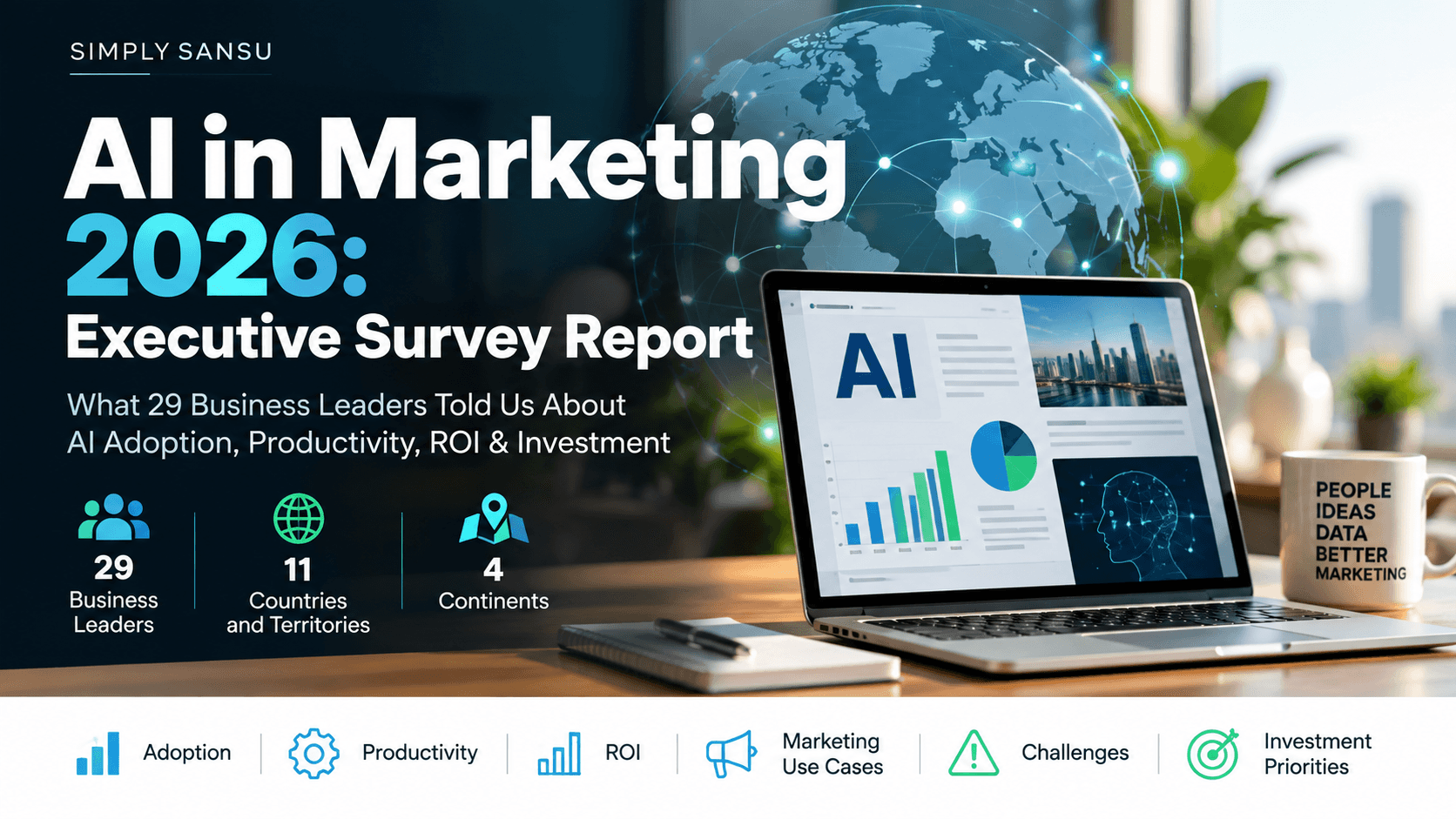

What Is AI SEO? A Beginner’s Guide to Ranking in AI Search
In case you have been into SEO for some time, then you definitely know the game.
Find keywords. Create content. Build authority. Earn rankings.
But search is changing.
People do not anymore use Google blue links alone; instead, they ask queries straight to ChatGPT, Gemini, Perplexity, Claude, and Google’s own AI overviews.
Instead of showing ten websites, these platforms often provide a direct answer.
The obvious question is:
How do you make your website part of that answer?
That is where AI SEO comes in.
So, what is AI SEO?
If you are a business owner, marketer, or website owner, understanding AI SEO today is as important as understanding traditional SEO ten years ago.
For businesses looking to improve their AI search visibility and increase their chances of being cited by ChatGPT, Gemini, Perplexity, and Google AI Overviews, my dedicated service page explains the process in detail:
👉 https://simplysansu.com/ai-seo-services/
What Is AI SEO?
The term AI Search optimization refers to making sure that your website is optimized so that artificial intelligence can make sense of, rely upon, and reference your content to formulate their answers.
AI SEO, also known as AI Search Optimization, is the process of optimizing content to improve visibility in AI-powered search experiences such as ChatGPT, Gemini, Perplexity, and Google AI Overviews.
Traditional SEO focuses on rankings.
AI search optimization revolves around citations, mentions, recommendations, and visibility within AI-driven answers.
Here’s what that means.
Traditional Search
A user searches:
“What is AI SEO?” or “What is AI Search Optimization?”
Google shows ten links.
Your goal is to rank #1.
AI Search
A user asks ChatGPT:
“What is AI SEO?” or “What is AI Search Optimization?”
ChatGPT may generate an answer using information from several websites.
Your goal is to become one of those trusted sources.
That is the difference.
SEO vs AEO vs GEO
You may have seen new buzzwords appearing everywhere.
Now, let me simplify it.
SEO (Search Engine Optimization)
The objective is to rank web pages within search engines.
Example:
Your AI SEO service page ranks on Google for:
“AI SEO services”
AEO (Answer Engine Optimization)
The goal is to provide direct answers to user questions.
Example:
A blog answering:
“What is AI SEO?”
in a clear, structured format.
GEO (Generative Engine Optimization)
The objective is to be cited on AI platforms like ChatGPT, Gemini, and Perplexity.
Example:
Your content gets mentioned on ChatGPT if the reader queries AI SEO.
In reality, all three overlap.
You cannot ignore traditional SEO and expect AI search visibility.
Good AI optimization is usually built on good SEO fundamentals. Google itself states that the same core SEO best practices remain important for AI search experiences. (Google for Developers)
How ChatGPT, Gemini, and Perplexity Find Content
This is where many website owners get confused.
People assume AI tools simply “know everything.”
They don’t.
Most modern AI systems combine trained knowledge with information retrieved from the web.
ChatGPT
When web search is used, ChatGPT can retrieve information from online sources and cite them.
Strong authority signals help.
Well-structured content helps.
Recognized brands help.
Gemini
Gemini is deeply connected with Google’s search ecosystem.
If Google understands and trusts your content, Gemini is more likely to understand it too.
Perplexity
Perplexity is heavily citation-driven.
It loves content that is factual, clear, and easy to verify.
In many cases, it provides more source citations than other AI platforms. (Whitehat SEO)
What Are AI Overviews?
AI Overviews are Google’s AI-generated summaries that appear directly in search results. Instead of showing only links, Google provides a synthesized answer and includes supporting sources. (Google for Developers)
You have probably already seen them.
Search for something like:
“How does AI Search optimization work?”
Google may show an AI-generated answer before the traditional organic listings.
This changes user behavior.
People often get answers without clicking multiple websites.
That means visibility inside AI Overviews is becoming just as important as ranking on page one. (blog.google)
Why Authority Matters More Than Ever
If there is one lesson I have learned from years in SEO and digital PR, it is this:
Authority wins.
AI systems do not want to recommend random websites.
They want sources they can trust.
That trust comes from signals such as:
- Strong topical expertise
- High-quality backlinks
- Brand mentions
- Digital PR coverage
- Expert content
- Consistent publishing
- Positive reputation
This is one reason I continue investing in digital PR and authority building for Simply Sansu.
When it comes to AI platforms selecting what sources should be visible, having credibility as an expert is important.
A website with 20 high-quality posts on AI Search optimization is more valuable than a website with 200 average posts generated by AI.
Quality beats quantity.
An Example Using Simply Sansu
Let’s assume someone asks:
“Who provides AI SEO services?”
AI systems may evaluate:
- Service pages
- Expert articles
- Brand mentions
- Backlinks
- Industry recognition
If my page:
clearly explains AI SEO, includes real expertise, demonstrates experience in SEO and digital PR, and earns authority signals from other websites, it has a better chance of being referenced.
The same applies to any business.
AI engines are looking for evidence.
Not claims.
Common AI SEO Mistakes
I see businesses making these mistakes repeatedly.
1. Publishing AI Content Without Expertise
AI-generated content alone is not a strategy.
If everyone can generate the same article, why would AI search engines cite yours?
Add experience.
Add insights.
Add original thinking.
2. Ignoring Brand Building
Many companies focus only on keywords.
AI systems increasingly evaluate brand authority.
If nobody talks about your business online, visibility becomes harder.
3. Chasing Hacks
There is currently no magic AI SEO trick.
No secret prompt.
No hidden schema.
Most successful AI visibility strategies still rely on strong SEO fundamentals. (Google for Developers)
4. Weak Content Structure
Huge blocks of text are difficult for users and AI systems.
Use:
- Headings
- Lists
- FAQs
- Definitions
- Examples
Make content easy to understand.
5. No Digital PR
AI engines frequently favor authoritative third-party mentions.
If respected websites mention your brand, your credibility increases. (arXiv)
How Businesses Can Prepare for AI Search
Do not panic.
Don’t rebuild your website.
You do need to adapt.
Here is where I would start:
Build Topical Authority
Cover your niche thoroughly.
If you offer AI SEO services, create content around:
- What is AI SEO
- AI Overviews
- GEO
- AEO
- AI content optimization
- AI visibility
Improve Your Brand Presence
Get mentioned on:
- Industry websites
- News sites
- Blogs
- Podcasts
- Directories
Create Helpful Content
Answer real questions.
Not keyword-stuffed content.
Real answers.
Strengthen Digital PR
Earn mentions and backlinks from authoritative websites.
Keep Technical SEO Strong
Make sure:
- Pages are indexable
- Content is crawlable
- Structured data is implemented correctly
- Website speed is optimized
The fundamentals still matter. (Google for Developers)
Final Thoughts
AI SEO is not replacing SEO.
It is the next evolution of SEO.
The businesses that will succeed in the coming years will not be the ones that take shortcuts to reach the top in an AI world.
They will be the ones who develop authority and value in their field, through content
If someone asks ChatGPT, Gemini, Perplexity, or Google AI Overviews a question related to your industry, the goal is simple:
Make your website worthy of being part of the answer.
AI SEO includes strategies often referred to as ChatGPT SEO, Gemini SEO, and Perplexity SEO, helping businesses improve their visibility across AI-powered search platforms.
If you want help improving your visibility in AI search, learn more about my AI SEO services here:
👉 https://simplysansu.com/ai-seo-services/
Frequently Asked Questions
AI SEO (Artificial Intelligence Search Engine Optimization) is the practice of optimizing your website so it can be understood, trusted, and referenced by AI-powered search platforms like ChatGPT, Google AI Overviews, Gemini, Claude, Perplexity, and Microsoft Copilot. It builds on traditional SEO by focusing on how AI systems retrieve, interpret, and present information.
Traditional SEO focuses on improving your rankings in search engine results pages. AI SEO expands on those foundations by helping your content become easier for AI systems to interpret, summarize, and reference in AI-generated answers. Both strategies work together rather than replacing one another.
No. Traditional SEO remains the foundation of online visibility. AI SEO builds on proven SEO practices such as technical optimization, helpful content, and website authority while preparing your content for AI-powered search experiences.
Yes, AI SEO can improve your chances of appearing in Google AI Overviews by strengthening your website’s content quality, topical authority, technical SEO, and trustworthiness. However, no one can guarantee inclusion because Google decides which sources to use for each query.
AI systems evaluate multiple signals, including content quality, relevance, authority, website structure, factual accuracy, and user intent. They aim to provide clear, reliable answers by drawing information from trusted sources.
Yes. Keywords remain important because they help identify user intent. However, AI SEO also emphasizes semantic relevance, topical depth, natural language, and comprehensive answers instead of simply repeating keywords.
AI SEO helps improve your visibility across both traditional search engines and AI-powered search platforms. It encourages the creation of helpful content, strengthens topical authority, improves user experience, and prepares your website for the future of search.
AI systems tend to favor content that is accurate, well-structured, easy to understand, and genuinely helpful. Step-by-step guides, tutorials, FAQs, comparisons, definitions, and in-depth articles often perform well because they directly answer users’ questions.
AI SEO is a long-term strategy. Technical improvements can have an impact relatively quickly, while building authority, trust, and stronger visibility in AI-powered search typically takes several months, depending on your competition and website authority.
AI-generated content can be useful for brainstorming, outlining, or research, but it should always be reviewed, edited, and enhanced by a human. The goal of AI SEO is to publish accurate, original, and trustworthy content that genuinely helps readers rather than relying solely on AI-generated text.
Start by mastering traditional SEO fundamentals, then focus on creating helpful content that answers real questions. Improve your website’s technical performance, organize content clearly with headings, strengthen internal linking, build authority through Digital PR, and write for people first. AI-friendly content naturally follows these best practices.