Traditional SEO Is Not Dead. It Is the Data Layer AI Search Still Needs.
By Maksim Arsholoev, Founder & Product Lead, UseCalcPro
Every few years, someone declares that SEO is dead.
The statement usually appears when the search interface changes. Featured snippets were supposed to change everything. Voice search was supposed to replace traditional search behavior. Zero-click results were supposed to reduce the value of organic traffic. Now AI search is being treated the same way.
But from my experience building UseCalcPro, a large online calculator platform with more than 1,700 calculators, I see the opposite. AI search has not made traditional SEO irrelevant. It has made the fundamentals more important.
Search is changing, but AI systems still need source material. They need pages they can crawl, understand, compare, summarize, and trust. If a website is technically weak, poorly structured, slow, vague, or disconnected from real user intent, it will struggle in traditional organic search and in AI-driven discovery.
The interface may be changing from blue links to AI-generated answers, but the foundation is still the same: useful, accessible, well-structured pages.
AI Search Still Depends on Source Material
AI search can feel like a completely new category, but it does not exist in isolation. Answer engines, AI summaries, and citation-based search experiences still rely on information that comes from the web.
That means websites still need to be understandable.
A page that cannot be crawled properly will not become more visible simply because AI search exists. A page with unclear headings, thin explanations, weak internal links, missing context, or poor performance is not suddenly more useful to an AI system than it was to a traditional search engine.
In fact, AI search raises the standard. When an answer engine chooses what to reference, it needs content that is clear enough to extract, summarize, and cite. The more structured and specific the page is, the easier it becomes for both users and AI systems to understand its value.
Traditional SEO is not only about ranking. At its best, it is about making information discoverable, interpretable, and trustworthy. Those goals are still central in the AI search era.
What I Learned From Building UseCalcPro
Calculator pages are a useful example because they cannot survive on vague content alone.
When someone uses a mortgage calculator, BMI calculator, loan calculator, construction calculator, recipe calculator, or auto repair cost calculator, they are not only looking for words. They want a result they can use. They also want to understand what that result means.
That creates a different kind of SEO requirement. The page has to satisfy both functional intent and informational intent.
From building UseCalcPro, I have found that calculator pages perform best when several fundamentals are strong: the calculator loads quickly, the input fields are clear, the formula or methodology is transparent, the result is easy to interpret, and the page gives the user a practical next step.
This is where traditional SEO and product quality overlap.
In a recent 90-day analytics window, UseCalcPro recorded 36,799 calculator views, 33,666 visitors, 106,242 total events, and 54,741 calculator computations across 1,653 unique calculators. That means users were not simply landing on pages and leaving. They were entering values, adjusting inputs, comparing outputs, and using calculators as decision-support tools.
This is one reason I do not see SEO as separate from usefulness. A calculator page may become discoverable because it is crawlable, fast, clearly titled, internally linked, and structured around a specific intent. But it earns trust when the user can understand the formula, interpret the result, and decide what to do next.
For example, a loan calculator should not only show a monthly payment. It should help the user understand total interest, loan term, payment structure, and what the numbers mean in a real financial decision. A construction calculator should not only output material quantity. It should explain assumptions, units, waste factors, and practical usage.
The strongest SEO pages are not written only for algorithms. They are built around real user problems.
The Traditional SEO Tactics That Still Matter
There is a temptation to treat “AI SEO” as a completely separate discipline. In practice, many of the most important tasks are still familiar.
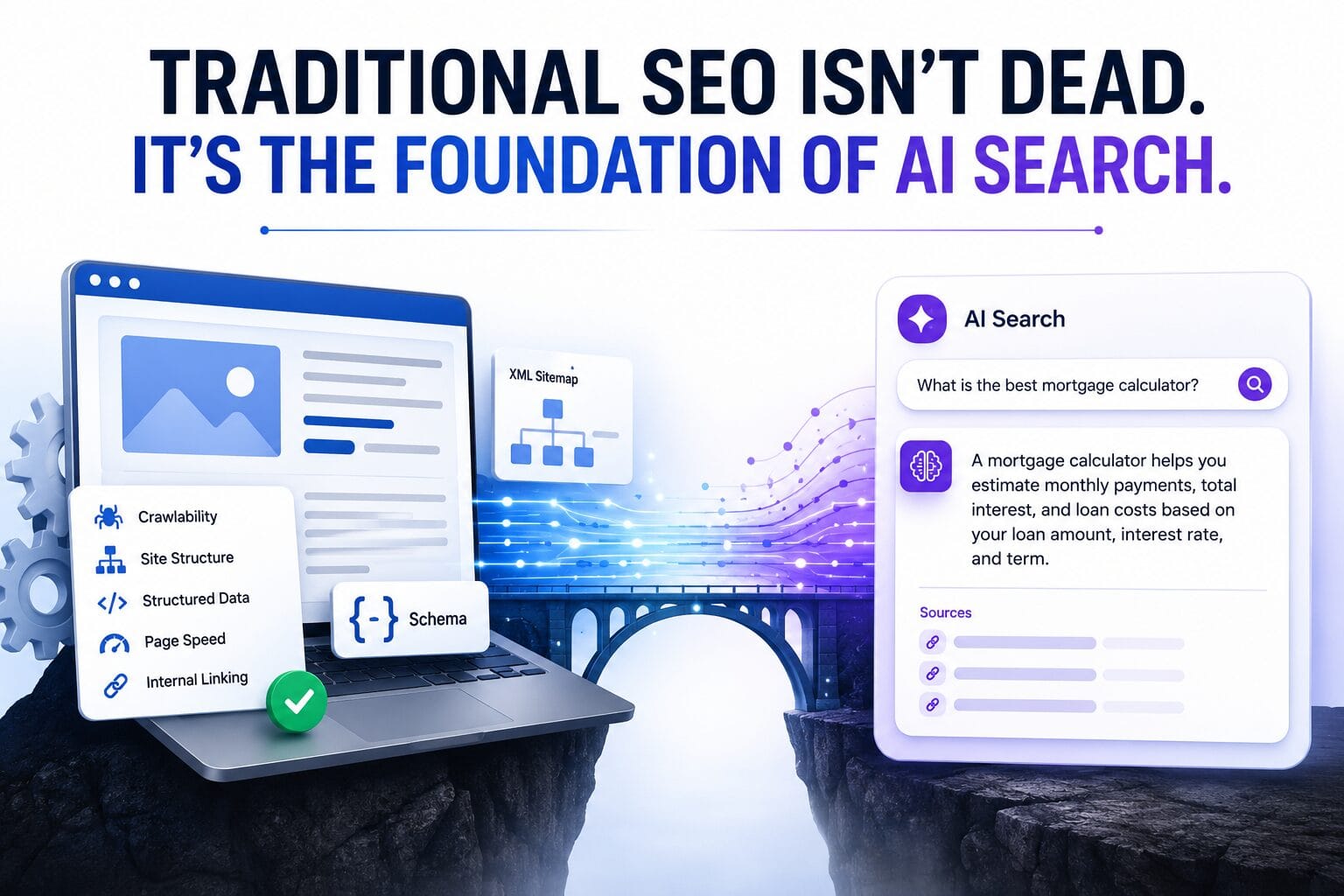
Technical SEO still matters because crawlability matters. If search engines and AI systems cannot access or understand your pages, the content has a weak foundation.
Page speed still matters because users do not want slow tools, slow articles, or slow landing pages. Performance affects experience, engagement, and trust.
Schema and structured data still matter because they help clarify what a page contains. For calculators, articles, FAQs, products, recipes, local services, and many other page types, structured information can make content easier to classify and interpret.
Internal linking still matters because it explains relationships between pages. A site with strong topical architecture gives both users and crawlers a clearer path through the content.
Descriptive titles and headings still matter because they define intent. A vague title creates ambiguity. A specific title tells the user, search engine, and AI system what the page is designed to answer.
Answer-focused content still matters because people search with problems, not just keywords. Pages that answer clearly, directly, and accurately are more likely to be useful across search formats.
These are not outdated tactics. They are infrastructure.
Where AI Search Changes the Strategy
AI search does change the strategy, but not by eliminating SEO.
The biggest change is that ranking as a blue link is no longer the only visibility goal. Pages now also need to be citation-worthy.
A citation-worthy page is not necessarily the longest page. It is the page that gives a clear answer, explains its reasoning, and provides enough structure for the information to be trusted.
For a calculator page, that may mean showing the formula, defining the variables, explaining assumptions, and giving practical interpretation of the result.
For an informational article, it may mean using clear sections, concise explanations, first-hand experience, examples, and specific takeaways.
For a business website, it may mean strengthening trust signals: author information, company details, transparent methodology, updated content, and useful supporting pages.
On UseCalcPro, users generated more than 1,500 AI explanation actions during the same 90-day period. That is a useful signal. People do not only want the final number. They want the result explained in plain language.
This is exactly where AI search and traditional SEO meet. A page that clearly connects inputs, methodology, output, and explanation is easier for humans to use. It is also easier for AI systems to understand, summarize, and reference.
AI search rewards clarity. It is harder for an answer engine to cite a page that is generic, bloated, or unclear. It is easier to reference a page that is specific, factual, and well organized.
That means content volume alone is not enough. Publishing hundreds or thousands of pages without a strong structure, clear purpose, or real usefulness is a weak strategy. AI search makes that weakness more visible.
Traffic Alone Is Not the Goal
One of the most important lessons from analytics is that traffic alone does not prove success.
In the same 90-day window, UseCalcPro had hundreds of “quiet calculators” — pages that received views but did not generate high-intent actions such as saves, shares, PDFs, ratings, explanations, or leads.
That is an important SEO lesson.
A page can be discoverable and still underperform if the user does not see a clear next step. This is where traditional SEO, UX, and conversion strategy overlap. The goal is not only to attract a visit. The goal is to help the visitor complete a task.
For calculator pages, that task may be estimating a project cost, planning a trip, comparing materials, calculating food quantities, checking a health-related metric, or understanding a financial scenario.
If the page only brings the visitor in but does not help them move forward, the SEO work is incomplete.
Practical Takeaways for Site Owners
Site owners should not abandon SEO basics for a trend called “AI SEO.” The practical path is to strengthen the foundation.
Start with crawlability. Make sure important pages can be discovered, indexed, and rendered correctly.
Improve page structure. Use clear titles, logical headings, concise sections, and internal links that reflect real user journeys.
Write from experience. Generic content is easy to produce, but first-hand insight is harder to replace. In my case, lessons from building and analyzing calculator pages are more valuable than generic advice about search.
Show methodology where relevant. If a page includes a calculation, recommendation, comparison, or process, explain how it works. Transparency builds trust.
Strengthen trust signals. Include author information, company context, update history where appropriate, and clear explanations of assumptions or limitations.
Focus on decision support. Users do not only want information. They want help making a decision, estimating a cost, understanding a result, or choosing a next step.
Traditional SEO is not dead because the web still needs structure. AI search has simply made that structure more valuable.
The future of search will include AI summaries, answer engines, citations, conversational discovery, and new interfaces we cannot fully predict yet. But all of those systems still need reliable source material.
The websites that win will not be the ones that chase every new label. They will be the ones that make their content fast, crawlable, useful, structured, and trustworthy.
That has always been good SEO.
Now it is also the data layer AI search still needs.
SEO Details
Focus keyword: traditional SEO still matters
Meta description: Why traditional SEO still matters in the AI search era, based on first-party analytics and lessons from building a large calculator platform.
Tags: SEO, Traditional SEO, AI Search, Technical SEO, Search Marketing, Content Strategy, Programmatic SEO, Website Growth, Digital Marketing, Calculator SEO, AI Search Optimization
Author Bio
Maksim Arsholoev is the founder and product lead at UseCalcPro, a free online calculator platform with 1,700+ calculators across finance, health, construction, auto, education, math, travel, pets, food, and everyday planning. His work focuses on calculator UX, technical SEO, structured content, and using first-party analytics to understand what people are trying to calculate before making real-world decisions.
Related reading