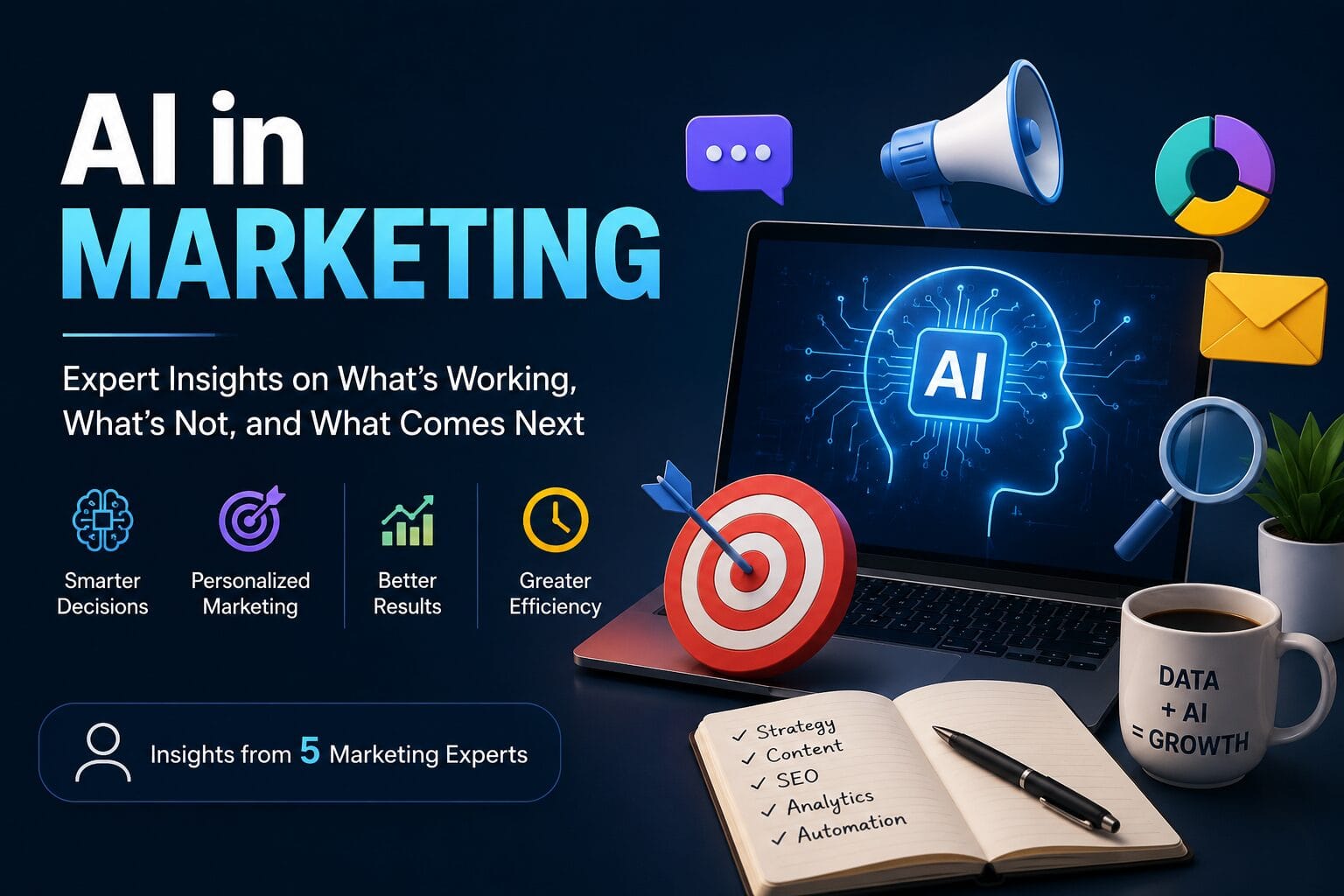
AI in Marketing: 12 Experts Share What’s Working, What’s Not, and What Comes Next
Artificial intelligence is no longer a futuristic concept. It’s reshaping the way marketers create content, run campaigns, analyze data, and connect with customers.
From generating ad creatives in minutes to identifying audience segments and automating repetitive tasks, AI is helping businesses work faster than ever before.
But speed comes with a question.
Is AI making marketers better, or simply making marketing faster?
To find out, I reached out to marketers, founders, SEO specialists, and content experts who use AI every day. While each has a unique perspective, one message stood out consistently:
AI delivers its best results when it works alongside humans, not instead of them.
AI Is Your Smartest Assistant, Not Your Replacement
The biggest misconception about AI is that it replaces marketers.
According to Josiah Roche, Kruno Sulić, Amit Agrawal, Ashmitha Chatterjee, and Wayne Lowry, AI shines when it handles repetitive work, speeds up research, drafts first versions, and automates workflows. But strategy, judgment, and creativity still belong to humans.
Josiah shares how a client reduced content production time from eight hours to three using ChatGPT and SurferSEO. Yet the real results only came after human interviews and expert editing were added. Organic traffic increased by around 35%, proving that AI accelerated the process—it didn’t replace expertise.

“A B2B services client cut content production time from about 8 hours a page to 3 by using ChatGPT for first drafts and SurferSEO for content briefs, but the pages only performed once human interviews and subject-matter edits were added. Organic traffic to that section grew by roughly 35% over four months, and enquiry form submissions rose about 18%, because the AI sped up research and structure rather than replacing judgment.
The backfire came when AI was used too far down the funnel. An e-commerce brand let AI write most of its product descriptions and email copy at scale, and click-through rates dropped by about 22% in six weeks. The copy was clean, but it sounded the same across products and missed the language customers used in reviews and support tickets. I’ve found AI works best on pattern-finding, first drafts, clustering search terms in Ahrefs, and ad variant ideation, while humans handle claims, tone, differentiation, and final approval. The safest rule is to treat AI like a junior assistant: useful for speed and volume, not for unsupervised publishing or brand judgment.”
Josiah Roche, Fractional CMO, JRR Marketing (www.josiahroche.co)
Kruno echoes the same thought, saying AI should shorten production time and increase experimentation, not replace human judgment.

“AI has been most valuable for us when it shortens production time and increases testing volume, not when it tries to replace judgment. As the founder of Cliprise and someone with more than a decade in digital marketing, SEO, and online publishing, I’ve seen AI work best in three areas: creative iteration, workflow automation, and first-draft production. For example, AI image and video generation can dramatically reduce the time it takes to move from concept to multiple ad or social variations, which makes campaign testing faster and cheaper. That speed is useful because marketers usually improve results by testing more angles, hooks, and formats, not by waiting for one “perfect” asset.
Where AI backfires is when teams treat output as finished work instead of raw material. We’ve seen this with generic copy, visuals that technically look polished but feel off-brand, and automation that removes too much human review from the process. In content and SEO especially, AI can create volume very easily, but volume without editorial control often weakens trust and lowers quality. If a brand publishes bland or inaccurate content at scale, the short-term efficiency gain can create a long-term reputation problem.
The biggest lesson is to use AI as a leverage tool, not a substitute for strategy, taste, or accountability. The practical approach is simple: let AI help with ideation, variation generation, formatting, and repetitive workflows, but keep humans responsible for brand voice, factual review, and final decision-making. The companies that get the most value from AI are usually the ones with a clear workflow for prompting, editing, approving, and measuring output. AI improves marketing when it helps teams learn faster. It hurts marketing when it encourages teams to publish faster than they can think.”
Kruno Sulić Founder & SaaS Product Builder, Cliprise
The takeaway?
Think of AI as your smartest junior teammate. It works faster than you, but it still needs your direction.
Adding to this perspective, Senin Abraham, Placement Manager – Corporate Relations, highlights AI’s role in smarter decision-making. By analyzing customer behavior and preferences, AI helps businesses connect the right product or service with the right audience at the right time, enabling better personalization, improved customer experiences, and more efficient marketing.

“AI helps businesses sell the right product or service to the right person at the right time without wasting time or money. By analyzing customer data, preferences, and behavior, AI enables businesses to make better decisions, personalize recommendations, target the right audience, and improve the overall customer experience while maximizing efficiency and reducing costs.”
Senim Abraham, Placement Manger Corporate Relations
AI Doesn’t Create Your Brand Voice, You Do
One of my favorite insights came from Gina Dunn.

“Most of the AI marketing failures I see get blamed on the tool. They’re not tool problems. They’re input problems. AI amplifies whatever you feed it, signal or sludge, and when a campaign goes flat or generic, the root cause is almost always a brand voice that was never specific enough to survive automation.
I built my own AI assistant with guardrails around it, specifically so it carries my voice instead of replacing my judgment. It cannot make the call. That’s still mine. What it can do is scale output once the voice is actually named and trained into the system, which is the part most marketing teams skip. They plug in a tool before they’ve done the work of defining what makes the brand unmistakably theirs.
I’ve also watched this play out with a client who designed her AI workflows around a clearly defined brand voice first. Same tools everyone else is using. Different result, because the input wasn’t generic.
The lesson isn’t ‘use AI carefully.’ It’s that AI will hand you back an average brand if you feed it an average brand. Protect the voice before you scale the output, or the output goes flat, no matter how good the prompts are.”
Gina Dunn Founder and Brand Strategist, Podcast host, OG Solutions
She believes marketers often blame AI when campaigns become generic. In reality, the problem starts much earlier, with an undefined brand voice.
Her advice is simple.
Train AI on your brand after you’ve clearly defined what makes your business unique. Otherwise, AI simply amplifies generic messaging.
This point is reinforced by Will Mitchell, who found that AI-generated copy began sounding identical across completely different product categories. Customers noticed the change before the business did.

“I run product launches for entrepreneurs selling physical products online, and my team started feeding AI our ad copy workflows about a year ago. The immediate win was speed. We could draft and split-test dozens of headline variations for a single product listing in the time it used to take us to write a handful. Click-through rates on several campaigns improved within the first few weeks.
Then we hit a wall. The AI-generated copy started blending together across different product categories. A supplement launch sounded like a kitchen gadget launch sounded like an outdoor gear launch.
My customers were flagging it before I noticed. One entrepreneur told me his returning buyers thought he’d changed brands because the tone felt off. Repeat purchase rates dropped on some of his campaigns.
So now we use AI to generate the raw volume of variations, and a human on my team rewrites the final versions with brand-specific language and customer stories pulled from reviews.”
Will Mitchell Founder, StartupBros
Similarly, Hans Graubard explains how AI-generated copy in regulated industries like healthcare requires careful human review because compliance and trust cannot be automated.
AI can scale your content.
Only humans can protect your brand identity.

“AI has been a real efficiency unlock for us on email. When we layered AI-driven segmentation onto our lifecycle flows — cohorting by purchase stage, symptom category, and content engagement — we saw meaningful lift in click-through and repeat purchase versus our prior rules-based segments. Segmentation worked.
Where it bit us was copy. AI-generated subject line and body drafts kept drifting toward disease language. A women’s health brand can talk about supporting vaginal or digestive comfort; we cannot say “treats” or “cures.” Structure-function rules under FDA and FTC are strict, and generic LLM outputs don’t know that. Drafts came through that would’ve been fine for a fintech newsletter and a serious problem on a supplement voice.
The fix was a compliance review layer between the AI draft and the send — a claims checklist our marketing lead runs, with our scientific advisory board consulted on gray-area wording. It slows the workflow, but in a regulated category the guardrail cost is non-negotiable. If you’re in health, finance, or legal-adjacent marketing: budget for the review layer before you scale the automation, not after.”
Hans Graubard COO & Cofounder, Happy V
3. AI Creates More Content, Not Necessarily Better Content
Generating content has never been easier.
Publishing meaningful content is another story.
Several experts warned against confusing quantity with quality.
Kruno Sulić points out that AI can generate endless content, but without editorial control, brands risk producing polished yet forgettable material.
Roman Sydorenko (SEOBRO) experienced a similar challenge when AI-generated programmatic pages weakened overall site performance because they failed to satisfy real search intent.

“The clearest lesson I’ve learned shipping AI into SEO workflows: scaling AI-generated content without pressure-testing each template against real search intent can drag your whole site down, not just the bad pages. On one project we rolled out programmatic pages built from an LLM-drafted template — thousands of URLs, thin variation, technically “on-topic.” Rankings held for a few weeks, then softened site-wide, including cornerstone pages that had been earning for years. The failure mode was intent mismatch at scale: quality classifiers discounted the templates, and link equity and crawl budget got diluted across URLs that didn’t deserve them. The fix wasn’t more AI polish — it was pruning most of the programmatic set and rebuilding the rest around genuine query patterns. That matters beyond SEO: thin AI pages don’t just cost rankings, they erode the brand trust that makes any marketing channel convert.
Where AI earns its keep in my workflow: drafting briefs, restructuring cornerstone pages into answer-block format for LLM grounding, and automating audit steps in n8n. The rule I use now — AI accelerates work a human would have done anyway. It doesn’t replace the judgment call on whether the page should exist.”
Roman Sydorenko, Founder, SEOBRO
Their advice aligns perfectly with today’s SEO landscape.
AI should help you produce better content—not simply more content.
4. AI Search Rewards Authentic Conversation
The rise of AI search has changed marketing in unexpected ways.
According to Roman Sydorenko of RedditServices, brands weren’t necessarily losing to better websites—they were losing to genuine conversations happening on community platforms like Reddit.

“The brands that got caught off-guard by AI Overviews and Perplexity weren’t losing to better competitors. They were losing to Reddit threads written by strangers, because that’s what the AI trusted. Around 2022, when LLM-based search interfaces started reshaping discovery, I noticed client sites with strong traditional SEO were still absent from AI-generated answers. The grounding layer had shifted to community sources, and polished brand copy simply wasn’t in that dataset.
The win came from participating honestly in threads where our clients’ audiences were already researching. Same care for context, timing, and community norms as any long-term SEO play. On our side, that means a human writes every comment, a second operator reviews before posting, and we walk away from threads where our presence wouldn’t be welcome. The failure mode I saw repeatedly: teams shortcutting this with AI-drafted Reddit comments. Communities detect that tone instantly, and one bad thread can undo months of work.
Lesson: use AI to brief and research, not to speak for you. Discovery is influenced, not controlled.”
Roman Sydorenko, Founder, RedditServices
His biggest lesson?
Use AI to research and prepare.
Don’t let AI pretend to be human in conversations where authenticity matters.
That insight feels particularly relevant as AI-powered search engines increasingly reference trusted communities alongside traditional websites.
5. AI in Content Creation: A Boon and a Bane
As a content creator myself, this was perhaps the insight I connected with most.
Ashmitha Chatterjee, who has over nine years of experience in B2B and B2C content writing, describes AI as both a blessing and a curse.

“AI in content creation is both a boon and a bane.
Where at times it acts as your editor, suggesting grammar corrections and better synonyms, on the other hand, it can kill your creative thinking capacity. It can be your guide to stronger research and better writing. But the moment you rely on it completely and start structuring and refining your sentences with it, you’re a goner.
As long as AI is used as a tool, it’s good. The problem begins when you start replacing your own brain and talent with artificial intelligence.
Of course, there’s speed and instant results with AI—something that all of us in this fast-paced world crave. But it’s only when you start getting repetitive answers that you tap into your own skills. That’s when you realize you haven’t sharpened them for a while and go looking for another AI tool to give you a better answer rather than pushing yourself to think better.
AI is becoming a necessity for every writer. I’m not against it. Yes, it is very useful. But because the line between it helping you write better and replacing your job is so narrow, I’d say sticking to using it just as a tool makes a lot of sense.
A few ways I like to use AI for my writing are, of course, to speed up my research. It cuts hours of scrolling, searching, and reading. It also suggests better synonyms, especially when you know you’re not finding the right words to express yourself. And sometimes it’s great for sparking inspiration.
But the best use, in my opinion, is to give your published content or written copy to AI and ask it to be your cold-hearted editor and give you blunt feedback. It might hurt, but it will be honest—and it could be your first step toward sharpening your skills using the very same AI that’s trying to replace you! 😅
So, I guess AI for content creation is a gift, as long as you remember that you are the human with the greater intelligence.”
Ashmitha Chatterjee, 9+ years of experience in content writing and marketing for B2B and B2C
It can dramatically reduce research time, improve grammar, suggest better word choices, and even help overcome writer’s block.
But there’s a catch.
The more writers rely on AI to think for them, the less they exercise their own creativity.
Her advice resonated deeply with me.
Use AI as a writing companion—not as your replacement.
One suggestion I particularly liked was treating AI as a “cold-hearted editor.” Instead of asking it to write everything, let it critique your finished work. Honest feedback can sharpen your skills far more than effortless content generation.
As Ashmitha reminds us, AI is a gift, but only if we remember that the greater intelligence still belongs to the human using it.
Other Expert Insights Worth Noting
Several other experts reinforced these themes from different perspectives.
Rhillane Ayoub highlighted AI’s ability to generate advertising creatives quickly while cautioning against trusting it with facts without verification.

“Biggest win: AI image generation for ad creatives. For an e-commerce client we needed dozens of creative variations per month, each showing a specific product in a specific scene. A studio shoot at that volume was unaffordable. AI got us there, but only after we learned to write a precise spec per image and lock the recurring persona’s face with a reference anchor, because characters drift between generations and audiences notice.
Biggest backfire: trusting AI with facts. Drafts came back citing references and URLs that simply did not exist, and early AI-written copy read flat enough that a client rejected it outright. Nothing damages trust faster than a broken link or generic prose under your brand name.
The lesson: AI is a volume tool, not a truth tool. Every claim, link, and number gets checked by a human against the source before anything ships, and the brand voice pass stays human. Used that way, AI multiplies output without costing you credibility.”
- Jeremy Swiller warned that AI can quietly increase output while reducing originality if teams stop challenging their own ideas.

“The failure mode I see most often isn’t the dramatic one. It’s quieter. A team uses AI to move faster, output goes up, and nobody notices for six months that the work stopped being interesting. The volume looked like productivity. The clients started feeling it before the agency did.
What works is treating AI as a creative pressure test, not a production shortcut. The agencies getting real results are the ones who use it to interrogate their own thinking: does this idea hold up, or did we just generate something that sounds right? That question, asked before anything ships, is the difference between faster mediocre and faster good.
The tool doesn’t know what your agency stands for. You still have to.”
Jeremy Swiller Founder & Chief Innovation Catalyst, Flux+Form
- Wayne Lowry reminded marketers that AI speeds up execution, but audits, backlinks, local SEO, and strategic thinking still drive results.

“AI has been a genuine force multiplier for us on the content and efficiency side of SEO, not a magic wand for rankings. Running Scale By SEO from Harlingen, I’ve seen what actually sticks. Our biggest win is using AI to draft first passes on blog outlines, FAQ blocks, and meta descriptions once a full site audit shows where content and technical gaps live. That frees our team for Google Business Profile work, citations from 50 to 250 plus depending on plan, and backlink building that scales with the client. Marketing efficiency jumps when humans still own strategy and the KPI story we commit to on Pro, Elite, and Enterprise, including our six-month performance guarantee.
We’ve lived the failure side too. Teams publish AI copy without local fact-checking or a real brand voice, then wonder why engagement flatlines. Personalization that sounds like everyone else’s hurts plumbing, healthcare, and auto body clients harder than a bland ad ever would. Lesson one: treat AI as a fast junior writer, never the strategist. Lesson two: plug every AI-assisted workflow into the same monitoring we use for rankings and discovery, or you’re flying blind. Lesson three: be transparent. We explain tradeoffs clearly. Faster drafts, same accountability on accuracy and trust.
For SEO specifically, AI helps us scale blog output toward those 100 to 300 post ranges without burning people out, but wins still come from expert content creation plus technical optimization, not autopilot. The marketers who pull ahead aren’t chasing the flashiest tool. They’re the ones who won’t skip the audit, citations, backlinks, and human review before anything goes live. That’s the lesson I’d take to any CMO table: AI saves labor; judgment and consistency still sell the outcome.”
Wayne Lowry CEO, Scale By SEO
- Amit Agrawal emphasized using AI to analyze data and automate operations while leaving storytelling to people.

“The most effective use of AI in marketing is treating it as an operational efficiency layer rather than a creative replacement. AI excels in high-volume tasks, such as audience segmentation and churn prediction based on historical data, which sharpens campaign performance by ensuring the right message reaches the right user at the moment of intent. The strategy falters, however, the moment brands attempt to fully automate content generation. Over-reliance on generative tools often results in high-volume, hollow content that merely contributes to digital noise. Customers are perceptive; they immediately sense when content lacks genuine empathy or intent. AI can pinpoint what a customer needs, but it cannot authentically express the mission and values that foster long-term trust. For effective integration, I advocate for a strict ‘human-in-the-loop’ workflow. Use AI to surface data, analyze performance gaps, and handle technical SEO, then empower your team to translate those insights into resonant narratives. If your output doesn’t feel like it was crafted by someone who understands the customer’s pain points, it is time to recalibrate. Technology should scale your reach, but human connection must remain the driver of your message.”
Amit Agrawal Founder & COO, Developers.dev
Final Thoughts
AI has undoubtedly transformed marketing.
It writes faster, analyzes quicker, automates repetitive work, and helps marketers accomplish in minutes what once took hours.
But after listening to these experts, one conclusion became impossible to ignore.
The future doesn’t belong to marketers who simply use AI. It belongs to marketers who know where AI should stop and human intelligence should begin.
Because in the end, people don’t build trust with algorithms.
They build trust with other people.
Related reading