By Nisha Kumari, Co-Founder, Ranqo
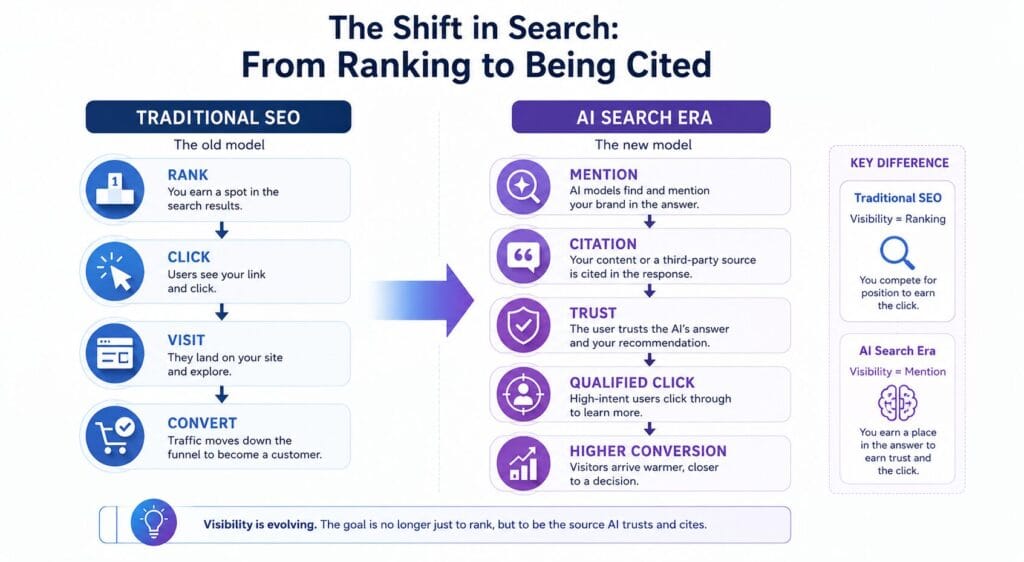
For twenty years, the search question was simple: where do I rank? You earned a spot in the ten blue links, and the click followed. In 2026, that question is quietly being replaced. More buyers now ask ChatGPT, Gemini, Claude, Perplexity, or an AI Overview for a recommendation and read one answer instead of scrolling a results page. The new question is not where you rank. It is about whether the answer mentions you at all and what it says when it does.
That is a bigger shift than it sounds, and most of the conventional SEO playbook quietly stops working at the edge of it.
From ranking to being cited
In the old funnel, ranking and visibility were the same thing. In AI search they come apart. The model reads a handful of sources, then writes a single answer. Your page can be the source that the answer is built on while the user never sees your link. Or your page can rank number one on Google and never enter the answer at all.
We measured this directly. Across roughly 100,000 AI responses for more than 100 brands, tracked from March to May 2026 over five engines, the most surprising finding was where the citations actually came from. About 78% of citations pointed to corporate websites, but only 2.9% pointed to the brand’s own domain. In other words, most of the citations that decide whether a brand appears live on someone else’s page. Ranking your own site is still necessary. It is nowhere near sufficient.
The six-month myth
There is a popular claim that it takes months to get an AI to start mentioning you. Our data does not support it. When a prompt names a brand, that brand surfaces almost immediately, roughly 94 to 100 percent of the time on the very first tracked run. Recognition is fast.
The hard part is the unbranded query, the “best CRM for a small team” type of question a buyer asks before they have decided anything. There, first-run visibility ranged from 12 to 52 percent depending on the brand. So the work was never about waiting for AI to notice you exist. It is about earning the unbranded recommendation, where the buyer hasn’t yet typed your name.
Topical authority still sets the floor
The clearest single pattern in the data was a ladder. On a brand’s first run, unbranded category visibility was about 73% for global household names, around 44% for established mid-market and regional brands, and roughly 11% for niche and smaller brands. That is close to 30 percentage points per rung.
The reason is straightforward. These models lean on what the open web already says about an entity. That is the AI-era version of topical authority. It is not keyword density on your homepage. It is how widely and how consistently your brand is described across the sources the models already trust. Smaller brands are not invisible because AI is biased against them. They are invisible because the web has not said enough about them yet.
Content formats and first-hand experience
Format matters more than most teams expect. The single most-cited content format in our data was the ranked “best-of” listicle, which accounted for about 21% of all citations. Among non-corporate sources, YouTube was cited most often, ahead of Reddit, editorial media, and Wikipedia.
The practical read is that structured, comparative, answerable content gets pulled into answers, while thin brochure pages do not. This is also where first-hand experience and genuine expertise earn their keep. The pages that get cited tend to make specific, checkable claims, the kind a model can lift cleanly into an answer without rewording. Vague positioning copy rarely survives the summarization step, because there is nothing concrete in it to quote.
Measuring visibility when there is no ranking to measure
If you cannot see the answer, you cannot manage it, and a rank tracker will not show it to you. The metrics that matter now are different: mention rate (does the answer name you), position (where you land when it does), share of voice (your slice versus the competitors named in the same prompts), and sentiment (how you are characterized).
One caution from our data on that last one. Sentiment is noisy. Whether a model framed a brand positively or negatively flipped roughly 6.7 times more often than whether it mentioned the brand at all. So mention rate is the stable signal to manage against over time. Treat tone as a weaker, slower input, not your headline number.
It also means a single manual check is close to useless. Ask the same model the same question twice and you can get two different brand lists. Visibility has to be sampled and tracked, not spot-checked once and declared solved.
What this does to traffic, and where it goes next
AI overviews and answer engines compress the click. A large share of searches now end inside the answer, and publisher traffic from Google has fallen sharply over the past year, by around 38% to U.S. publishers, according to the Reuters Institute. That is real, and pretending otherwise helps no one.
The more useful framing is that the traffic that does come through is changing shape. When someone reads an AI recommendation and clicks anyway, they arrive warmer and closer to a decision than a cold search visitor. The future of content discovery is being the source the answer is built on and then capturing the smaller, higher-intent stream of clicks that follows.
If I had to compress the lessons into something a team can act on this quarter,
- Audit your unbranded prompts, not just searches for your name. That is where you are actually winning or losing.
- Earn mentions off your own domain. Most of the citations that move you live on other sites.
- Build structured, comparative, claim-dense content. Listicles and clear answer formats get surfaced; brochureware does not.
- Track mention rate over time. AI answers are volatile, and a brand visible this week can drop out the next.
The channel changed underneath everyone at the same time, which is rare and a little disorienting. But it also resets the board. The brands that do well over the next two years will be the ones that stopped asking where they rank and started asking a sharper question: What does the answer say about us, and who else is in it.
The full study, “Generative Engine Optimization at Scale: Measuring Brand Visibility Across AI Search Engines,” is on arXiv at arxiv.org/abs/2606.20065 (CC BY 4.0).
Author
Nisha Kumari is the Co-Founder of Ranqo, where she focuses on AI search visibility, brand intelligence, and Generative Engine Optimization (GEO). Her work explores how brands are discovered, cited, and recommended across AI-powered search platforms such as ChatGPT, Google AI, Gemini, Claude, and Perplexity. She combines research-driven insights with practical strategies to help businesses measure AI visibility, strengthen digital authority, and adapt to the evolving search landscape.
Related Reading:
Want to understand how AI search works and what businesses can do to improve visibility in ChatGPT, Gemini, and AI Overviews? Read: What Is AI SEO? A Beginner’s Guide to Ranking in AI Search