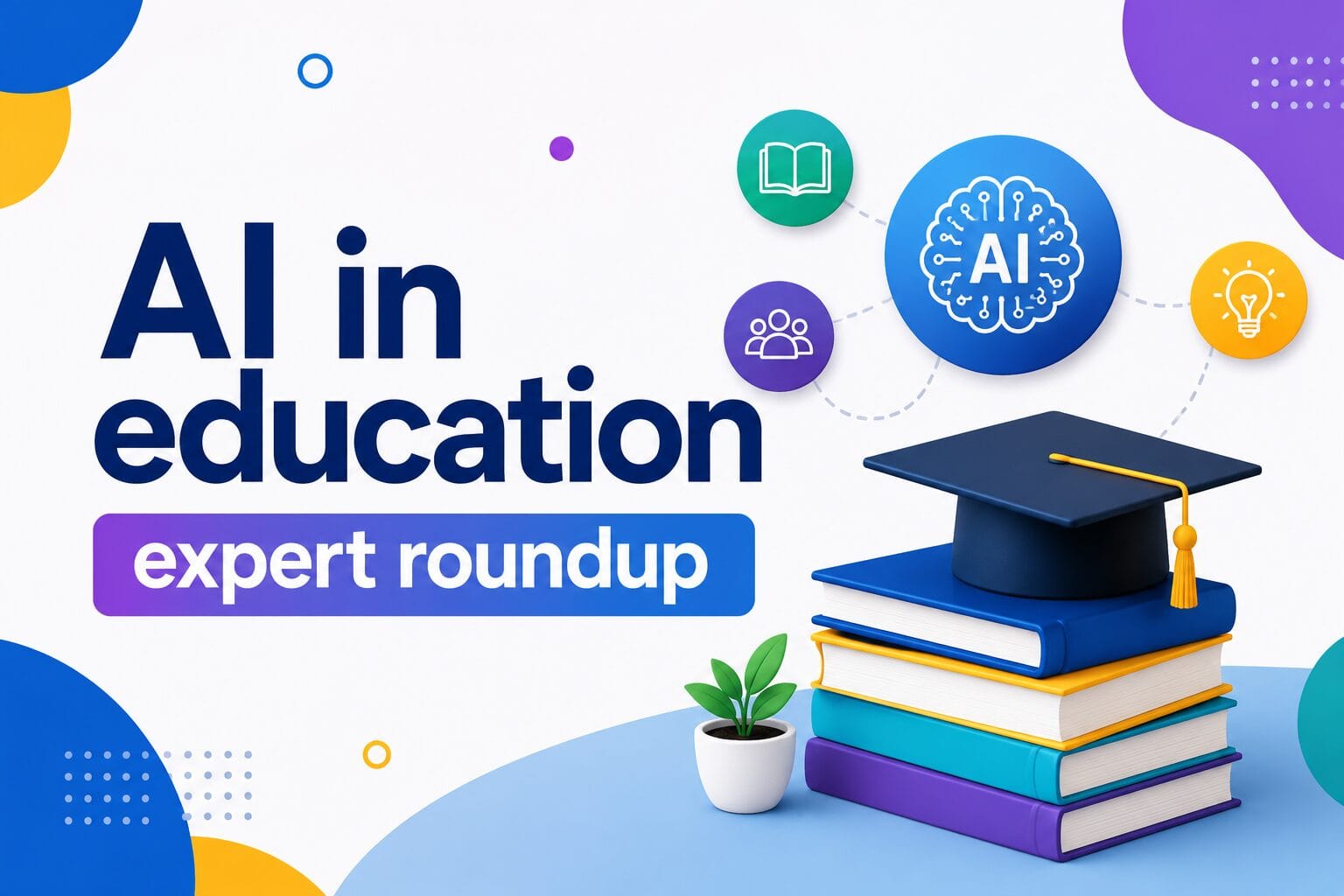
The Biggest Educational Risk Isn’t AI: It’s Blind Trust – An Expert Roundup on the Future of AI in Education
This expert roundup features perspectives from an EdTech leader, an educator, a student, a child development leader, an AI company founder, and an AI technology leader, each offering unique insights into how AI is reshaping education.
Why critical thinking, AI literacy, and human judgment matter more than ever
Artificial Intelligence has been one of the biggest technological breakthroughs that education has seen in the last few decades. Students have been provided with options for AI tutors, writers, coders, personalized learning aids, and explanations for anything and everything. On the other hand, teachers have begun to use AI in order to make lesson plans, tests, and reports.
This has certainly provided opportunities for making education more efficient and accessible.
But in midst of all this hype around AI, it seems that we are asking the wrong question altogether.
The question is not whether the students will use AI technology in class. That’s already happening.
The real question is whether we are teaching the students how to think using AI, or simply training them to believe everything that comes out of it.
If AI can answer almost any question, are we still teaching students how to think—or simply how to prompt?
AI Is Transforming Education in Meaningful Ways
Properly used, AI holds great promise for enhancing educational opportunities.
This includes personalized learning, immediate feedback, assistance for teachers in identifying weaker students, reduction in mundane tasks, and creating customized learning environments.
This is real progress which should not be overlooked.
But the greatest gains from AI in education become evident when it works in tandem with educators.
Few organizations have observed AI’s impact on learning at scale as closely as Cognito. With millions of student users, the company has taken a deliberately measured approach to AI adoption.
EdTech Perspective

At Cognito we’ve got around two million student signups, and we’ve been deliberately slow with our AI rollout. A lot of what makes learning effective can’t be replaced by AI.
One thing we did build is a purpose-built AI marking tool, trained on thousands of our own handwritten questions. Students on our platform improve by around two grades on average, but that lift holds whether they use the AI marking feature or not.
Many students told us they engage more with the material when they mark their own answers, so we built a toggle to switch the feature off. Some schools ask us to disable it entirely. So we didn’t just have to build AI-enablement features but also AI-disablement features. We need to be guided by students and educators, and they don’t always want AI.
The honest read: the biggest measurable wins from AI in our business have been on the engineering side, not the student side. AI helps us ship code faster and produce content at scale. The learning-outcomes case for students is real but narrower than the hype suggests. The hard bits of learning , sitting with a problem, thinking it through, forming your own memory of it, still have to be done by the person doing the learning.
Jono Ellis, Chief Product Officer (Cognito Education) (https://cognito.org/)
Jono’s experience highlights something many discussions overlook.
Despite building AI-powered educational tools used by millions of students, Cognito has discovered that some of the most valuable learning still happens when students wrestle with problems themselves. AI can support learning, but it cannot replace the cognitive effort required to develop understanding.
That distinction is likely to become one of the defining principles of responsible AI adoption in education.
Rather than replacing effort, AI appears to deliver the greatest educational value when it supports the learning process without removing it.
Learning Requires Cognitive Struggle
One unintended consequence of AI is that it makes it incredibly easy to arrive at answers.
The problem is that education has always been devoid of finding solutions.
Education takes place through questions, failures, problem solving, improvement, and justifying one’s findings.
When artificial intelligence takes away all the struggles, it may also take away some of the very things that help students build knowledge.
Education has always valued the process—not simply the outcome.
Technology Leadership Perspective

AI in education succeeds only when it functions as a scaffold for human interaction rather than a substitute for cognitive struggle. In my experience leading digital transformations, the most impactful deployments aren’t the generative tools writing essays but the systems automating administrative friction-scheduling, grading, and resource allocation-to reclaim time for direct mentorship. Conversely, adoption backfires when we treat AI as an oracle. When students use these tools to bypass the foundational labor of research and synthesis, critical thinking inevitably atrophies. Educational institutions must prioritize AI literacy over raw utility. We have to teach students not to accept AI outputs as objective truth but to verify, challenge, and refine them. Responsible implementation requires a clear, non-negotiable demarcation between where the machine assists and where human judgment is required. AI holds the potential for greater equity, but without a curriculum that mandates verification, we risk raising a generation of passive information consumers.
Kuldeep Kundal (CISIN), Founder & CEO, CISIN
Kuldeep’s emphasis on AI literacy reinforces an important shift taking place in education.
In an AI-powered world, success will depend less on memorizing information and more on evaluating it. Students must learn to question AI-generated content, verify facts, recognize bias, and understand when human judgment should take precedence over machine-generated suggestions.
The Human Relationship Still Matters
If cognitive struggle builds understanding, relationships build confidence. That may be AI’s biggest limitation.
Technology can personalize content.
It can summarize information.
It can recommend resources.
But it cannot replace trust.
Teachers do more than simply provide knowledge. Teachers inspire students, identify emotional issues, spark interest, and teach according to human interaction, which cannot be duplicated by an algorithm.
The best learning results still come through a connection between teacher and student.
Child Development Perspective

I’ve spent years at Sunny Glen Children’s Home watching kids in crisis relearn that adults can be trusted, and that’s the same filter I’d use for AI in education: the wins are real when tech gives educators time and insight, and the mess usually starts when we treat software like a substitute for presence.
The successes I’ve seen up close, often from schools and partners around the Rio Grande Valley, look a lot like what we aim for in residential care and Supervised Independent Living at the Allen House. Tools that cut repetitive admin, so counselors aren’t buried in notes and teachers can actually debrief with a kid, boost engagement because a human still closes the loop. Adaptive practice that spots a gap before a student checks out can improve learning outcomes the same way early support does for a child who’s been neglected. When it works, it’s measurable in hours returned to staff and in conversations that wouldn’t have happened if everyone was still doing data entry.
Where AI adoption backfires, it’s almost always a trust problem. Students lean on chatbots instead of building writing and reasoning muscles. Districts buy platforms frontline staff never trained to use. Vague data policies make refugee families and build-involved parents wary of school apps. We’ve served more than 25,000 children since 1936; we don’t hand a hurting child a screen and call it care, and classrooms shouldn’t trade mentorship for automation on the work that shapes character.
My lesson for edtech leaders and administrators: pilot small, define success in human terms (skill growth, engagement, staff sanity), and keep a human veto on high-stakes calls. Explain tradeoffs plainly to families, the way we do in San Benito when stakes are emotional. AI earns its place when it amplifies a committed adult in the room, not when it’s a shortcut around the slow, relational work of teaching a child someone believes in them..
Wayne Lowry Executive Director / CEO, Sunny Glen Children’s Home
His viewpoint provides a valuable lesson for people that education goes beyond sharing information.
Students Understand the Risks Too
Curiously enough, doubts regarding AI are voiced not only by educators.
Students themselves have realized that using AI too much might harm their independent thinking.
They understand well the convenience of using AI in order to make difficult material more understandable and to speed up the process of education while realizing that over-reliance on AI reduces creativity and self-confidence
That awareness is encouraging.
This means that most students are not seeking a replacement for learning from AI, but rather an aid to learning.
Student Perspective

AI helps us easily grasp complex subjects and learn quickly at our own pace. However, the main issue is that we are beginning to rely on it too much instead of developing our own skills. If we let AI handle every task, we gradually lose the ability to think independently, solve problems, and build the critical skills that come from learning through experience.
Rinu Thomas K, CSE Undergrad SBCE26 Flutter Developer, AI Enthusiast
That distinction may become one of the defining skills of the AI era. Knowing when AI can accelerate learning is valuable. Knowing when independent thinking produces deeper understanding is even more valuable.
Education Must Teach AI Literacy: Not Just AI Usage
With the increasing integration of AI in education, the competencies students will require have changed.
The ability to compose prompts comes in handy.
Knowing how to evaluate the response is essential.
Future-ready students will need to develop skills such as:
- Fact-checking AI-generated information
- Evaluating sources
- Recognizing misinformation
- Identifying bias
- Asking better questions
- Thinking independently
- Understanding AI limitations
- Using AI ethically
These abilities are rapidly becoming as important as traditional digital literacy.
Educator Perspective

From an educator’s perspective, the advent of AI has been a significant boon, enabling the delivery of personalized learning experiences that adapt to individual students’ needs, abilities, and learning pace.
It has also enhanced teaching efficiency by supporting lesson planning, generating high-quality learning resources, and streamlining routine tasks, allowing educators to dedicate more time to meaningful student engagement.
At the same time, the rapid adoption of AI has prompted important discussions about academic integrity, ethical use, and data privacy.
These developments highlight the growing need to equip students with critical thinking skills and AI literacy so that they can use these technologies responsibly and effectively.Manoj Alex Varghese, Teacher and Assistant Boarding House Parent at United World College of South East Asia, Singapore
His observations reinforce an important reality.
Future education is not just about the implementation of the technologies but is also about providing the right kind of judgment and critical thinking skills to make use of AI-based tools properly.
Rethinking Assessment in the Age of AI
Perhaps one of the key challenges that we face with respect to education is whether the traditional methods of testing are sufficient to assess what the learner needs to know.
If AI systems can generate essays, summarize research work, program computers, and solve mathematical equations, shouldn’t education be more focused on assessing reasoning, creativity, teamwork, and problem-solving skills rather than memory?
This does not mean neglecting academic honesty in education.
This means changing the criteria of what learning should mean in the age of AI.
A Different View: Should AI Change the Way We Assess Learning

The biggest lesson I’ve learned about AI in education isn’t from a classroom. It’s from building a company. David and I run Magic Hour with millions of users as a two-person team. That’s only possible because we treat AI as our entire workforce, not a supplement. And that mental model is exactly what’s missing in most education conversations.
Here’s what I’ve seen work: we’ve had creators on our platform, people with zero technical background, learn to produce professional video content in hours instead of weeks. One user, a small business owner in Texas, told us she went from paying $2,000 per promotional video to making them herself in 20 minutes. That’s not a teaching outcome in the traditional sense, but it’s education in the most real way possible. She learned a new skill, applied it immediately, and generated economic value the same day.
Where AI in education backfires is when institutions treat it like a textbook upgrade instead of a fundamental shift in how people learn and produce work. Academic integrity “concerns” are mostly just institutions refusing to update what they’re measuring. If a student can use AI to produce a better essay, the question isn’t whether they cheated. The question is whether the essay was the right assignment in the first place.
The best practice is simple: stop teaching people to do what AI already does better, and start teaching them to direct AI toward outcomes that matter. Prompt engineering is the new literacy. The schools that teach students how to think with AI, not just about AI, will produce the most capable graduates of the next decade.
The institutions clinging to pre-AI assessment models aren’t protecting rigor. They’re manufacturing irrelevance.
Runbo Li (Magic Hour AI), CEO, Magic Hour AI
Not every expert agrees on where education should draw the line. Runbo Li challenges conventional thinking by arguing that AI should reshape not only how students learn, but also how schools assess learning.
What the Experts Agree On
Despite approaching AI from different perspectives, several common themes emerged:
- AI should be used for the betterment, but not as a replacement of teachers.
- Students need to have AI literacy in addition to digital literacy.
- Judgment by humans is still very important.
- Thinking critically becomes even more crucial now.
- AI is at its best when it eliminates tedious tasks, not thinking.
- Learning outcomes should be measured in schools, not the use of AI.
Final Thoughts
AI can answer questions.
It cannot replace curiosity.
It can generate essays.
It cannot build wisdom.
It can accelerate learning.
But it cannot decide what is worth learning.
The future of education won’t be defined by how much AI enters the classroom.
It will be defined by whether students continue to leave the classroom as independent thinkers.
Because the greatest educational risk isn’t AI.
It’s forgetting how to think without it.