By Callum Gracie, Founder, Otto Media
AI Search Just Handed Small Business a Real Shot at the Big Leagues
I spend my days helping service businesses get found online, and I build software that does the same job. So when people ask me whether AI search is going to crush the little guy, I tell them the opposite. And this shift might be the best thing to happen to small businesses since Google Maps.
Let me explain why and what you should do about it this week.
The ground moved under our feet
For twenty years, search worked one way. You typed something, you got ten blue links, and you clicked one. But that world is fading fast. Google AI Overviews now show up on roughly half of all searches, and Google’s AI Mode handles over a billion queries a month. Plus, ChatGPT, Perplexity, and Gemini have joined the party too.
Here’s the part that stings. And most of those AI answers never send anyone to a website. One big study found that 93% of AI Mode searches end without a single click. People read the answer and move on. So if your whole plan was ranking number one and waiting for the click, that plan is leaking traffic right now.
Before you panic, though, sit with the upside for a second. Because the upside is real, and it favors you.
Why the small guy suddenly has a shot
Old-school SEO rewarded whoever had the deepest pockets. More backlinks, more domain authority, more ad spend. Big brands bought their way to the top, and the rest of us fought over scraps.
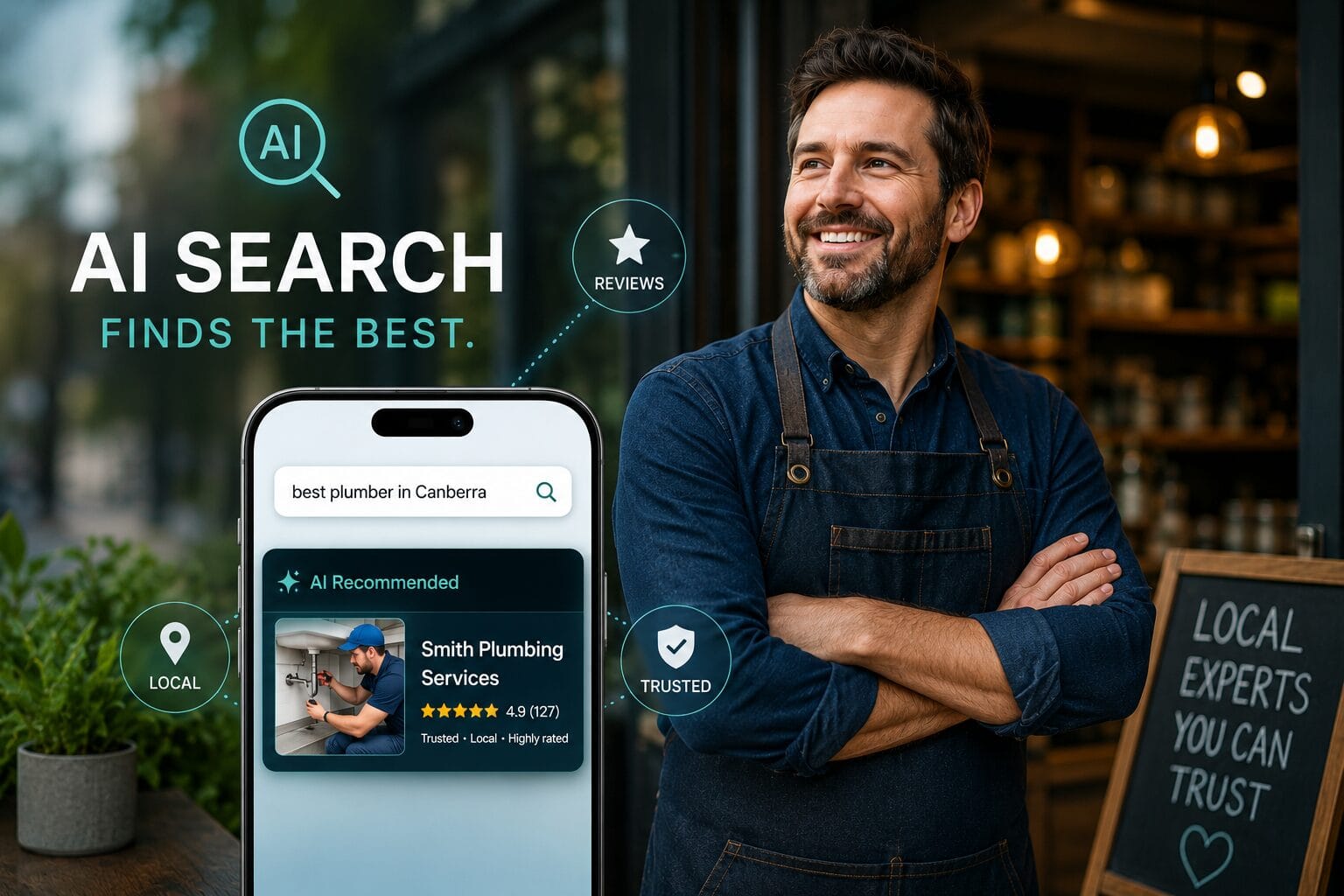
But AI doesn’t play that game. When someone asks ChatGPT for the best plumber in Canberra, the AI isn’t counting your backlinks. Instead, it reads your reviews, checks whether your business makes sense, and looks at what other people say about you across the web. And that changes everything.
Researchers at Princeton tested this and found something wild. Lower-ranked websites gained far more visibility from smart AI optimization than the top dogs did. One method gave a fifth-place site a 115% visibility boost while the top site slipped backward. So the moat that protected big brands for two decades doesn’t hold the same water anymore.
And the playing field got flatter. Now here’s the catch.
The catch nobody mentions
AI is picky. Brutally picky. One 2026 study of hundreds of thousands of locations found ChatGPT recommends only 1.2% of local businesses. And the rest stay invisible. So while the door is open, almost nobody is walking through it. That gap is your whole opportunity.
The businesses winning right now aren’t doing anything magical. They’re doing the boring stuff well, and they’re doing it before their competitors wake up.
What moves the needle
Start with your Google Business Profile. Fill in every single field. Add your services with real descriptions, your hours, your photos, your products. Then post something every week. This one asset still carries more weight than almost anything else, yet most businesses treat it like an afterthought.
After that, get serious about reviews. Not just any reviews though. Recent ones. Three out of four people care most about reviews from the last ninety days, and AI leans hard on review quality when it picks who to recommend. So text your happy customers a review link within a day of finishing the job, and reply to every review you get. And that rhythm compounds over time.
Next, clean up your business details everywhere they live. Your name, address, and phone number need to match across Google, Yelp, Apple Maps, Facebook, and your industry directories. One study found that a third of businesses feed AI conflicting information about themselves. Fix that, and you instantly look more trustworthy to the machine.
Here’s a tactic most people miss. AI loves “best of” lists. When a respected local blog writes up “the five best landscapers in town,” AI tends to repeat that list word for word. So get yourself onto those lists. Pitch the writer, earn the mention, and show up in the answer.
Write like a human who knows things
Your content still matters, just not the way it used to. Stop padding articles with fluff. The research is clear that AI rewards specifics. So add a real statistic. Then quote a real source. Answer the question in your first few sentences instead of burying it under three paragraphs of throat-clearing.
Think about how people talk to AI. They ask full questions, not keyword fragments. So write the way they ask. Use real questions as your headings, then answer them plainly underneath. That structure makes it easy for AI to lift your words straight into its answer with your name attached.
Don’t forget where AI looks
Different AI tools trust different corners of the web. ChatGPT loves Reddit and Wikipedia. Google’s AI loves Reddit and YouTube. The B2B tools lean on review platforms like G2. So show up where your customers’ favorite AI is already looking. A few honest Reddit answers or one simple YouTube walkthrough can do more for you than another blog post nobody reads.
Start now, while it’s still early
Here’s my honest take after living in this stuff every day. And we’re in a rare window. The tools are powerful, the rules are still loose, and most of your competitors haven’t noticed yet. That combination never lasts long.
You don’t need a huge budget or a fancy agency to win here. You need to move before everyone else does. So sort out your profile this week. Start asking for reviews tomorrow. Get your details consistent. Land one good list placement. Do those four things and you’ll sit ahead of 90% of the businesses in your category.
The giants are slow. You’re not. That’s the whole game right now, so go play it.
Related Reading:
Want to understand how AI search works and what businesses can do to improve visibility in ChatGPT, Gemini, and AI Overviews? Read: What Is AI SEO? A Beginner’s Guide to Ranking in AI Search