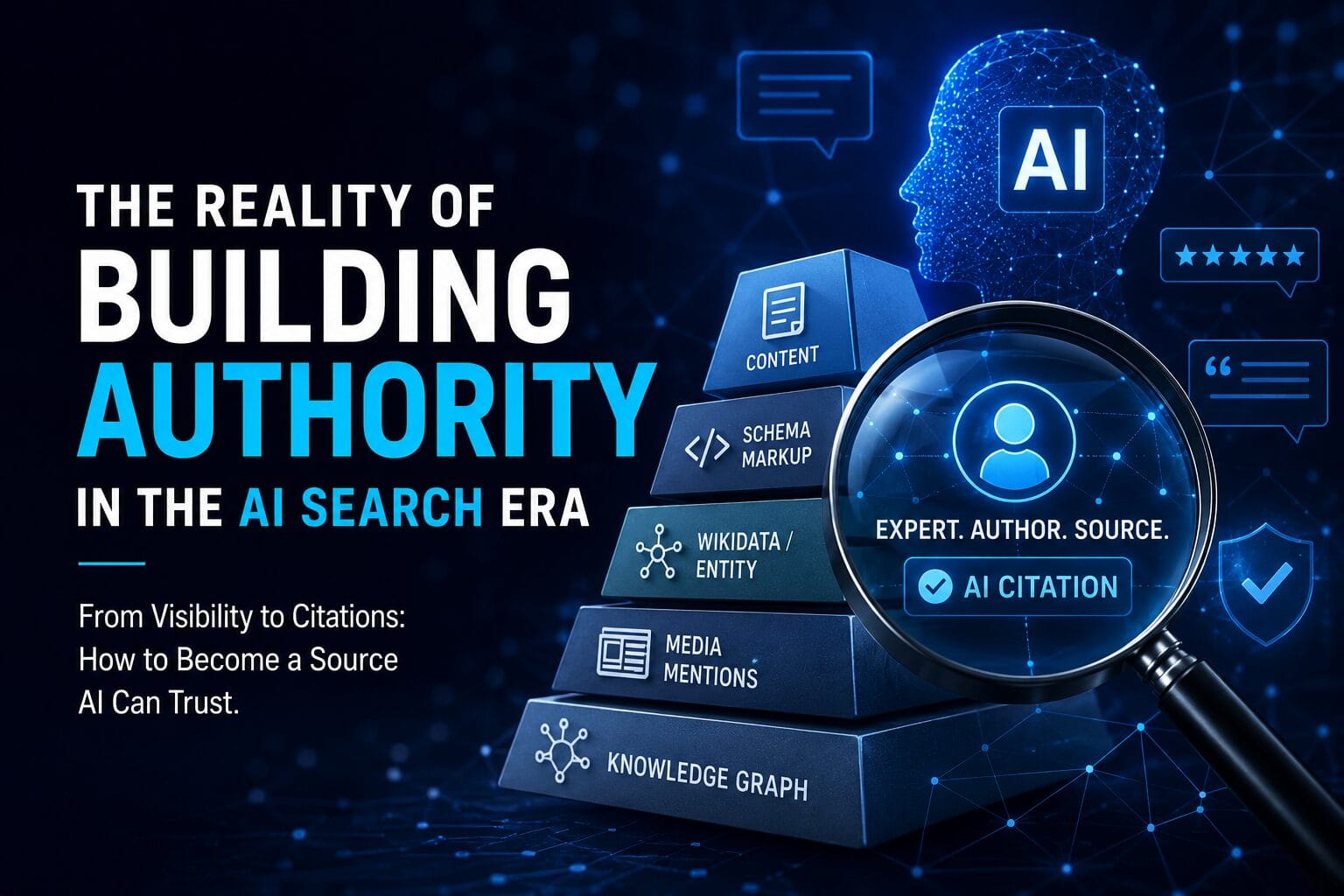
The Reality of Building Authority in the AI Search Era
By Syed Asif Ali, Founder & Digital Identity Architect at Point Media
The Shifting Search Landscape
So here’s the thing nobody warned me about — I spent 18 months trying to get Google to recognize my name as an actual entity, not just a string of text, and the whole time the search game was rewriting itself underneath me.
I run Point Media out of Sharjah, UAE. I’m not an agency with twenty employees. It’s me, a laptop, and a lot of failed experiments. And somehow that turned out to be the perfect setup for figuring out what AI search actually wants from content.
I started because I needed to exist online. Not just have a website — exist as a thing Google could point to and say, “This person is real, and here’s what they do.”
Crawlers vs. LLMs: The Strategic Shift
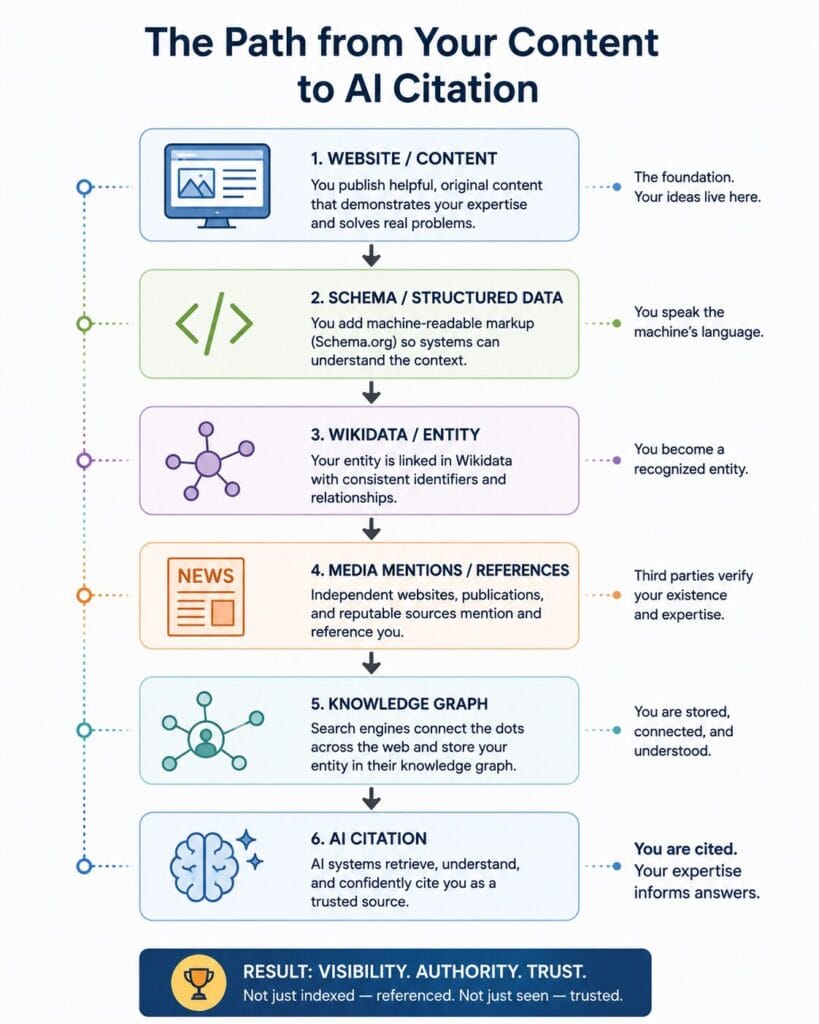
That meant schema markup, entity-based SEO, and Wikidata entries. Three times I submitted structured data, and three times Google basically shrugged. The markup was technically correct. Validators passed. But the Knowledge Panel wouldn’t stick.
What I finally realized — and this is the part most guides miss — is that Google’s crawlers and LLMs don’t want the same thing from your markup:
- Crawlers want: Machine-readable tags.
- LLMs want: Machine-understandable context.
- There’s a difference, and it’s the difference between being indexed and being cited.
My website, syedasifali.link, still ranks above my own Google Knowledge Panel in search results. Sounds backwards, right? But it taught me the first real lesson of 2026: traditional ranking signals and AI citation signals are already diverging.- My site ranks because of: Backlinks, domain age, and all the old mechanics.
- My Knowledge Panel exists because of: Entity consistency across multiple sources — Wikidata, Wikipedia references, repeated media mentions, and structured SameAs properties.
- One system rewards popularity. The other rewards referenceability. And if you’re only optimizing for one, you’re already behind.
How Small Publishers Can Win
Which brings me to how small publishers can still win. It’s not about keyword stuffing or topical clusters in the old sense. It’s about becoming a source an LLM can confidently cite.
I went from zero media mentions to being quoted in TechTarget, TechRound, Law Society Journal, Daily Trust, and several others in under a year. Not because I pitched better, but because I started thinking the way an LLM would:- What facts would it need to confidently say, “According to Syed Asif Ali, Founder and Digital Identity Architect at Point Media…”?
- What structured data would support that claim?
- What third-party references would verify it?
- The answer was uncomfortable: the content that gets surfaced isn’t always the best written. It’s the most structurally explicit. An LLM extracts entities, relationships, and confidence signals. If your expertise isn’t encoded in a way the system can disassemble and reassemble, it might as well not exist.
The Reality of Traffic and Conversions
Here’s the part nobody talks about at conferences: AI search is great for users and terrible for traffic.
My own site gets fewer raw clicks than it did two years ago. But the visitors who do arrive are higher intent, pre-qualified, and convert at roughly three times the old rate. One TechRound quote brought me a $4,500 project without a pitch deck, sales call, or lead magnet. Just recognition from being cited as a source.
The traffic drop stings, though. Organic discovery used to mean click-throughs. Now, an AI system ingests your content, synthesizes it, and presents the user with an answer that may not include your URL at all. Your ideas travel without your brand attached.
4 Formats That Get Surfaced Most Reliably
From my own A/B tests on my properties, here are the formats that reliably get surfaced by AI search tools:- 1. Structured FAQ Schema: Concise, factual answers with direct solutions (no marketing fluff) and author credentials encoded in the same structured block. I saw a 40% increase in AI Overview citations after implementing this.
- 2. Entity-Focused About Pages: Pages that read like knowledge graph entries (Name, Role, Organization, Credentials, References) in plain text, not buried inside design elements. LLMs parse HTML; they don’t admire your CSS.
- 3. Case Studies with Specific Metrics: Real numbers and failures included. Journalists quote my failed Knowledge Panel attempts because it’s verifiable and human.
- 4. Intent-Driven Content: Providing the raw material for AI synthesis, not just generic steps. When you supply the core authority signals, you become the source.
- The Ultimate Search Flip
The percentage of my business that comes from traditional search versus AI-mediated discovery has completely flipped over the last eighteen months.- Traditional Search: Past Share 80% — Current Share (2026) 30%
- AI-Mediated Discovery: Past Share 20% — Current Share (2026) 70%
This 70% doesn’t show up in Google Analytics nicely. It shows up as direct emails, LinkedIn messages, and people saying, “I read about you somewhere.” A lead who found me through an AI citation closes faster, negotiates less, and refers more often.
Future-Proofing Your Digital Identity
The future of content discovery looks less like publishing and more like being referenceable. The survivors won’t be the ones with the most traffic; they’ll be the ones whose expertise is structured clearly enough for AI to cite, and whose human credibility is strong enough for users to trust.
I built my entire digital identity while the rules were changing. The only advantage I had was that I wasn’t optimizing for the past—I was trying to exist in whatever system came next. Turns out that’s exactly what the current system rewards.
Biography
Syed Asif Ali is the Founder & Digital Identity Architect at Point Media, a UAE-based consultancy focused on entity-based search, machine-readable identity, and AI-mediated brand discovery. His work has been cited in TechTarget, TechRound, Law Society Journal, and Daily Trust. He writes from Sharjah about the practical reality of building authority in a shifting search landscape.
Related Reading:
Want to understand how AI search works and what businesses can do to improve visibility in ChatGPT, Gemini, and AI Overviews? Read: What Is AI SEO? A Beginner’s Guide to Ranking in AI Search