The SEO Rules Just Changed. Here’s What Actually Works Now.
By Amber Goetz, Founder & Lead Strategist, The Active Media
For the past two decades, SEO has meant following best practices designed to improve search engine rankings.
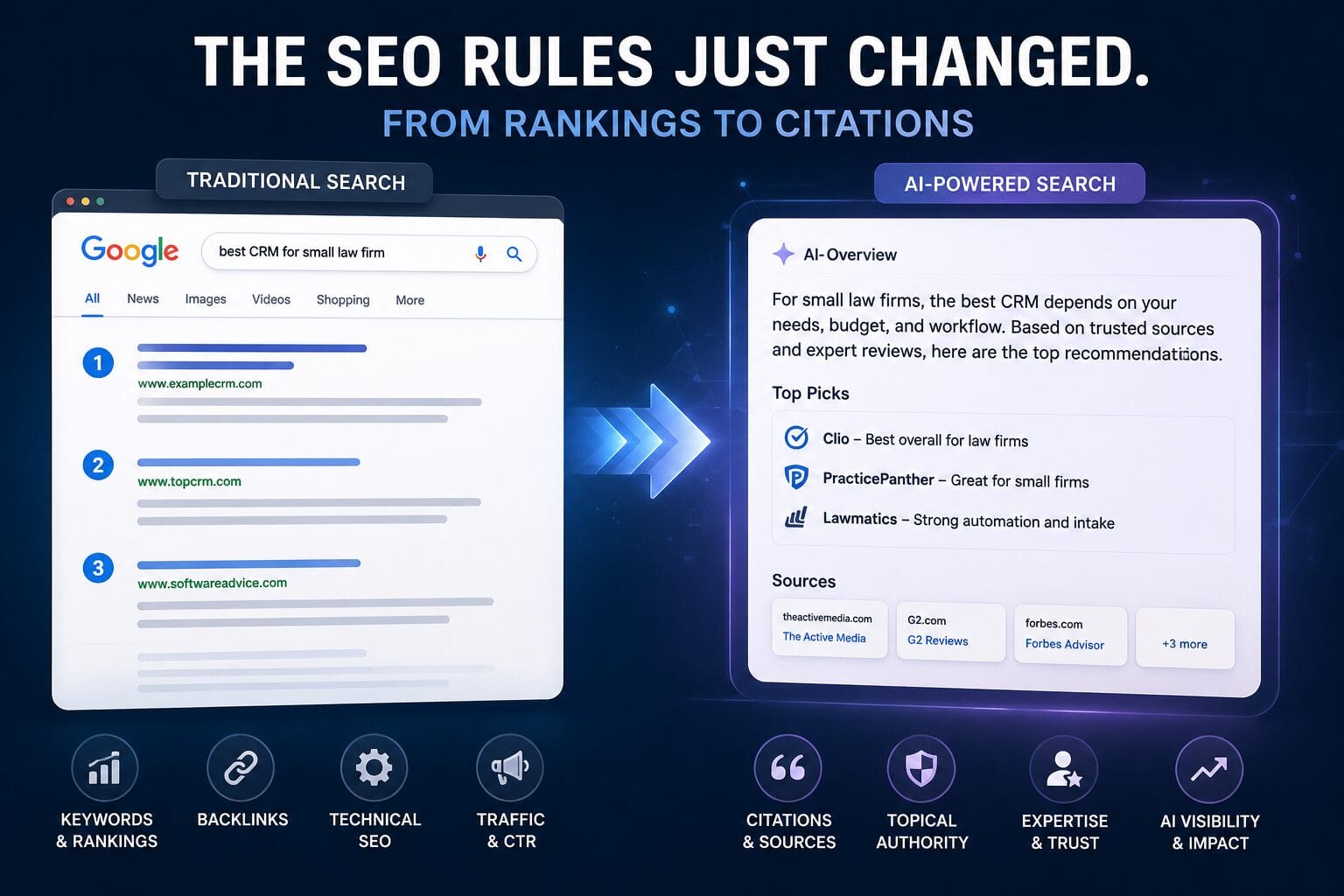
In practice, the seo fundamentals of search engine optimization centered on getting to page one and staying there. Everything: keywords, backlinks, technical structure- was engineered around that singular goal. Effective search engine optimization SEO combines technical SEO, on page seo, and off-page work.
Long-term seo success still depends on unique, relevant content and user experience, not manipulative shortcuts. That game isn’t over. But the board just changed completely.
AI-powered search isn’t coming. It’s here. ChatGPT, Perplexity, Gemini, Claude, and Google’s own AI Overviews are now answering questions that used to send users clicking through ten blue links. And the businesses that understand what that shift actually means- not the hype version, the real version- are going to have a significant advantage over everyone still optimizing for a search experience that’s rapidly becoming secondary.
I’ve spent the last two years watching this unfold in real client work, real audits, and real traffic data. Here’s what I know for certain.
Ranking Is No Longer the Whole Race
The old success metric was simple: keyword rankings. Page one. Position one if you could get there.
Here’s the problem with that metric in 2026: a user can ask ChatGPT, “What’s the best CRM for a small law firm?” and get a comprehensive, sourced answer without visiting a single website. If you’re not one of the sources being cited, your ranking is largely irrelevant to that user’s journey.
We’ve started tracking what I call AI visibility alongside traditional rankings for every client. That means monitoring whether our clients’ brands, content, and expertise are being surfaced in AI-generated answers, not just whether they appear on page two of Google.
These are different problems requiring different solutions. And most businesses aren’t solving the second one yet.
Being Cited Is the New Ranking
When an AI system generates an answer, it’s pulling from content it trusts. The question is: what makes content trustworthy to an AI?
The same things that make it trustworthy to a human expert: depth, specificity, original insight, and demonstrated experience.
Generic content, the kind that says everything and means nothing, is getting filtered out faster than ever. AI systems are pattern matching for actual expertise. That means firsthand experience, documented processes, real case studies, and nuanced positions on industry topics are no longer just “nice to have” for content strategy. They’re the entry fee.
One of our clients in a competitive professional services space had solid rankings, but almost zero presence in AI-generated answers. When we audited their content, the problem was obvious: everything they’d published was surface-level overview content. Technically accurate. Completely generic. Nothing an AI would select when it’s looking for a credible, specific voice.
We rebuilt their content strategy around documented client outcomes, their founder’s specific methodology, and direct answers to the exact questions their clients ask in initial consultations. Within four months, they started appearing consistently in Perplexity responses for their core service category. Their inbound inquiry quality improved noticeably; people arrived already familiar with their approach, already partially sold.
That’s what AI visibility looks like when it’s working.
Topical Authority Is the Engine
One of the biggest strategic mistakes I see businesses making right now is continuing to publish broad content across too many topics in hopes of capturing traffic. That approach is losing ground fast.
AI systems and Google’s own algorithms increasingly reward topical authority: the signal that a website covers a specific subject area in depth and in a comprehensive way. Not a little bit about everything. A lot about something specific.
Think of it like this: if your website were a person showing up to a dinner party, would that person be known for having an interesting, specific perspective on one or two things? Or would they be the one who has a take on everything and expertise in nothing?
For our clients, we’ve shifted content planning to map entire topic ecosystems before publishing a single word. What are all the questions a serious buyer in this space would ask, from first awareness through deep consideration? Which of those questions does our client have genuine, differentiated answers to? Build from that. Cover it completely. Let the authority accumulate.
This isn’t a quick play. But it’s the one that compounds.
Technical SEO Still Matters – It Just Has New Priorities
I’ve seen some declarations that technical SEO is “dead” in the AI era. That is incorrect, and I’ll tell you exactly why.
If AI systems can’t crawl and parse your content efficiently, it doesn’t matter how good that content is. Structured data and schema markup are becoming more important, not less, because they help AI systems understand context, entities, and relationships within your content. Page speed still matters because slow-loading pages get less crawl attention. Clean site architecture still matters because it signals organizational credibility.
What’s changed is the order of priorities. We now lead technical audits with a new category of questions: Is this content structured in a way that an AI system can extract a clean, accurate answer from it? Are we using structured data to identify our key entities, our service areas, our credentials? Are our FAQ and how-to formats providing the kind of direct answer structure that AI Overviews and citation engines prefer?
The fundamentals haven’t changed. The application of them has.
Measuring Visibility in 2026
If you’re only measuring organic traffic and keyword rankings, you have an incomplete picture of your search presence.
Here’s what we’re tracking now for every client:
Brand mention monitoring across AI platforms, manually querying ChatGPT, Perplexity, and Gemini for the questions our clients should be answering and checking whether they appear.
Zero-click impact analysis, understanding which queries are now being answered entirely in AI Overviews and adjusting strategy for those versus queries where click-through still happens at volume.
Content citation audits that identify which pieces of content are being pulled into AI-generated answers and use them as models for future content development.
Referral traffic from AI platforms– Perplexity in particular is driving meaningful referral traffic for clients with strong topical authority. That number is growing.
Traditional rankings still matter. Don’t abandon them. But if that’s your only measurement, you’re navigating a new city with an old map.
What This Means Practically
I’ll leave you with the three things I tell every client who asks me how to adapt their content strategy for AI search:
One: Publish what only you can publish. Your documented experience, your specific methodology, your real client outcomes. AI systems are looking for original, credible, specific information. Generic content is no longer a viable strategy.
Two: Build depth before breadth. Pick the topics where you have genuine authority and cover them completely. A hundred shallow articles won’t outperform twenty deeply authoritative ones in AI-driven discovery.
Three: Structure for extraction. Write in ways that make it easy for an AI to pull a clean, accurate answer from your content: clear headings, direct responses to questions, specific data and examples. If your content reads like a corporate brochure, it won’t be cited like an expert resource.
The brands that win in AI-era search are going to be the ones that are genuinely, demonstrably good at something, and have built their content to prove it.
If you’re not first, you’re last. And right now, most businesses aren’t even in the race.
Author
Amber Goetz is the Founder and Lead Strategist at The Active Media, a performance SEO and digital marketing agency, and the creator of SEO Sidekick. She specializes in technical SEO, AI-era content strategy, and analytics-driven growth for established brands.
Related Reading:
Want to understand how AI search works and what businesses can do to improve visibility in ChatGPT, Gemini, and AI Overviews? Read: What Is AI SEO? A Beginner’s Guide to Ranking in AI Search