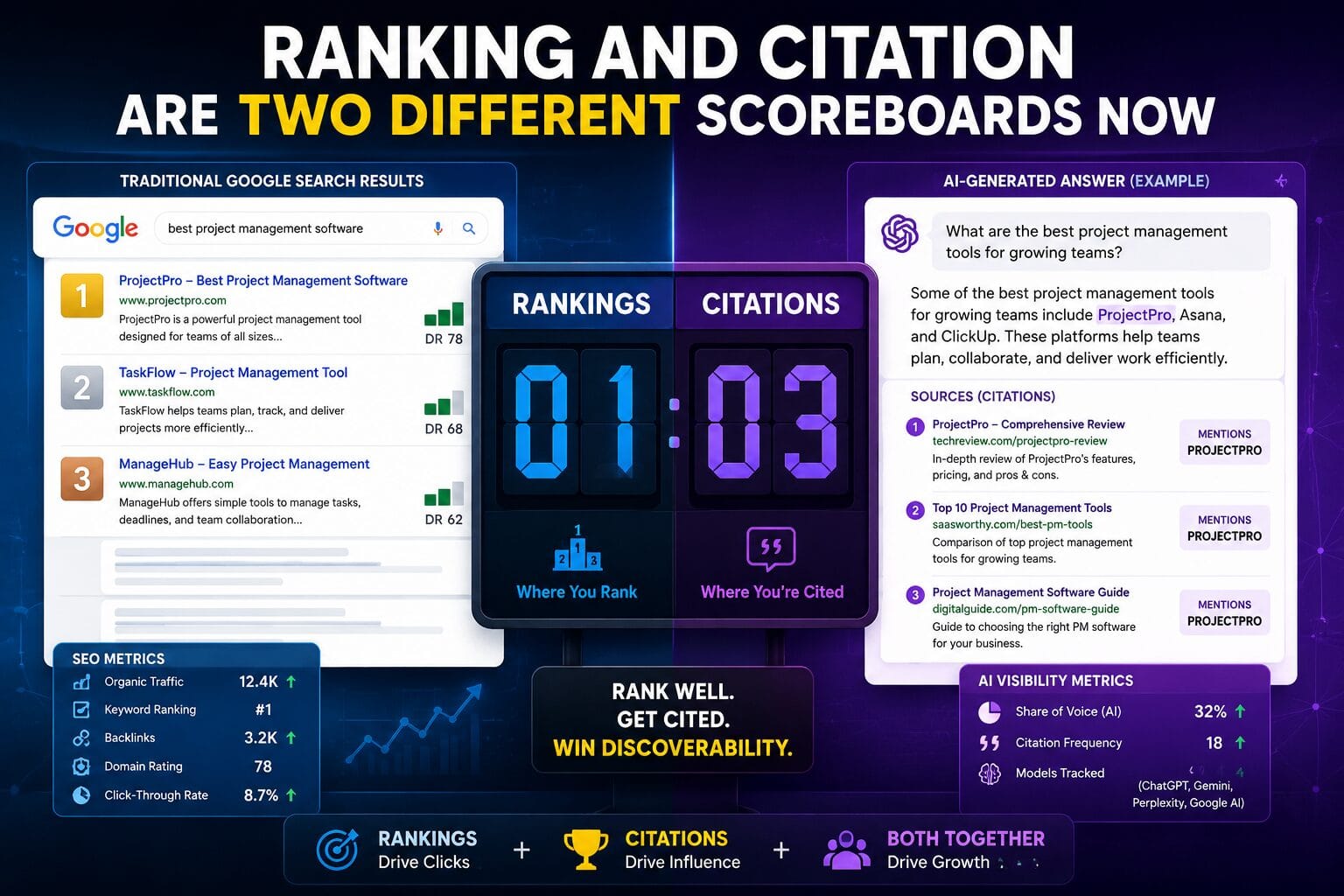
Ranking and Citation Are Two Different Scoreboards Now
Robertas Voroneckis, SEO strategist at Demo Agency
For most of my career, one number was enough to judge whether the work was moving in the right direction: where a client’s page ranked in Google.
That number still matters. I would not pretend otherwise.
But it no longer tells the whole story. On some projects, it does not even tell half of it.
Lately, I have been running more AI visibility analyses for clients. These are not the usual “where do we rank?” audits. The better question now is: when an AI assistant answers a question in our category, does it mention us? And if it does not, who does it mention instead?
After doing this work across different categories, one thing has become clear: ranking and citation have become two separate scoreboards. They overlap, but not as much as many SEO teams would like to believe.
The page that ranks is often not the page that gets cited
The first surprise is usually the mismatch.
A client can rank first for an important query and still be completely absent from the AI answer above the results. At the same time, a thinner page, an old reference article, a comparison list, or a third-party roundup can be pulled into the response instead.
That feels strange until you look at the mechanics.
A ranking system orders documents for a query. A generative system builds an answer and looks for passages that help it answer clearly. Those are related jobs, but they are not the same job.
The page that wins a competitive keyword is often a long commercial page built to convert. It may have strong positioning, persuasive copy, internal links, proof points, and calls to action. Good SEO page. Good sales page.
But the passage an assistant wants is often much simpler: a clear, self-contained explanation of one specific thing.
So your money page can be the best organic result and still be a poor source for an AI-generated answer.
That is the first assumption worth dropping: a strong ranking does not automatically buy you a seat in the AI answer.
“AI visibility” is not one number
The second lesson comes quickly once you start measuring this properly: there is no single AI visibility score, because there is no single AI.
Run the same set of category questions through ChatGPT, Gemini, Perplexity, and Google’s AI Overviews, and you will often get four different pictures. A brand that appears confidently in one can be invisible in another.
The models rely on different sources. They weigh those sources differently. They also update at different speeds.
That makes “AI search” a useful umbrella term, but a risky reporting shortcut. If you flatten everything into one score, you hide the variation that actually tells you what to do next.
In practice, visibility needs to be tracked per model, across a set of real category questions. Not just “are we visible in AI?” but:
How often are we mentioned?
Where are we cited?
Which competitors appear more often?
And which sources get used when we do not appear at all?
That last question is usually the most useful one.
The bottleneck is often the source ecosystem, not the website
This is the finding that has changed my recommendations the most.
When a brand is missing from AI answers, the first instinct is to fix the website. Add more content. Improve structure. Build more pages. Clarify entities. Rewrite service pages.
Sometimes that helps.
But quite often, the bigger issue is outside the site. The brand is missing because the sources the model already leans on do not mention it.
The comparison sites do not include it. The industry roundups ignore it. The forum threads discuss other names. The reference pages in that category describe the market without the brand being part of the conversation.
That reframes the work.
Getting cited is not always an on-page SEO problem. Very often, it is a mention, PR and source ecosystem problem.
You are not only trying to rank your own page. You are trying to get your brand into the set of sources a model already appears to trust.
That means being mentioned in the right places, in plain and factual language that a model can understand and carry into an answer. Not another keyword forced into another H2. Not another generic “leading solution” paragraph on your own site.
What this looks like in a smaller language market
I work mostly in the Lithuanian market, and the pattern is even sharper here than most English-language commentary suggests.
In smaller language markets, assistants often lean heavily on English-language sources and a much thinner pool of local ones. That creates both a problem and an opportunity.
The opportunity is that the local citation pool is shallow. A small number of genuinely credible local mentions can matter more than they would in a saturated English-language niche.
The problem is that if those few local sources do not mention you, there may not be much long tail to save you. The coverage can feel almost binary: either you are present in the small set of trusted sources, or you are not part of the AI answer at all.
For local brands, this makes a deliberate set of credible local placements one of the highest-leverage moves. Not hundreds of weak links. A smaller number of relevant, trustworthy mentions in places that actually define the category.
What actually earns a citation
After enough of these audits, the pattern is fairly consistent. And, in a way, reassuringly old-fashioned.
Self-contained answers win.
A passage that answers one clear question without depending on the rest of the page is easier for a model to use. Clear entity naming helps too. Say who the brand is, what the product or service is, and where it fits in the category. Do not make the reader, or the model, infer everything from context.
Specifics beat adjectives.
“Modern, reliable, and convenient solution” gives an AI system almost nothing to quote. A concrete method, a named feature, a clear comparison, a real limitation, or an honest trade-off gives it something to work with.
First-hand experience also seems to matter more than it used to. Content that clearly comes from someone who has done the work is harder to replace with a generic explanation. It sounds less like a summary of the internet and more like a useful source.
That is partly why this article exists in the first place.
The common mistake is treating AI visibility as a completely new discipline with a completely new playbook. It is not. Much of what earns citations is what has always made content useful: clarity, structure, density, relevance, and being worth referencing.
The targets shifted. The craft mostly did not.
Measure both, because they are no longer the same thing
If I had to reduce this to one recommendation, it would be simple: keep two scoreboards.
Keep tracking rankings. They still drive a large share of search demand, and they are not going away soon.
But add a second board for AI visibility. Track, per model, your share of voice across the questions that matter. Track how often you are mentioned. Track whether you are cited directly. And most importantly, track which sources are cited when you are missing.
That last column is the roadmap.
It tells you whether you need a better explanatory page, clearer entity information, stronger third-party mentions, more local credibility, or a presence in comparison sources the model already trusts.
None of this means burning the existing strategy. The fundamentals that made content findable still matter: usefulness, structure, relevance, and being referenced by others.
What changed is that one number is no longer enough.
Discovery has split into two scoreboards.
The job now is to watch both.
Author
Robertas Voroneckis works on SEO, content strategy, and AI visibility at Demo Agency. He helps brands understand not only where they rank in Google, but how often they are mentioned, cited, and compared across AI-generated answers.
Related Reading:
Want to understand how AI search works and what businesses can do to improve visibility in ChatGPT, Gemini, and AI Overviews? Read: What Is AI SEO? A Beginner’s Guide to Ranking in AI Search