
The End of Rankings: Why AI Visibility Is Becoming a Conversation Problem
For twenty years, businesses optimized for a search result. A keyword, a ranking, a blue link on page one. The whole industry built itself around that single moment of being found.
Today, that moment barely matters. Businesses are no longer being evaluated by a result. They are being evaluated inside a conversation.
When a buyer asks ChatGPT, Gemini, Claude, or Perplexity a question, they rarely stop after the first answer. They ask follow up questions. They compare options. They validate recommendations. They narrow their decision over multiple turns, sometimes across several sessions, before they ever land on a name they trust.
The challenge is no longer showing up once. The challenge is staying in the conversation.
What Changed
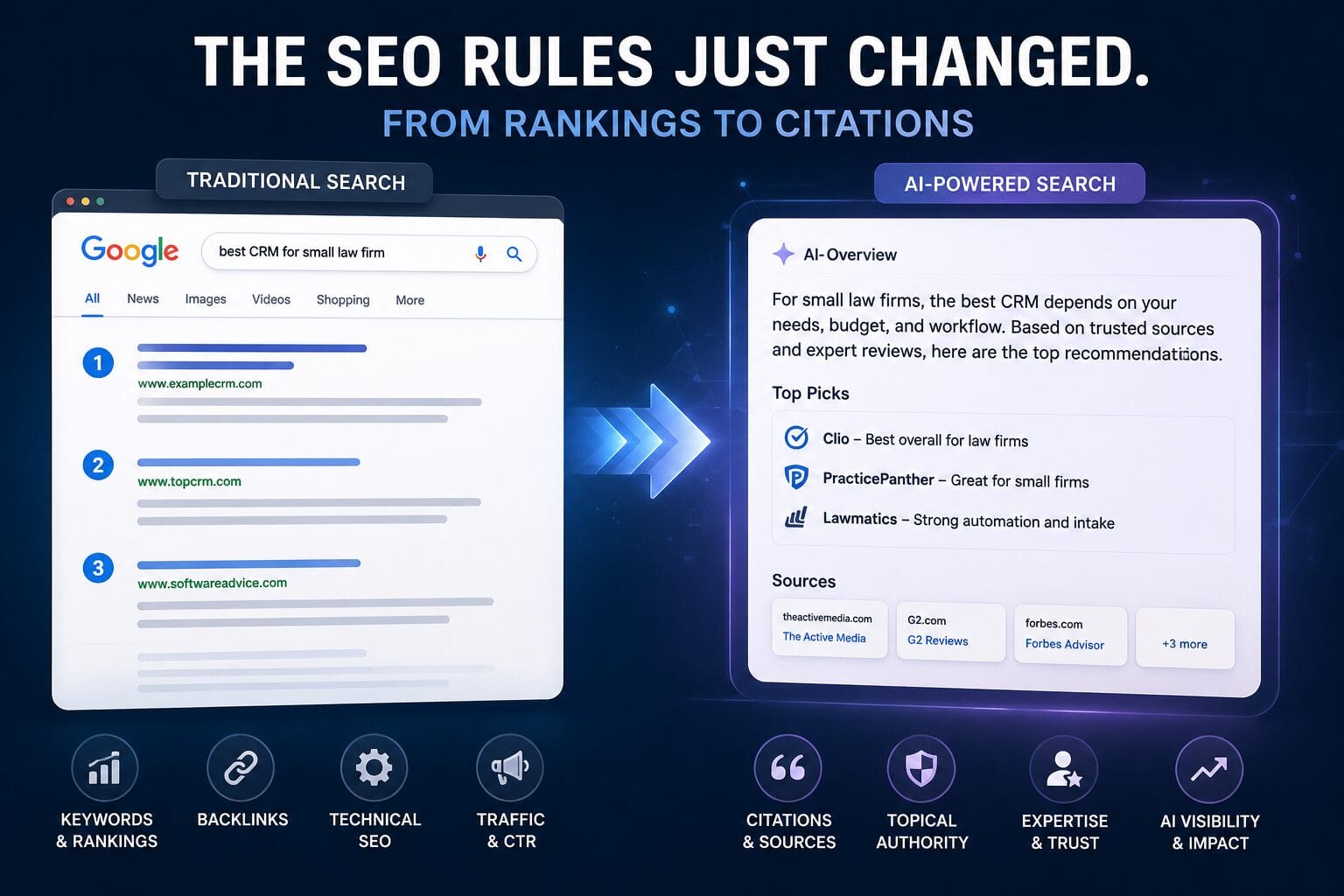
Traditional SEO measured rankings. Position one, position three, position ten. It was a single score, applied at a single moment, and businesses chased it with backlinks, keyword density, and technical fixes.
AI systems do not work that way. They measure confidence.
Behind every AI-generated answer is a model trying to decide how sure it can be about recommending something. To build that confidence, it pulls from a wide and uneven mix of sources: websites, interviews, reviews, press mentions, podcasts, FAQs, citations, and structured content scattered across the web. The model is not looking for the page that ranks highest. It is looking for enough consistent signals to feel comfortable putting your brand in its answer.
That changes the question every business needs to ask.
The old question was: can Google Search find you?
The real question now is: does AI understand you well enough to recommend you?
Those are not the same thing. A business can be technically indexed, crawlable, and visible, and still get skipped over in the moment that actually matters, because the AI does not have enough context to feel confident.
The New Visibility Gap
Here is the part most businesses are missing entirely. Many companies show up just fine in the early, educational stage of a prompt sequence. Then they quietly disappear the moment a buyer gets specific.
Picture a real buyer journey, turn by turn:
Turn 1: How do I show up in AI search?
Turn 2: What tools help with AI visibility?
Turn 3: Which platform is best for a small marketing agency?
Turn 4: Who should I hire?
Different brands show up at every single stage. The names that appear in turn one are rarely the same names that survive to turn four. Most businesses are putting all their effort into optimizing for that first, broad question, the one with the most search volume and the most competition.
But the revenue is not hiding in question one. It is hiding in question four.
That is the turn where the AI is no longer educating. It is recommending. And by then, most businesses have already fallen out of the conversation because nothing about their content gave the model enough confidence to carry them forward.
Why Content Must Change
This requires a real shift in how content gets built, not just where it gets published.
Instead of standalone keyword pages built to rank for one query, businesses need content built around how a buyer actually thinks across an entire decision:
- Intent chains that follow a buyer’s logic from curiosity to comparison to decision.
- Journey stage content that speaks differently to someone just learning a category than to someone ready to choose a vendor.
- FAQs that answer the follow-up questions a buyer would actually ask next, not just the obvious first one.
- Founder expertise that signals real, first-hand experience rather than generic advice.
- Comparison content that helps AI place a business accurately against alternatives.
- Validation content, like reviews, case studies, and third-party mentions, that gives the model independent confirmation.
- Proof content that backs up claims with specifics instead of broad statements.
None of this is about gaming a single ranking anymore. The goal is to help AI maintain context about a business across multiple turns, so that when the buyer finally asks the question that matters, the model still remembers who you are and why you fit.
What We’re Seeing
In working with businesses on AI visibility, the pattern above shows up constantly. A landscaping company, a basement remodeler, a boutique consultancy, a regional service provider, they all tend to score reasonably well on broad, top-of-funnel prompts and then fade out by the time a buyer is comparing specific options.
Running AI visibility audits across a buyer’s full conversation, not just a single prompt, tends to surface this gap immediately. A business might look strong on paper and still be invisible at the exact turn where a customer is ready to choose. Mapping the buyer journey turn by turn, and tracking how recommendations shift from one prompt to the next, shows exactly where that drop off happens and what is missing from the content that would have carried the business through.
The businesses that close that gap are not necessarily the ones with the most content. They are the ones whose content was built with the next question in mind.
The Future
Rankings are not disappearing overnight, but they are losing their grip as the primary measure of visibility.
The winners in this next phase will not necessarily have the highest rankings. They will be the businesses that AI can confidently explain, compare, validate, and recommend throughout an entire buying conversation, from the first curious question to the final decision.
Search is becoming conversational. Visibility is becoming cumulative, built turn by turn rather than earned in a single moment. And authority, the kind that comes from genuine expertise, consistent proof, and a clear point of view, is becoming the new ranking factor.
The businesses paying attention to that shift now will be the ones still in the conversation when it counts.
Author Bio
Monic AI Systems
Monica Tomasso, Chief AI Visibility Expert
www.monicaisystems.com
Monica Tomasso is Founder and Chief AI Visibility Expert at Monic AI Systems, where she helps businesses improve their visibility and recommendations across AI-powered search platforms.
Related Reading:
Want to understand how AI search works and what businesses can do to improve visibility in ChatGPT, Gemini, and AI Overviews? Read: What Is AI SEO? A Beginner’s Guide to Ranking in AI Search