Why Traditional SEO Is the Foundation AI Search Is Built On
By LIJUN SUN Founder & CEO, Citadex
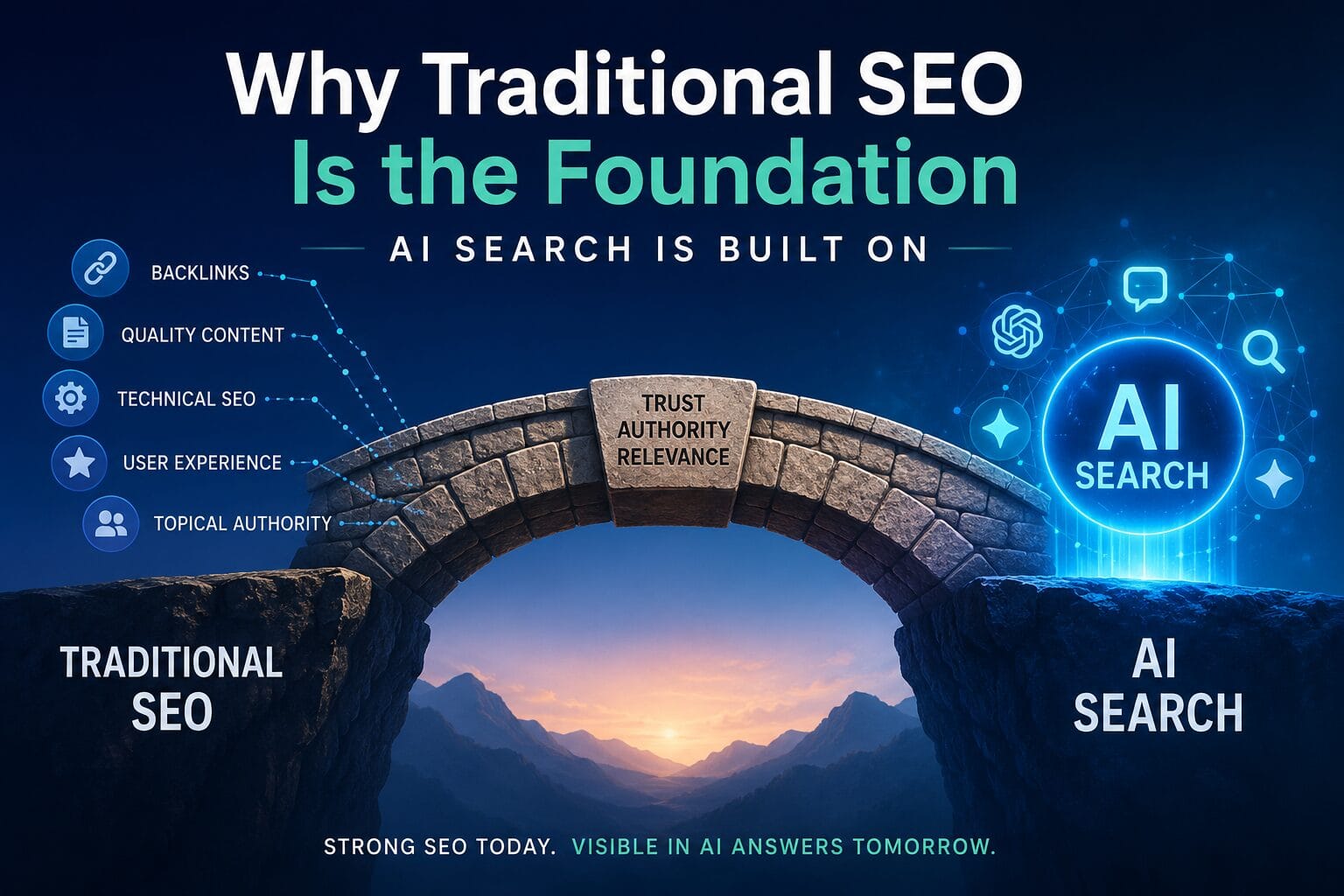
Every few months a headline declares SEO dead. The latest obituary blames ChatGPT, Perplexity, and Google’s AI Overviews: if AI just answers the question, who needs to rank? Having spent the last few years watching how these engines actually choose what to say, I’ve reached the opposite conclusion. Traditional SEO isn’t being replaced by AI search — it’s the very thing that decides whether AI mentions you at all.
AI answers are assembled from the web, not invented
The most important thing to understand about retrieval-based engines—ChatGPT with search, Perplexity, Google AI Overviews — is that they don’t pull brand recommendations out of thin air. At the moment a user asks a question, the model fetches, reads, and cites pages it can find and trust right then. That means the entire question of “will my brand appear in the answer?” reduces to a familiar one: is my content discoverable, crawlable, and credible enough to be retrieved? Those are SEO questions. They didn’t go away; they got a new, higher-stakes surface.
The signals AI trusts are SEO’s home turf
When an AI engine decides which sources to cite, it leans on exactly the trust signals SEO practitioners have worked on for years: authoritative backlinks, consistent entity information, topical depth, and content that other reputable sites reference. A brand that is well-linked, clearly described across the web, and cited by third parties is a brand the model can “confidently” name. A brand with thin authority is one the model skips in favor of a competitor with a stronger footprint. The currency changed from “rank position” to “citation,” but the underlying economy—earned authority—is the same.
Technical SEO is now table stakes for being quotable
Here’s where I see teams get burned. During redesigns and migrations, content that humans can see in a browser sometimes isn’t present in the raw HTML a crawler or AI fetcher reads first. Organic rankings may hold steady because Googlebot eventually renders the page — but retrieval-based engines that parse the initial HTML quietly stop citing it. Clean rendering, fast and crawlable pages, accurate structured data, sensible redirects: these classic technical SEO fundamentals are now the difference between being citable and being invisible to AI. The work didn’t change. The penalty for skipping it did.
Where AI search genuinely differs—and where SEO alone falls short
To be fair to the “SEO is changing” camp, it is changing. Two things are genuinely new. First, you’re often optimizing for no click—the goal is to be the cited source inside the answer, not necessarily to win the visit. Second, visibility is now fragmented across many engines and languages that each behave differently; ranking #1 on Google no longer guarantees you appear in a Perplexity answer or a Japanese-language response. Traditional SEO tooling, built around Google rankings, doesn’t measure any of that. So the honest position isn’t “SEO is enough”—it”‘s “SEO is necessary, and answer-engine visibility is the layer you now build on top of it.”
What still works, in practice
The teams adapting well aren’t throwing out the playbook; they’re extending it. They build genuine topical authority instead of chasing isolated keywords. They earn third-party citations — reviews, mentions, well-placed guest articles — because those are the sources AI repeats. They structure content the way models like to lift it: direct answers up top, clear headings, real FAQs that mirror how buyers actually ask. And they treat technical health as non-negotiable, because a page that can’t be retrieved can’t be cited no matter how good it is. None of that is exotic. It’s traditional SEO, pointed at a new endpoint.
The takeaway
“Traditional SEO vs. AI search” is a false choice. AI engines are, in a sense, the most demanding SEO audience yet: they only surface sources that are discoverable, technically sound, and demonstrably trusted. Brands that kept doing the unglamorous fundamentals are the ones showing up in AI answers today. The ones that treated SEO as dead are learning that the model agreed — and quietly recommended a competitor instead.
Author Bio:
Lijun Sun is the Founder and CEO of Citadex, where he leads the company’s vision and strategy in advancing AI-driven search and digital discovery. With expertise in search technologies, artificial intelligence, and online visibility, he helps businesses adapt to the evolving landscape of AI-powered search.
Related Reading:
Want to understand how AI search works and what businesses can do to improve visibility in ChatGPT, Gemini, and AI Overviews? Read: What Is AI SEO? A Beginner’s Guide to Ranking in AI Search