76% Don’t Trust AI Output. Why Are 97% Increasing Their AI Budgets?
The AI adoption paradox, and what I have learned using AI in SEO and Digital PR at Simply Sansu
AI adoption is moving quickly. But something stood out to me while analyzing the Simply Sansu AI in Marketing 2026 Executive Survey.
Businesses are increasing their AI investment while still questioning whether they can trust what AI produces.
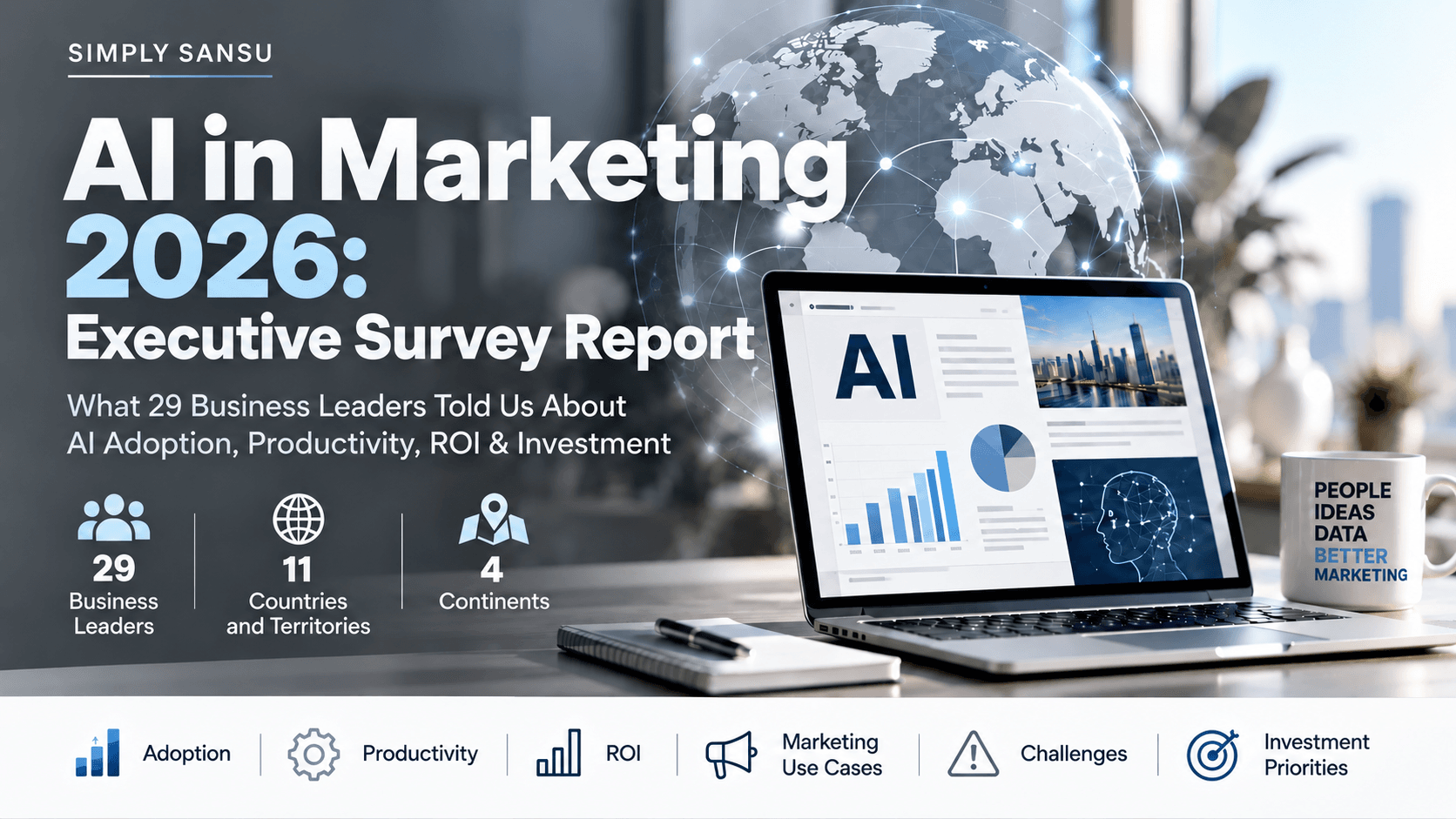
In our survey of 29 business leaders across 11 countries and four continents, 97% said their AI budget is increasing, while 76% said they don’t trust what AI produces. Pasted markdown(20261005-054650)
That may sound contradictory.
From my own experience, I don’t think it is.
AI is saving me time, but I don’t hand over the decision-making
At Simply Sansu, I use AI regularly for SEO, Digital PR research, content review, outreach and workflow automation.
Before using AI, Digital PR research could take a lot of time. I would search Google for relevant websites, check their authority and relevance, look through their content, find suitable articles to reference and search for contact information.
AI has changed that part of my workflow significantly.
I can give AI specific requirements, such as the industry, website type, authority range and relevance, and get a much larger pool of potential opportunities much faster. I can also ask it to find a relevant article on a particular website that I can naturally reference in an outreach email. Answers to Queries from Daniel
But I don’t simply take the results and start sending emails.
I still check whether the website is active, whether its content is indexed, whether it is genuinely relevant, and whether the opportunity makes sense for the campaign. Answers to Queries from Daniel
That distinction is important.
AI can find an opportunity. It doesn’t necessarily know whether it is a good opportunity.
My biggest gain has been productivity
The biggest change for me has not been replacing my work with AI.
It has been getting more time back.
AI handles some of the repetitive research, helps me organize opportunities, suggests outreach variations and helps me experiment with subject lines. I also use my own AI-assisted Digital PR app for smaller, targeted campaigns. Answers to Queries from Daniel
That saved time gives me more room to think.
Instead of spending most of my time finding websites and contact information, I can spend more time asking:
- Is this actually a good opportunity?
- Is this website relevant enough?
- Is this the right angle?
- Can I make the outreach more personal?
- Would a survey work better than a poll?
- Is this subject line appropriate for this publication?
That additional thinking time is one of the biggest benefits AI has given me. Answers to Queries from Daniel
But AI still gets things wrong
“The hardest part is teaching people when not to trust it. I’ve watched AI produce something that looked completely finished, and that’s actually the dangerous part.”
Peter Murphy Lewis
Founder / CEO, Strategic Pete
United States
This is where my own experience aligns closely with the survey finding around trust.
I have seen AI suggest websites that had already shut down or were no longer active. Contact information can also be inaccurate, which means I still have to verify it manually. Answers to Queries from Daniel
AI-generated Digital PR ideas can also be generic or repetitive.
For that reason, I usually develop the initial campaign idea myself based on the client’s industry, audience, current conversations and available data. I may then use AI to develop or challenge the idea, but I don’t rely on it to create the entire concept. Answers to Queries from Daniel
The same applies to content.
I sometimes use different AI tools as a second opinion on clarity, usefulness, SEO, structure and overall quality. But I decide which suggestions actually fit the content and my voice. AI feedback does not get the final say. Answers to Queries from Daniel
AI is an assistant, not the strategist
Almost every stage of my Digital PR workflow still has a human approval step.
AI can help with:
- Research
- Finding opportunities
- Finding relevant content
- Contact discovery
- Drafting
- Subject-line variations
- Content analysis
- Repetitive tasks
I still handle the decisions that require experience, creativity and judgment. Answers to Queries from Daniel
For example, a client may suggest building backlinks through coupon websites. AI might identify those sites as potential opportunities based on the criteria provided.
But SEO isn’t simply about finding a website with a particular metric.
I look at topical relevance, whether the site is active, whether its content is indexed, editorial quality, audience and whether the backlink makes sense in context. Answers to Queries from Daniel
That’s where experience matters.
Why are businesses still increasing their AI budgets?
The survey gives us an important clue.
Employee productivity and efficiency was the leading reason for AI investment, at 86.2%, followed by automation at 79.3%. Pasted markdown(20261005-054650)
That matches what I have experienced at Simply Sansu.
The value of AI isn’t necessarily that it can do everything for me.
The value is that it can take some of the repetitive work off my plate so I can spend more time on the work that actually requires me.
And the investment outlook supports that. The survey found that 48.3% expected a significant increase in AI investment and 44.8% expected a moderate increase over the next 12 months. Pasted markdown(20261005-054650)
The AI adoption paradox
So, are businesses trusting AI?
Not completely.
Are they investing in it?
Absolutely.
I think these two things can exist together because businesses are learning where AI works well and where it needs human oversight.
My own approach at Simply Sansu is simple:
Let AI handle more of the repetitive work. Keep humans at the decision points.
For me, the biggest result isn’t simply doing the same work faster.
It is having more time to analyze, experiment, personalize, improve processes and focus on higher-value strategic work. Answers to Queries from Daniel
That, to me, explains the AI adoption paradox better than simply asking whether people trust AI.
Businesses don’t have to trust AI blindly to invest in it. They just need to know where it can create value, where it can fail, and where human judgment still matters.
About the survey
The AI in Marketing 2026 Executive Survey by Simply Sansu collected responses from 29 business leaders across 11 countries and territories spanning four continents. The research was conducted by Sansu Abraham, Founder, Simply Sansu. The findings represent the survey respondents and are not intended to represent the entire marketing industry. Pasted markdown(20261005-054650)