Why 29 Business Leaders Expect Marketing & Communications to Get the Most AI Investment
AI is no longer just an experiment for many businesses. But why is Marketing & Communications emerging as the leading area for expected AI investment growth?
When I conducted the Simply Sansu AI in Marketing 2026 Executive Survey, I wanted to understand not just whether businesses were using AI, but where they expected to invest more in it.
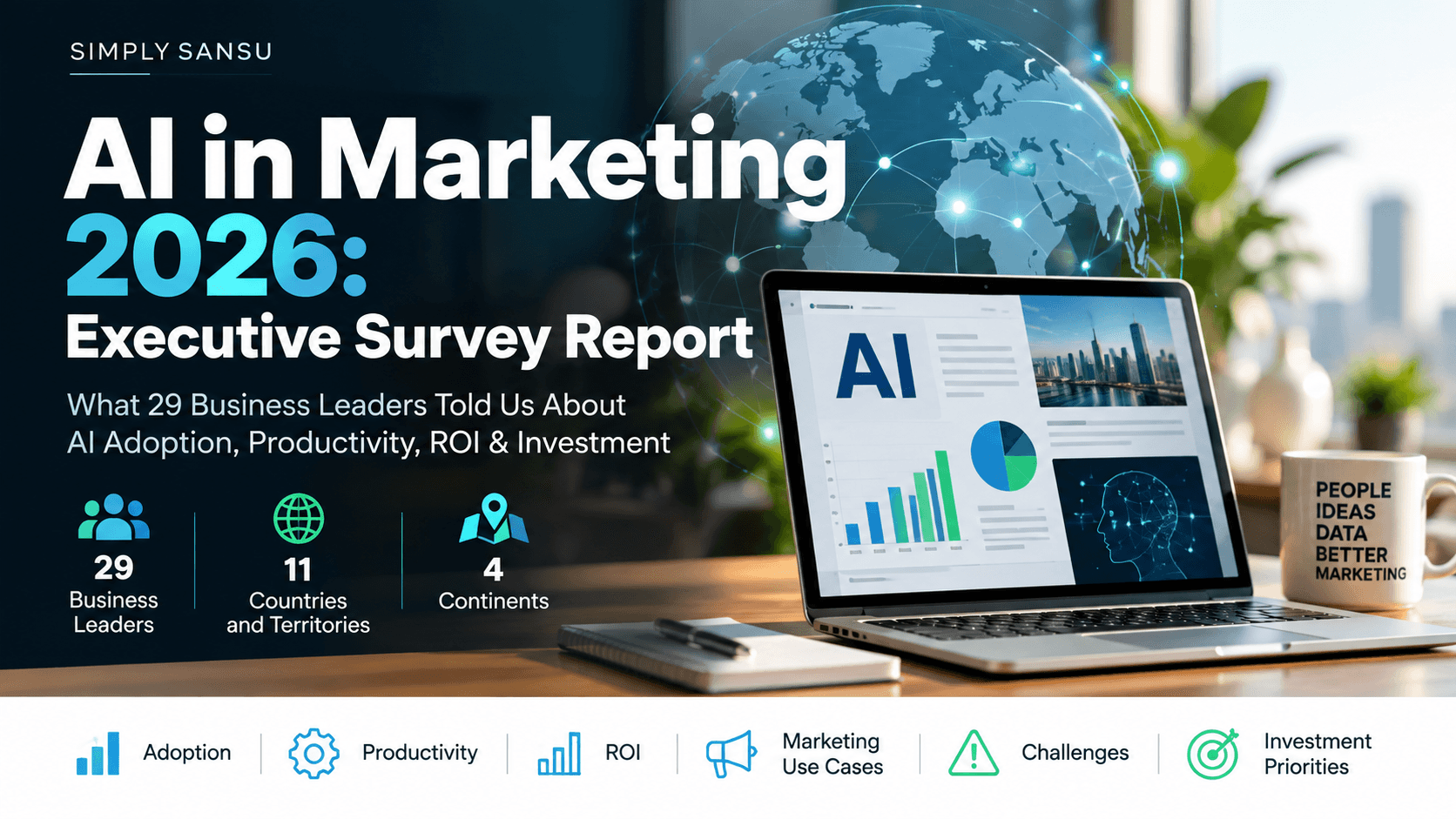
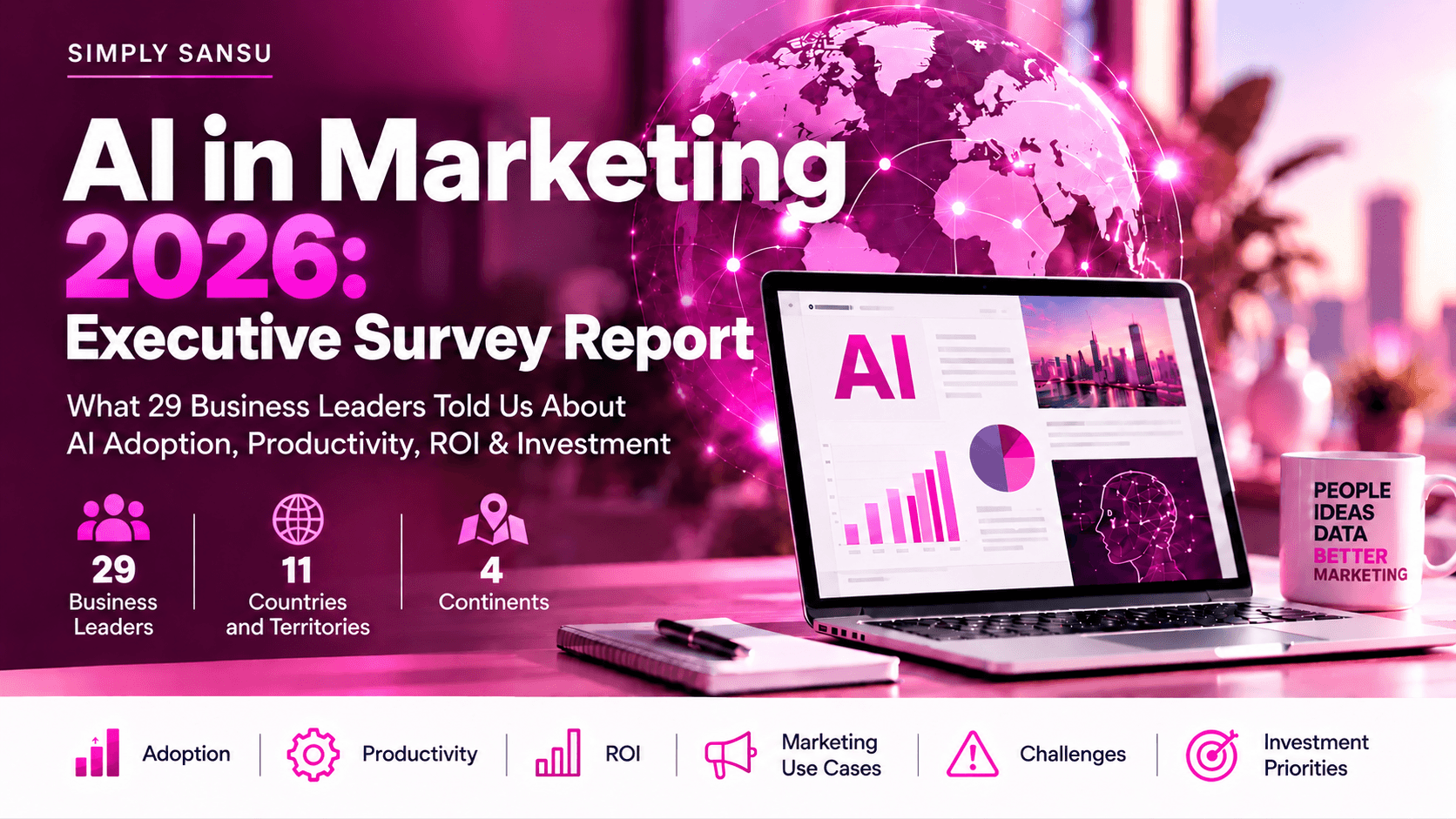
The survey included 29 business leaders across 11 countries and territories spanning four continents, with founders and CEOs making up the majority of respondents. The findings represent this survey group and are not intended to represent the entire marketing industry. Pasted markdown(20261005-054650)
One finding stood out to me.
Marketing & Communications emerged as the top area where business leaders expect AI investment to grow.
Eight respondents, or 27.6%, selected Marketing & Communications as the area likely to receive the greatest AI investment over the next 12 months. Operations & Process Automation followed closely with seven respondents, or 24.1%. AI_in_Marketing_2026_Executive_…
So, why Marketing & Communications?
AI Is Already Delivering Value in Marketing
“The biggest benefit has been leverage. AI allows us to automate repetitive work, accelerate content and marketing workflows, and give our team more capacity to focus on higher-value decisions and business growth.”
Simply Sansu AI in Marketing 2026 Executive Survey
Deepak Shukla, Founder & CEO, Pearl Lemon
The answer becomes clearer when we look at where respondents are already seeing value from AI.
Content Strategy & Creation was the leading area, with 86.2% of respondents saying AI is delivering value there.
AI is also delivering value in:
- SEO & AI Search Visibility: 58.6%
- Marketing Analytics & Reporting: 58.6%
- Social Media Marketing: 41.4%
- Email Marketing & Marketing Automation: 34.5%
- Lead Generation & Demand Generation: 31%
- Digital PR & Brand Visibility : 27.6% Pasted markdown(20261005-054650)
These numbers show that AI is already being used across different parts of marketing, rather than being limited to experimentation.
And from my own experience in SEO, digital PR, outreach, and content marketing, I can see why.
My Experience: AI Is Making Marketing Work Faster
I use AI in different parts of my own marketing workflow, including research, brainstorming, content development, SEO analysis, and outreach.
It can save considerable time when I need to research a topic, explore ideas, analyze information, or work through a repetitive task.
For example, when I’m working on outreach, AI can help me identify potential websites and opportunities much faster than doing everything manually.
But there is an important second step.
I still have to evaluate the results.
An AI tool may give me a list of websites, but I need to determine whether those websites are actually relevant, credible, and worth pursuing.
The same applies to SEO recommendations and content ideas.
AI can suggest a strategy, but I need to ask whether that strategy actually makes sense for the business.
AI can give me options. My experience tells me which options make sense.
That distinction has become increasingly important in my own work.
Content Creation Is a Major Driver
Marketing has always involved a lot of repetitive and time-consuming work.
Researching topics. Creating content. Repurposing content. Analyzing performance. Preparing reports. Generating ideas. Managing campaigns.
AI can speed up many of these activities.
In the survey, 55.2% of respondents said accelerating content creation and campaign execution was a reason for investing in AI. Meanwhile, 86.2% cited employee productivity and efficiency, and 79.3% cited automating repetitive and time-consuming tasks. Pasted markdown(20261005-054650)
For marketing teams, that can mean getting more work done without necessarily increasing the size of the team.
But I don’t think faster content production alone explains why Marketing & Communications is attracting so much attention.
Marketing Is Becoming More Data-Driven
Another important factor is decision-making.
58.6% of respondents said faster decision-making using data and insights was a reason for investing in AI.
The same percentage cited improving marketing experience and ROI. Pasted markdown(20261005-054650)
Marketing teams now have access to enormous amounts of data.
Website traffic. Search data. Customer behavior. Campaign performance. Social engagement. Conversion data. Email performance.
The challenge isn’t always collecting the information.
It is understanding it quickly enough to act.
AI can help marketers process large amounts of information, identify patterns, and support faster decision-making.
AI Can Help Marketers Do More With Less
Another recurring theme in the survey was productivity and scale.
Respondents described AI as a way to increase output, reduce repetitive work, and help small teams accomplish more. Speed was another recurring theme, particularly around research, content creation, execution, and delivery. AI_in_Marketing_2026_Executive_…
I can relate to this from my own experience.
As someone who works across SEO, digital PR, outreach, and content, there are many tasks that can consume hours if done completely manually.
AI can help me move through the initial stages much faster.
That doesn’t mean I simply accept whatever it produces.
It means I can spend less time on repetitive work and more time on strategy, evaluation, creativity, and decision-making.
For smaller businesses and lean marketing teams, that can be particularly valuable.
But More AI Investment Doesn’t Mean Less Human Involvement
This is perhaps the most interesting part of the survey for me.
Businesses are increasing their investment in AI, but that doesn’t mean they are ready to hand over marketing decisions to AI.
Accuracy and reliability of AI-generated outputs was the biggest implementation challenge, identified by 75.9% of respondents.
That creates an interesting contradiction.
Businesses want more AI while still being cautious about what AI produces.
I have experienced this myself.
There are times when an AI tool gives me exactly what I need. There are also times when I have to go back and explain the context, correct an assumption, or remind it of an instruction that was already given.
The output may look convincing, but that doesn’t automatically make it right.
This is particularly important in marketing because not every technically correct answer is a good marketing answer.
A piece of content can be grammatically perfect but still fail to connect with the audience.
An SEO recommendation can look good on paper but may not fit the business.
An outreach opportunity can have strong metrics but be completely irrelevant to the brand.
This is where human experience matters.
AI Is Changing My Workflow, Not Replacing My Judgment
I don’t see AI as something that replaces my marketing expertise.
I see it as a tool that extends what I can do.
It allows me to research faster, explore more ideas, automate parts of my workflow, and process information more efficiently.
But I still need to make the final call.
This is why I think the future of AI in Marketing & Communications is less about AI replacing marketers and more about marketers who know how to use AI effectively becoming more productive.
The value comes from combining the technology with experience.
Why Marketing & Communications?
When I look at the survey findings alongside my own experience, the picture becomes quite clear.
Marketing & Communications is attracting AI investment because it combines:
- High volumes of repetitive work
- Content-heavy workflows
- Large amounts of data
- Pressure to produce results quickly
- Demand for personalization
- Constant need for research and ideas
- The need to measure performance and ROI
AI can address many of these challenges.
It can help marketers:
- Produce content faster
- Automate repetitive tasks
- Analyze marketing data
- Generate ideas
- Improve campaign execution
- Support SEO and AI search visibility
- Personalize customer communication
- Reduce manual workload
- Make faster data-driven decisions
The survey findings support this. Employee productivity and efficiency was the most frequently cited reason for AI investment at 86.2%, followed by automating repetitive tasks at 79.3%. Pasted markdown(20261005-054650)
The Bigger Question Is What Happens Next
The fact that Marketing & Communications leads expected AI investment growth doesn’t mean every marketing task will become automated.
Instead, I believe the role of the marketer will continue to evolve.
The ability to use AI will become increasingly important.
But so will the ability to question AI, verify information, understand the customer, recognize what is relevant, and make the final decision.
That’s especially important when AI-generated output is still one of the biggest challenges businesses face.
For me, the model is simple:
AI helps me work faster.
Experience helps me work smarter.
Human judgment helps me decide what is actually worth doing.
Final Thought
The biggest takeaway from my survey isn’t simply that Marketing & Communications is expected to receive the most AI investment growth.
It is why businesses are investing.
They want to make their teams more productive, automate repetitive work, accelerate content creation, improve decision-making, and get more value from their marketing efforts.
My own experience has reinforced the same thing.
AI can make marketing faster. But the real opportunity is using it to make marketing better.
And as AI becomes more accessible, I believe the marketers who combine AI capability with real-world experience, domain expertise, and human judgment will have the strongest advantage.
Resource: AI in Marketing 2026 Executive Survey