Beyond Search Volume: How to Choose the Right Keywords for SEO
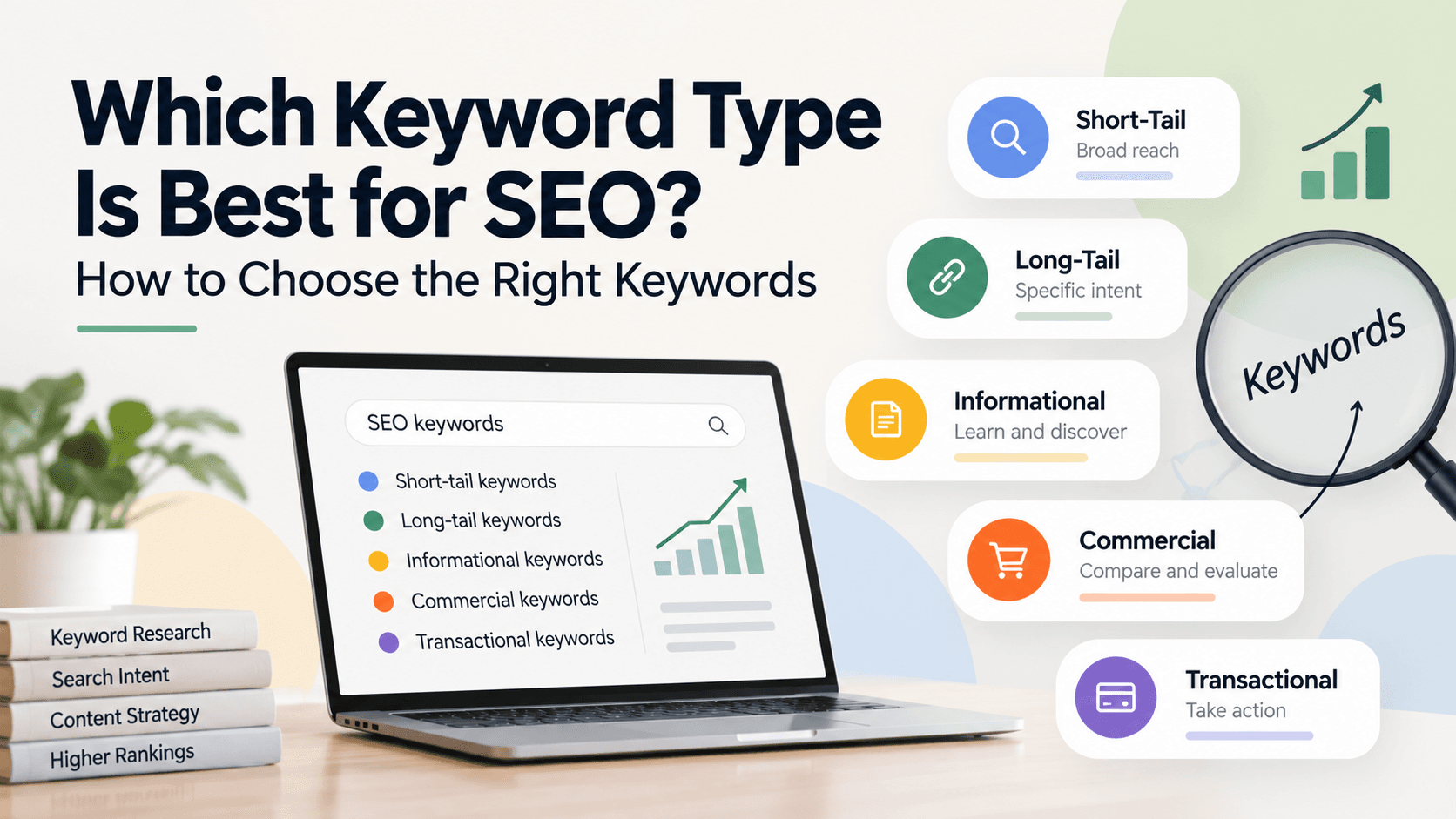
When people talk about keyword research, one question comes up repeatedly: Which keyword type is the best for SEO? Should you target short-tail keywords, long-tail keywords, commercial keywords, or informational keywords? Example: A website could target “SEO,” “technical SEO for WordPress,” “SEO services,” or “what is SEO,” and each serves a different purpose.
After working with SEO, digital marketing, outreach, and content strategy for years, I have learned that the answer is not as simple as choosing one keyword category over another. Example: On Simply Sansu, I use different keyword approaches for my SEO articles, AI SEO services, digital PR content, and ebooks.
There is no single keyword type that is always best for SEO.Example: “SEO” may have broader demand, while “technical SEO checklist for WordPress” may have much clearer intent for a specific article.
The right keyword depends on what you are trying to achieve, who you want to reach, what the searcher actually wants, and whether your page genuinely satisfies that search. Example: A page targeting “AI SEO services” should address potential clients, while “what is AI SEO?” should educate beginners.
For my own website, Simply Sansu, I use different types of keywords for different purposes. A page targeting an SEO service should not be optimized in exactly the same way as an educational article about technical SEO or an ebook about launching a website. Example: My AI SEO services page and a technical SEO educational article may discuss related subjects, but they target different search needs.
That distinction is important. Example: Someone searching for “AI SEO services” is potentially evaluating a provider, while someone searching for “what is AI SEO?” is primarily looking for information.
Google itself says that its language systems can understand how a page relates to many queries, even when the exact search terms are not repeated on the page. Google also emphasizes creating useful, people-first content rather than relying on keyword repetition. Example: An article about website speed can naturally rank for related searches such as “improve website speed” and “optimize WordPress performance” without repeating the exact phrase dozens of times.
So, instead of asking “Which keyword type is best?”, I prefer to ask:
“Which keyword best matches the searcher’s intent and the purpose of this page?”
Example: For a Simply Sansu article explaining AI SEO, “what is AI SEO?” makes more sense than forcing a commercial phrase such as “AI SEO services” into the page.
Need Help Choosing the Right Keywords?
Keyword research is not just about finding keywords with high search volume. It is about understanding search intent, identifying the right opportunities, and matching each keyword to the right page.
If you are unsure which keywords to target, how to structure your content around them, or how to build a stronger SEO strategy, let’s talk.
Before deciding which keyword is best, it helps to understand the major categories. Example: The main categories include short-tail, long-tail, informational, commercial, transactional, and navigational keywords.
1. Short-Tail Keywords
Short-tail keywords usually contain one or two words. Example: “SEO,” “digital marketing,” “link building,” and “technical SEO.”
Examples:
SEO
digital marketing
link building
technical SEO
digital PR
These keywords can have substantial search demand, but they are often broad. Example: Someone searching “digital PR” could be looking for a definition, an agency, a strategy, or a career resource.
Someone searching for “SEO” could be looking for an SEO definition, an SEO course, an SEO agency, an SEO tool, a job, or simply general information. Example: The query “SEO” does not tell us whether the searcher wants to learn SEO or hire an SEO professional.
That makes the intent difficult to determine. Example: Compare “SEO” with “SEO consultant for small businesses.” The second query gives us considerably more information about the searcher’s need.
For a relatively small or growing website, competing directly for extremely broad terms can also require significant authority and a strong content ecosystem. Example: A newer site such as Simply Sansu may have a more realistic opportunity with specific technical SEO or AI SEO topics than with the extremely broad term “SEO.”
That does not make short-tail keywords bad. Example: A strong website can eventually build visibility for broader terms such as “digital PR” or “technical SEO.”
It simply means that search volume alone should not determine your keyword strategy.Example: A keyword with 10,000 searches may be less useful than a 300-search keyword that directly matches your service.
2. Long-Tail Keywords
Long-tail keywords are more specific search queries, often containing several words. Example: “how to improve technical SEO on WordPress” is much more specific than “SEO.”
Examples include:
how to improve technical SEO
how to optimize a website for Google
what is AI SEO
how to improve website speed
technical SEO for small businesses
The search volume may be lower than for a broad keyword such as “SEO.” Example: “how to improve website speed” will usually be more specific than the broad term “SEO.”
But specificity can provide something extremely valuable: clearer search intent.Example: Someone searching “how to improve website speed” has already identified a specific problem.
For example, someone searching for “what is AI SEO” has a very different intent from someone searching for “AI SEO services.”Example: I would use the first query for an educational article and the second for my service page.
The first person is probably researching. Example: They may want to understand how AI search affects traditional SEO.
The second may be evaluating a service. Example: They may be comparing AI SEO providers or looking for help improving their visibility in AI search.
That difference should influence the page you create. Example: An educational guide should explain AI SEO, while a service page should explain what an AI SEO engagement includes.
3. Informational Keywords
Informational keywords are used when someone wants to learn something. Example: “what is technical SEO?” indicates a learning intent rather than an immediate buying intent.
Typical examples include:
what is technical SEO
what is AI SEO
how does SEO work
how to optimize images for SEO
what is a canonical URL
These keywords are particularly useful for blogs, guides, tutorials, ebooks, and educational resources. Example: My SEO Fundamentals content can target people who are learning the fundamentals before considering more advanced SEO services.
This is an area where I use content on Simply Sansu extensively. Example: My articles explain subjects such as technical SEO, AI SEO, website speed, and SEO fundamentals.
For example, an article targeting “what is AI SEO?” can introduce someone to the concept before they are ready to consider an AI SEO service. Example: A reader may discover my educational article first and later explore my AI SEO services.
The search may begin with education, but the relationship with the brand can develop over time. Example: Someone who discovers Simply Sansu through an informational SEO article may later read another article, download an ebook, or explore a service.
This is one reason I do not look at blog traffic purely as an immediate conversion channel. Example: A reader visiting my technical SEO article may not contact me during that visit but could return later when they need SEO assistance.
Educational content can contribute to topical authority, discovery, internal linking, brand recognition, and future conversions.Example: An article about technical SEO can internally link to related content about website speed, indexing, sitemaps, or AI search.
4. Commercial Keywords
Commercial keywords indicate that the searcher is investigating a product, service, or solution. Example: Someone searching for “AI SEO services” is likely further along the buying journey than someone searching “what is AI SEO?”
Examples:
best digital PR services
AI SEO services
technical SEO agency
SEO consultant
link building services
These keywords are closer to a commercial decision. Example: A person searching “technical SEO agency” may already understand technical SEO and be looking for professional help.
For example, my AI SEO services page is fundamentally different from an educational article explaining what AI SEO means. Example: The article answers “What is this?” while the service page answers “How can you help me?”
The service page needs to communicate:
what the service is
who it is for
what problems it addresses
what the process involves
why someone should consider the service
what the next step is
Example: An AI SEO service page should explain the type of optimization offered, the businesses it can help, the problems it addresses, and how someone can get started.
Trying to optimize both pages for exactly the same intent would weaken the content strategy. Example: Turning an educational article into a sales page could make it less useful to someone who simply wants to understand AI SEO.
5. Transactional Keywords
Transactional keywords indicate that someone is closer to taking an action. Example: “buy website launch checklist” suggests a much stronger action intent than “what is a website launch checklist?”
Examples:
buy SEO ebook
buy website launch checklist
SEO audit service
hire digital PR specialist
website speed optimization service
These keywords can be particularly valuable for businesses because the searcher may already know what they want. Example: Someone searching “SEO audit service” may already understand SEO and simply need a provider.
My website ebooks provide a good example. Example: I offer resources such as my 2026 Website Launch Checklist and SEO-focused ebooks.
Someone searching for general information about launching a website may need an informational article. Example: A beginner might search “how to launch a website.”
Someone specifically looking for a website launch checklist has a much more defined requirement. Example: They may already be preparing to launch and want a practical checklist they can follow.
That is where a dedicated resource or product page makes sense. Example: A dedicated checklist page can explain what is included and direct the visitor toward the resource.
6. Navigational and Branded Keywords
These searches are usually intended to find a particular website, company, person, or resource. Example: Someone searching “Simply Sansu AI SEO” is probably looking specifically for my website or service.
Examples include:
Simply Sansu
Simply Sansu SEO
Sansu Abraham
Simply Sansu AI SEO
Simply Sansu blog
Branded keywords may not always be the first priority when building visibility, especially for a new website. Example: A newer website may have very few searches for its brand name because people have not discovered the brand yet.
But as your brand becomes more recognizable, branded searches can become an important part of your overall search presence. Example: Someone who has seen one of my LinkedIn posts may later search “Simply Sansu SEO” directly.
So, Which Keyword Type Is Actually Best?
Here is where I would challenge one of the most common assumptions in keyword research.
The keyword with the highest search volume is not automatically the best keyword.Example: “SEO” may attract significantly more searches than “technical SEO checklist for WordPress,” but the latter may be far more relevant to a particular article.
Imagine these two keywords:
Keyword
Search intent
Potential page
SEO
Extremely broad
SEO hub/resource
technical SEO for small business websites
Specific
Detailed guide
AI SEO
Broad/educational-commercial
Topic hub
what is AI SEO
Informational
Educational article
AI SEO services
Commercial
Service page
website launch checklist
Resource/product
Checklist or ebook page
If I simply selected keywords based on search volume, I could end up targeting terms that attract visitors who have no connection with what my page actually offers. Example: A page about AI SEO services may receive traffic from people searching for an AI SEO definition, but that does not mean those visitors are looking for a service.
That is not necessarily good SEO. Example: 1,000 irrelevant visitors are not automatically more valuable than 100 visitors who genuinely need your service.
The objective is not to attract everyone. The objective is to attract the right searcher to the right page.Example: My AI SEO services page should attract people interested in AI search optimization, while my educational content should serve people researching the subject.
Search Intent Is More Important Than Keyword Length
This is the part of keyword research I consider most important. Example: Before choosing “technical SEO,” I would ask whether the intended page should educate, solve a problem, or sell a service.
A keyword can be short and highly valuable. Example: “digital PR” could be an important commercial or topical term for a digital PR specialist.
A keyword can also be long and completely irrelevant to your business. Example: “how to become a professional photographer” is long-tail but may have little relevance to an SEO and digital PR website.
Consider:
“SEO”
versus
“technical SEO checklist for WordPress websites.”
The second keyword is much more specific. Example: It tells us the subject, platform, and likely purpose of the search.
But that does not automatically make it better. Example: If your website sells enterprise SEO software, this particular query may not be commercially relevant to your business.
If your business sells enterprise SEO software, for example, the second query may not be the strongest commercial opportunity for you. Example: A query such as “enterprise SEO software” would likely align more closely with that business model.
Keyword selection has to be connected to the business, audience, content, and search intent.Example: For Simply Sansu, “digital PR services” and “what is digital PR?” can both be useful, but they require different pages.
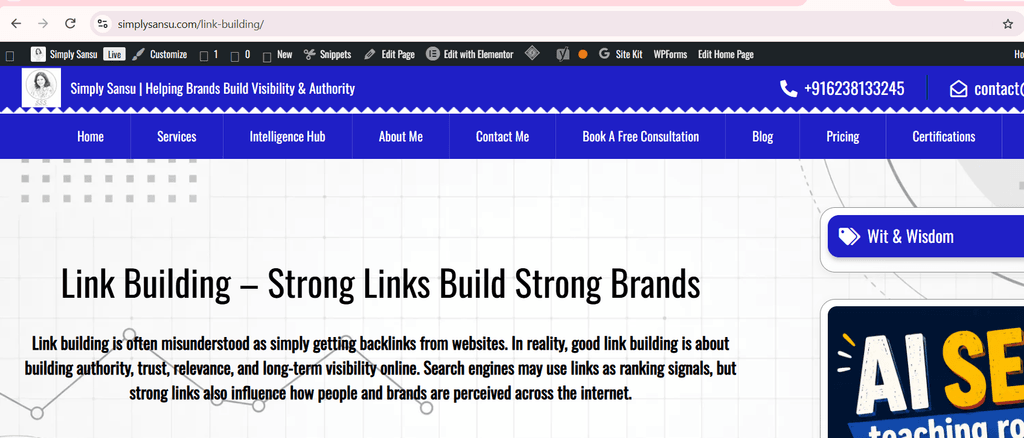
For example, a service page can use “Link Building” as its H1 while naturally targeting the commercial variation “link building services” elsewhere on the page, rather than forcing the longer phrase into the main heading. On my own Link Building page, the H1 is “Link Building,” while the SEO title is “Link Building Services | Simply Sansu.” The opening copy naturally introduces the service with a sentence such as: “Build a stronger backlink profile with strategic link building services designed to improve your website’s authority, visibility, and organic search performance.” From there, related terms such as strategic link building, white-hat link building, quality backlinks, backlink outreach, digital PR and link building, and link building campaigns can be incorporated naturally where they genuinely fit the content.
The goal is not to place every keyword variation in one paragraph. It is to build a page that clearly communicates the topic, service, and search intent while using relevant terminology naturally.
A Real Example From Simply Sansu
One of the easiest ways to understand this is to look at how I approach my own website. Example: Simply Sansu combines SEO, AI SEO, digital PR, link building, website optimization, and educational resources.
Simply Sansu covers several closely related areas:
SEO
technical SEO
AI SEO
digital PR
link building
website optimization
digital marketing
SEO resources and ebooks
These topics are related, but the search intent is not identical.Example: “digital PR strategy” and “digital PR services” belong to the same broad topic but represent different stages of the search journey.
For example:
Topic: AI SEO
Possible keywords:
AI SEO
what is AI SEO
AI SEO strategy
AI SEO services
AI search optimization
These should not necessarily become five pages targeting the same thing. Example: “what is AI SEO?” and “AI SEO services” can have separate pages because their intents are clearly different, while several closely related informational variations may belong on one comprehensive guide.
Instead, they can form a topic cluster. Example: An AI SEO hub could connect an educational guide, a technical article, and the AI SEO services page.
An educational article can answer:
What is AI SEO?
Example: A beginner-focused article can explain AI search, AI-generated answers, and how SEO is changing.
A service page can address:
AI SEO services
Example: The service page can explain how Simply Sansu can help businesses improve visibility across AI-driven search experiences.
Another article might explain:
How to optimize a website for AI search visibility
Example: This could focus specifically on technical and content considerations rather than selling a service.
The pages can then be connected through relevant internal links. Example: The educational article can link to the technical guide, which can then link to the AI SEO services page.
This creates a much more logical content architecture than simply publishing multiple articles because a keyword tool shows several variations. Example: Instead of creating six thin AI SEO articles, I can create a few comprehensive resources that each serve a distinct purpose.
Another Example: Technical SEO
Technical SEO is another good example from my own content strategy. Example: Technical SEO can cover indexing, sitemaps, canonical URLs, website performance, structured data, crawling, and other technical elements.
Suppose I want to create content around technical SEO.
I could target:
technical SEO
But that is extremely broad. Example: A person searching “technical SEO” could be looking for a definition, checklist, course, consultant, or advanced technical guide.
Instead, I can identify specific problems people encounter:
technical SEO checklist
technical SEO for WordPress
website indexing issues
sitemap SEO
canonical URLs
robots.txt SEO
Core Web Vitals
website speed optimization
These queries represent different problems. Example: Someone searching “website indexing issues” has a specific problem that can be addressed with troubleshooting content.
And problems create opportunities for useful content. Example: A guide explaining how to diagnose indexing problems can provide much more practical value than a generic definition of technical SEO.
For example, I have personally spent considerable time working through website performance issues, including caching, image optimization, WebP conversion, CSS optimization, font optimization, and Core Web Vitals. Example: My own website optimization work included improving image formats, reducing unnecessary plugins, and configuring caching and CSS-related settings.
That first-hand experience gives me something more valuable than simply rewriting a generic definition of website speed. Example: I can discuss what I changed, why I changed it, and what happened afterward.
I can explain what I actually tested, what changed, and what I learned.Example: Instead of simply saying “optimize images,” I can explain how converting large images to WebP affected my own website performance.
That is the type of experience I want to bring into my SEO content. Example: A technical SEO article becomes more useful when it combines established SEO principles with real implementation experience.
Long-Tail Does Not Mean “Low Value”
There is another misconception worth addressing. Example: Some marketers assume that keywords with lower search volume are automatically less important.
Many marketers assume:
High volume = valuable
and
Low volume = insignificant.
Example: A 10,000-search-volume keyword may attract a broad audience, while a 300-search-volume keyword may attract people specifically looking for a service you provide.
Imagine a keyword with 20,000 monthly searches where the intent is extremely broad. Example: “SEO” could attract beginners, agencies, students, software buyers, job seekers, and business owners.
Now imagine another keyword with 300 searches where the searcher is looking specifically for the service you provide. Example: “digital PR services for startups” may have less search volume but much clearer commercial relevance for the right provider.
The second keyword could be more commercially relevant to your business. Example: If your goal is generating digital PR leads, relevance may matter more than raw traffic.
This is why I look at keyword research through several filters:
Relevance + intent + competition + business value + ability to satisfy the query
rather than search volume alone. Example: A keyword may look attractive in Semrush, but if the search intent does not match your page, I would question whether it belongs in the strategy.
What About Low-Competition Keywords?
Low-competition keywords can be particularly useful for smaller websites. Example: A growing website may find it more practical to establish visibility around specific technical SEO or AI SEO topics before pursuing highly competitive head terms.
If your website does not yet have substantial authority, targeting highly competitive head terms across your entire strategy can be inefficient. Example: Trying to build an entire SEO strategy around “SEO” may be difficult for a relatively small website.
A more practical approach can be to identify narrower topics where:
You have genuine expertise.
The search intent is clear.
Your website can provide a better or more useful answer.
The topic supports your broader business goals.
You can build related content around it.
Example: I can build content around technical SEO, AI SEO, website performance, and digital PR because these subjects connect directly with my professional experience and Simply Sansu’s services.
This is one reason I prefer building topic depth rather than chasing whatever keyword happens to have the biggest search volume. Example: Several useful articles about technical SEO can establish stronger topical coverage than one generic article targeting “SEO.”
The Best Keyword Is Often the One You Can Actually Satisfy
This is an important distinction. Example: A keyword may have excellent search volume, but if your page cannot answer the underlying question properly, it may not be a sensible target.
Suppose I find a keyword with significant search volume. Example: I might discover a high-volume keyword such as “SEO tools.”
Before targeting it, I ask:
Can I create a page that genuinely deserves to rank for this query?
If the answer is no, the keyword may not be worth pursuing yet. Example: If I do not have a meaningful comparison of SEO tools, creating a thin article simply because the keyword has volume would not add much value.
For example, if someone searches:
“best enterprise SEO software”
and I do not sell or review enterprise SEO software, creating an article solely because the keyword has traffic potential would not make much sense. Example: A keyword related to AI SEO services or digital PR would align more naturally with my professional expertise.
But if someone searches:
“how to improve technical SEO on WordPress”
that is much closer to my expertise and the type of content I can support with practical experience. Example: My experience working with WordPress, technical SEO, website performance, sitemaps, indexing, and plugins gives me practical material for such a guide.
This is where keyword research and topical authority meet. Example: The strongest keyword opportunities for Simply Sansu are often topics where my professional experience gives me something meaningful to add.
Don’t Create a Separate Page for Every Keyword Variation
This is another mistake I see frequently. Example: A keyword tool may show dozens of variations around “AI SEO,” but that does not mean you need dozens of articles.
Suppose your keyword research produces:
AI SEO
AI SEO optimization
AI search optimization
AI search SEO
SEO for AI search
optimize for AI search
It can be tempting to create six articles. Example: A content calendar could easily turn these six variations into six separate titles.
I would not automatically do that. Example: First, I would compare the search intent and determine whether several of these queries can be addressed comprehensively on one page.
First, determine whether these queries represent the same underlying intent.Example: If several variations all ask how to optimize for AI search, one comprehensive guide may serve them better than multiple short articles.
If they do, one comprehensive page may be more useful than six thin pages competing with each other. Example: A detailed AI search optimization guide can naturally cover related terminology without creating keyword cannibalization risks unnecessarily.
Google’s guidance specifically says its language systems can understand how a page relates to many queries, even when the exact terms are not explicitly used. Example: A well-written article about AI search optimization does not need to repeat every possible variation of “AI SEO.”
That is one reason I would rather build one genuinely useful resource than create several pages that exist primarily to target keyword variations. Example: One authoritative technical SEO guide can be more useful than five short posts targeting nearly identical queries.
A Better Keyword Selection Framework
When I select keywords, I like to think about them using five questions. Example: I can apply the same five questions before deciding whether a keyword belongs on Simply Sansu.
1. Is it relevant?
Does the keyword relate directly to my website, audience, service, product, or expertise? Example: “digital PR strategy” is relevant to Simply Sansu, while “best running shoes” is not.
2. What is the intent?
Is the person:
learning?
researching?
comparing?
looking for a solution?
ready to buy?
looking for a specific website?
Example: “what is digital PR?” is learning intent, while “digital PR services” is commercial intent.
3. Can my page satisfy that intent?
This is critical. Example: If the query asks for a technical SEO checklist, the page should actually provide a usable checklist rather than a 500-word definition of technical SEO.
A keyword and a page should make sense together. Example: “AI SEO services” belongs naturally on a service page, while “what is AI SEO?” belongs naturally on an educational article.
4. Is there a business reason to target it?
Traffic is not the only objective. Example: An informational article may not directly sell anything, but it can introduce readers to my expertise and lead them toward related services.
A keyword may support:
brand awareness
lead generation
service discovery
product sales
topical authority
email signups
backlinks
internal linking
audience education
Example: A technical SEO guide could generate organic traffic, earn backlinks, strengthen topical authority, and internally link to a related service.
5. Do I have something original to contribute?
This is where first-hand experience becomes powerful. Example: My experience improving website speed gives me original observations that can strengthen an article about performance optimization.
If I have actually implemented a technical SEO change, tested website speed improvements, conducted digital PR outreach, or worked through an indexing problem, I can add observations that a generic AI-generated article cannot easily reproduce. Example: I can describe the actual optimization process I followed on Simply Sansu rather than simply listing generic PageSpeed recommendations.
My Keyword Strategy for Simply Sansu
If I were dividing my own keywords by the role they play, I would think about them roughly like this:
Content purpose
Example keyword
Example page/content
Broad topic
SEO
SEO hub/resource
Informational
what is AI SEO
Educational article
Problem-solving
technical SEO checklist
Detailed guide
Commercial
AI SEO services
Service page
Resource
website launch checklist
Checklist/ebook page
Experience-led
website speed optimization
Case study/article
Brand
Simply Sansu
Homepage/about content
Professional expertise
digital PR specialist
Service/expertise content
Notice that there is no single “best” keyword type here. Example: “what is AI SEO” can be valuable for education, while “AI SEO services” can serve a commercial purpose.
Each keyword has a job to perform.Example: One keyword may attract researchers, another may generate service inquiries, and another may help people discover a resource.
That is how I think keyword strategy should work. Example: Rather than building a keyword list first and forcing content around it, I start with the audience, intent, page purpose, and business objective.
Keywords Are Not the Whole SEO Strategy
There is one more point that is easy to forget. Example: A perfectly chosen keyword will not solve problems caused by poor indexing, weak internal linking, slow performance, or poor content.
SEO also involves:
crawlability
indexability
site architecture
internal linking
content quality
page experience
structured data where appropriate
mobile usability
performance
backlinks and mentions
brand visibility
satisfying search intent
Example: On Simply Sansu, improving SEO can involve working on technical issues, internal linking, structured data, page performance, content, and digital PR rather than simply adding keywords.
Google explicitly states that there is no secret that automatically makes a site rank first. Its SEO guidance focuses on helping search engines crawl, index, and understand content while creating useful content for people. Example: Adding a keyword repeatedly cannot compensate for a page that does not answer the searcher’s question.
Google also says there is no magical minimum or maximum content length for ranking. Example: A 1,000-word article can outperform a 3,000-word article if it answers the query more effectively.
So I would be equally cautious about another common SEO obsession:
“How many times should I use my keyword?”
The answer is not a fixed number. Example: If my target phrase is “technical SEO,” I would use it naturally in the title, introduction, headings, and relevant body copy rather than forcing it into every paragraph.
Use the terminology naturally where it helps explain the subject. Cover the topic properly. Use related concepts. Answer the questions your audience actually has. Example: An AI SEO article can naturally discuss AI search, search visibility, structured content, entities, and user intent without repeating “AI SEO” unnaturally.
Do not write for a keyword counter. Example: If removing three repetitions makes an article easier to read, remove them.
Write for the person behind the search. Example: Someone searching “how to fix website indexing issues” wants a practical solution, not a page where the phrase “website indexing issues” appears 30 times.
So, Which Keyword Type Is Best for SEO?
If I had to reduce the entire discussion to one sentence, it would be this:
The best keyword is not necessarily the keyword with the highest search volume. It is the keyword whose intent, relevance, business value, and content opportunity align with your website and your ability to provide the best answer.
Example: For Simply Sansu, “AI SEO services” may be appropriate for a service page, while “what is AI SEO?” may be more appropriate for an educational article.
For a new or growing website, that may often mean starting with specific long-tail and problem-focused queries. Example: A technical SEO checklist may be a more practical content opportunity than trying to rank immediately for “SEO.”
For an established brand, broader commercial and category-level keywords may become more important. Example: A recognized digital marketing brand may eventually target broader terms such as “digital marketing” alongside more specific queries.
For a service business, commercial intent can be particularly valuable. Example: “technical SEO services” has a different business value from “what is technical SEO?”
For a blog, informational keywords can help build topical depth and discoverability. Example: Articles answering questions such as “what is AI SEO?” can form part of a broader AI SEO content cluster.
For an ecommerce website, transactional queries may matter more. Example: “buy website SEO ebook” has a more direct action intent than “SEO tips for beginners.”
And for a personal brand like Simply Sansu, I believe there is another layer: your experience should influence your keyword strategy.Example: My first-hand experience with SEO, digital PR, WordPress, website performance, and AI SEO gives me specific subjects I can discuss with authority.
I don’t want Simply Sansu to rank simply because a page contains the phrase “technical SEO.” Example: I want a visitor landing on my technical SEO content to find practical information rather than keyword repetition.
I want someone searching for technical SEO to find a page that demonstrates that I actually understand the subject. Example: That means explaining technical issues using real implementation experience, examples, and practical recommendations.
That is a much stronger foundation for long-term SEO. Example: A page built around genuine expertise can support rankings, internal linking, backlinks, brand recognition, and future service discovery.
Final Takeaway
Stop asking:
“Which keyword has the highest search volume?”
Start asking:
“What is this person trying to accomplish, and can my website genuinely help them?”
Example: If someone searches “how to improve website speed,” the goal is probably not to read about keywords. They want practical ways to make their website faster.
Then choose the keyword that best represents that need. Example: A page about website speed optimization should target the relevant search intent rather than simply selecting the keyword with the largest volume.
Short-tail keywords have their place. Example: “SEO” can be useful as part of a broader topical strategy.
Long-tail keywords have their place. Example: “technical SEO checklist for WordPress” can address a much more specific need.
Informational, commercial, transactional, navigational, branded, and problem-focused keywords all have their place. Example: “what is AI SEO?” is informational, “AI SEO services” is commercial, and “Simply Sansu” is navigational or branded.
The best SEO strategy is not choosing one keyword type. It is knowing when to use each one.
And that is ultimately what good keyword research is about.
Not finding keywords.
Finding the right search opportunities.
Example: For Simply Sansu, the opportunity may be an informational AI SEO query today, a technical SEO problem tomorrow, and a commercial service query when the visitor is ready to hire an expert.
Ready to Find the Right Keywords?
The right keyword can bring the right audience to the right page. If you need help building a keyword strategy based on search intent, relevance, and business goals, explore my SEO services.
There is no single best keyword type. The right choice depends on search intent, relevance, competition, business value, and the purpose of the page.
Are long-tail keywords better for SEO?
Long-tail keywords can be useful because they often have more specific search intent, but they are not automatically better than short-tail keywords.
What are the main types of keywords in SEO?
Common categories include short-tail, long-tail, informational, commercial, transactional, navigational, and branded keywords.
Should I target high-volume keywords?
Search volume should not be the only consideration. A lower-volume keyword with strong relevance and clear intent can be more valuable to a business than a broad, high-volume keyword.
How do I choose the right SEO keywords?
Consider the searcher’s intent, relevance to your business, competition, potential business value, and whether your content can genuinely satisfy the query.
Contains information related to marketing campaigns of the user. These are shared with Google AdWords / Google Ads when the Google Ads and Google Analytics accounts are linked together.
90 days
__utma
ID used to identify users and sessions
2 years after last activity
__utmt
Used to monitor number of Google Analytics server requests
10 minutes
__utmb
Used to distinguish new sessions and visits. This cookie is set when the GA.js javascript library is loaded and there is no existing __utmb cookie. The cookie is updated every time data is sent to the Google Analytics server.
30 minutes after last activity
__utmc
Used only with old Urchin versions of Google Analytics and not with GA.js. Was used to distinguish between new sessions and visits at the end of a session.
End of session (browser)
__utmz
Contains information about the traffic source or campaign that directed user to the website. The cookie is set when the GA.js javascript is loaded and updated when data is sent to the Google Anaytics server
6 months after last activity
__utmv
Contains custom information set by the web developer via the _setCustomVar method in Google Analytics. This cookie is updated every time new data is sent to the Google Analytics server.
2 years after last activity
__utmx
Used to determine whether a user is included in an A / B or Multivariate test.
18 months
_ga
ID used to identify users
2 years
_gali
Used by Google Analytics to determine which links on a page are being clicked
30 seconds
_ga_
ID used to identify users
2 years
_gid
ID used to identify users for 24 hours after last activity
24 hours
_gat
Used to monitor number of Google Analytics server requests when using Google Tag Manager
1 minute
Google reCAPTCHA helps protect websites from spam and abuse by verifying user interactions through challenges.
Name
Description
Duration
_GRECAPTCHA
Google reCAPTCHA sets a necessary cookie (_GRECAPTCHA) when executed for the purpose of providing its risk analysis.
179 days
Marketing cookies are used to follow visitors to websites. The intention is to show ads that are relevant and engaging to the individual user.
Name
Description
Duration
sbjs_udata
Session
sbjs_session
30 minutes
sbjs_migrations
Helps SourceBuster handle changes or migrations between versions of its tracking/attribution system.
Session
sbjs_first_add
Stores additional first-visit/source attribution information
Session
sbjs_first
Records the visitor's first traffic source for attribution
Session
sbjs_current_add
Traffic-source/visit attribution
Session
sbjs_current
Tracks the visitor's current traffic/source information, such as where the visit originated.