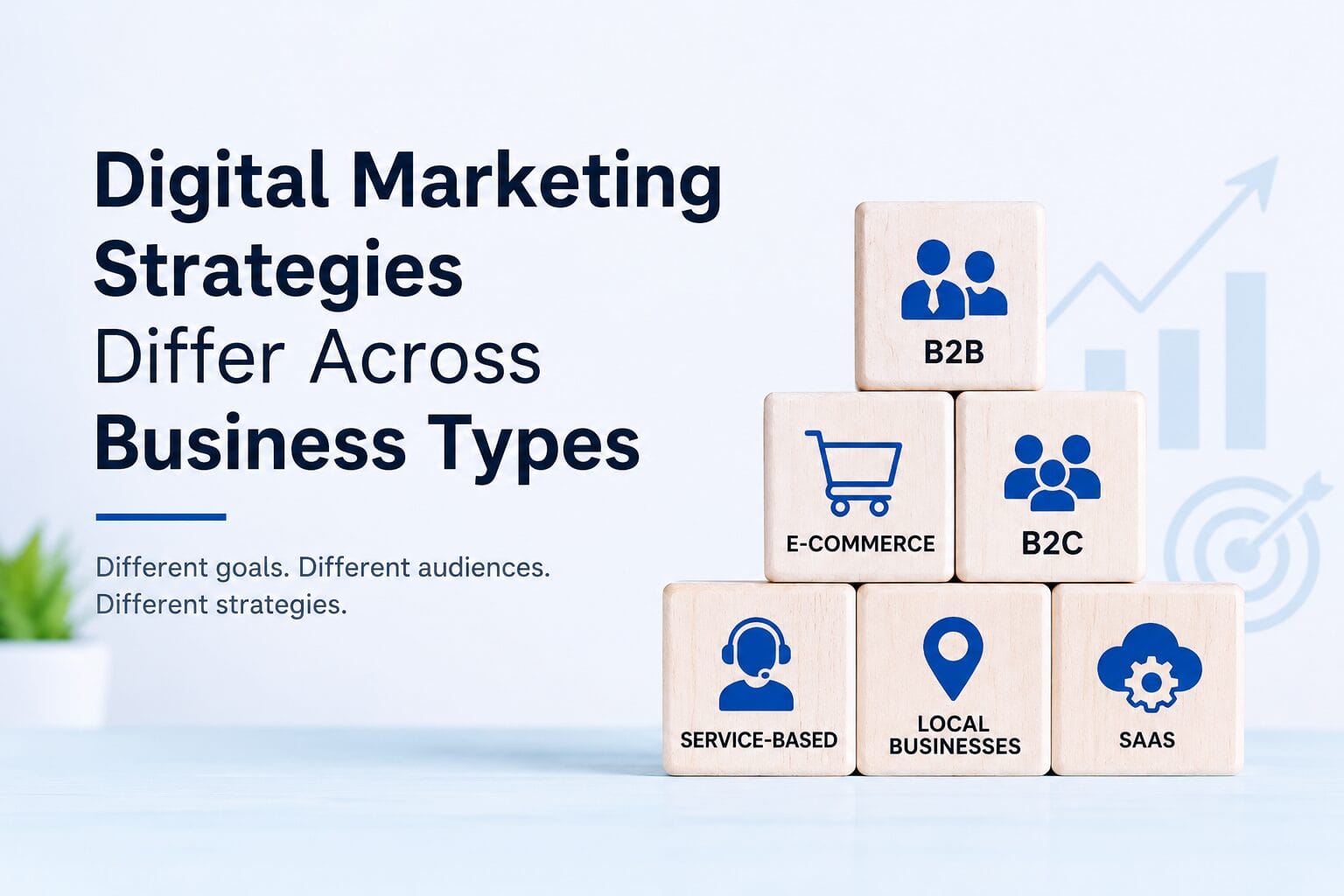
Why Digital Marketing Strategies Differ Across Business Types
A Guide to B2B, B2C, Ecommerce, SaaS, Service & Local Businesses
One of the biggest misconceptions about digital marketing is that the same strategy works for every business.
It doesn’t.
Over the years, I’ve worked with businesses across different industries, and one thing has become very clear: while the principles of digital marketing remain the same, the strategy and execution vary significantly depending on the business model, target audience, and buying journey.
Before choosing marketing channels, creating content, or investing in SEO, it’s important to understand what type of business you’re marketing.
What Happens When You Apply the Wrong Strategy?
Choosing the wrong digital marketing strategy doesn’t necessarily mean your marketing will fail—but it often means you’ll spend more time and money with fewer results. Here are a few practical examples.
B2B Business Using an Ecommerce Strategy
Imagine a cybersecurity company filling its website with “Buy Now” buttons and limited-time discounts.
Most business buyers aren’t ready to purchase immediately. They first want to understand your expertise, compare solutions, read case studies, and speak with your team. Without educational content and trust-building, they’re likely to leave.
B2C Business Using a B2B Strategy
Now imagine a clothing brand publishing lengthy white papers and technical industry reports.
While the content may be informative, most shoppers are looking for style inspiration, customer reviews, attractive visuals, and a seamless shopping experience. The strategy misses what the audience actually wants.
Ecommerce Business Using a Service-Based Strategy
Consider an online electronics store that focuses heavily on company history, founder stories, and long-form educational articles but neglects product descriptions, reviews, pricing, and checkout optimization.
Visitors may appreciate the content, but if buying becomes difficult, they’ll simply purchase from a competitor.
Service-Based Business Using an Ecommerce Strategy
Imagine a law firm or SEO agency whose website focuses only on pricing and “Buy Now” buttons.
Professional services are built on trust. Potential clients want to know your experience, read testimonials, explore case studies, and understand how you solve their problems before making contact.
Local Business Using a National Marketing Strategy
A neighborhood restaurant invests heavily in broad national SEO but ignores its Google Business Profile, local keywords, and customer reviews.
Even with increased website traffic, the people most likely to visit the restaurant may never find it in local search results.
SaaS Business Using a Traditional Product Marketing Strategy
Imagine a project management software company relying only on advertisements without offering product demonstrations, tutorials, onboarding resources, or a knowledge base.
Software adoption depends on helping users understand the product and experience its value. Without ongoing education and support, acquiring new users becomes far more difficult and retaining them even harder.
The lesson is simple: A strategy that delivers outstanding results for one business model may produce disappointing outcomes for another. The most effective digital marketing strategies are built around the way your customers research, evaluate, and make purchasing decisions—not around what worked for a different type of business.
Understanding Different Business Types
B2B Businesses: Build Trust Before You Sell
B2B buyers rarely make impulsive decisions. They research extensively, compare vendors, and often involve multiple stakeholders before making a purchase. The most effective strategy is to educate rather than aggressively sell.
Best-performing strategies
- Thought leadership content
- Case studies
- Educational blogs
- Webinars
- LinkedIn marketing
- Email nurturing
Supporting statistic
According to the Content Marketing Institute, 87% of B2B marketers say content marketing successfully created brand awareness, while 74% say it generated demand and leads. Videos, case studies, and webinars continue to be among the most effective content formats.
B2C Businesses: Create Emotional Connections
Unlike B2B, B2C purchasing decisions are often driven by emotion, convenience, and immediate needs. Customers want engaging experiences that quickly demonstrate value.
Best-performing strategies
- Storytelling
- Social media marketing
- Influencer collaborations
- Short-form videos
- Personalized offers
- Customer reviews
Rather than lengthy technical content, B2C marketing succeeds by creating memorable experiences and encouraging quick purchasing decisions.
Ecommerce Businesses: Remove Every Barrier to Purchase
An ecommerce visitor already has buying intent. Your job is to make purchasing as easy and trustworthy as possible.
Best-performing strategies
- Product page optimization
- Product SEO
- High-quality product images
- Customer reviews
- Fast page speed
- Simplified checkout
- Email remarketing
Every additional click or unnecessary step increases the likelihood of cart abandonment. Successful ecommerce businesses continuously optimize the customer journey from product discovery to checkout.
Service-Based Businesses: Sell Expertise Before Services
When people hire a service provider, they’re buying confidence as much as the service itself.
Whether you’re a lawyer, accountant, architect, consultant, or digital marketer, your expertise is your product.
Best-performing strategies
- Educational blogs
- Case studies
- Testimonials
- Personal branding
- Digital PR
- Speaking engagements
- Thought leadership
Demonstrating knowledge consistently often becomes the deciding factor when potential clients compare multiple providers.
Local Businesses: Become the Most Visible Business Nearby
Local businesses don’t need worldwide visibility. They need to be found by customers in their service area.
Best-performing strategies
- Google Business Profile optimization
- Local SEO
- Customer reviews
- Local citations
- Location-specific landing pages
- Community engagement
BrightLocal’s 2025 SMB Marketing Report found that businesses planning to invest more in marketing continue to prioritize SEO, local SEO, paid search, and community engagement, highlighting the importance of local visibility for growth.
SaaS Businesses: Educate, Demonstrate, and Retain
SaaS companies sell subscriptions rather than one-time purchases. Marketing therefore extends well beyond customer acquisition.
Best-performing strategies
- Product demonstrations
- Free trials
- Knowledge bases
- Product-led content
- Email onboarding
- Webinars
- Customer success programs
The objective isn’t simply generating sign-ups but helping customers experience value quickly and remain subscribers over time.
Final Thoughts
The tools may be the same—SEO, content marketing, email marketing, social media marketing, analytics—but the strategy should always reflect the business model.
A successful B2B campaign may fail completely for an ecommerce brand. Likewise, what works for a local business may have little impact on a SaaS company.
The best digital marketing strategy doesn’t begin with choosing channels or creating content. It begins with understanding who you’re trying to reach, how they make decisions, and what influences their buying journey.