
I Thought Someone Had Read My Blog. I Was Wrong.
A few days ago, I received what looked like one of the most insightful comments I’ve ever seen on my blog post, “Build Your First AI Keyword Tracker with Python.”
Article: https://simplysansu.com/build-ai-keyword-tracker-python-openai/
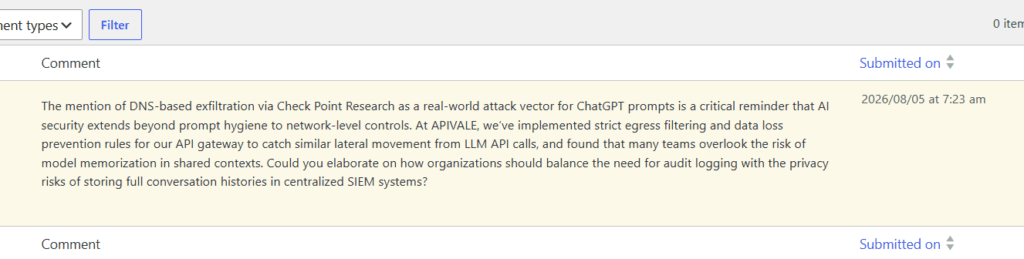
The comment read:
“The mention of DNS-based exfiltration via Check Point Research as a real-world attack vector for ChatGPT prompts is a critical reminder that AI security extends beyond prompt hygiene to network-level controls. At xxxxx, we’ve implemented strict egress filtering and data loss prevention rules for our API gateway to catch similar lateral movement from LLM API calls, and found that many teams overlook the risk of model memorization in shared contexts. Could you elaborate on how organizations should balance the need for audit logging with the privacy risks of storing full conversation histories in centralized SIEM systems?”
At first glance, it sounded genuine.
It referenced cybersecurity research, discussed AI security, and ended with what appeared to be a thoughtful question.
“Could you elaborate on how organizations should balance the need for audit logging with the privacy risks of storing full conversation histories in centralized SIEM systems?”
That’s what caught my attention.
A question usually suggests the reader has read your article, reflected on it, and wants to continue the discussion. As bloggers, that’s exactly the kind of engagement we hope for.
But when I read the comment carefully, I realized something was wrong.
My article wasn’t about AI security. It was about building a simple AI keyword tracker using Python and the OpenAI API. It never mentioned DNS-based exfiltration, Check Point Research, SIEM systems, audit logging, or enterprise security.
The comment wasn’t responding to my article. It was simply using an intelligent question to create the impression of genuine engagement.
In Most Cases, This Would Be Genuine Engagement
One part of the comment immediately caught my attention:
“Could you elaborate on how organizations should balance the need for audit logging with the privacy risks of storing full conversation histories in centralized SIEM systems?”
Normally, a question like this is a positive sign. It suggests the reader has read your article, reflected on it, and wants to continue the discussion.
But there was one problem.
My article wasn’t about AI security. It was about building an AI keyword tracker using Python and the OpenAI API. It never mentioned DNS-based exfiltration, Check Point Research, SIEM systems, or audit logging.
The question sounded intelligent, but it had nothing to do with my article. It was simply creating the impression of genuine engagement.
Why Blogs Still Matter
In an era dominated by AI search, short-form videos, and social media updates, some people question whether blogging is still relevant.
I believe it is.
A blog gives you the space to explain ideas in depth, share experiences, educate readers, and establish credibility in a way that a 30-second video or a social media post simply cannot.
Unlike a social post that disappears from people’s feeds within hours, a blog can continue attracting readers for months or even years.
For businesses, blogs demonstrate expertise.
For professionals, they build authority.
For readers, they provide detailed answers that solve real problems.
But one of the greatest strengths of a blog is that it creates opportunities for conversation.
The best blogs don’t just inform.
They invite readers to participate.
What Makes a Blog Engaging?
Publishing a blog is easy.
Creating one that people genuinely want to read—and respond to—is much harder.
An engaging blog isn’t necessarily the longest article or the one with the most keywords.
Instead, it’s the one that resonates with readers.
In my experience, engaging blogs usually have a few things in common.
They solve a real problem rather than repeating information that’s already available everywhere.
They include personal experiences instead of generic advice.
They use practical examples to explain concepts.
They express an opinion instead of simply summarizing what others have written.
And perhaps most importantly, they encourage readers to think, question, and respond.
Some of my most meaningful conversations with readers have started because I shared something I personally experienced rather than something I researched.
People connect with authenticity.
That’s what turns an article into a conversation.
What Real Engagement Looks Like
Many bloggers measure engagement by the number of comments their posts receive.
I think that’s only part of the story.
Real engagement isn’t about quantity.
It’s about quality.
A genuinely engaged reader might ask a question about something you’ve explained.
They may share their own experience.
They might respectfully disagree with your opinion.
Sometimes they’ll add information that makes the article even more valuable for future readers.
Those are the kinds of comments that enrich a blog.
They show that someone has actually read the article, reflected on it, and felt compelled to contribute to the discussion.
That’s far more valuable than collecting dozens of comments that add little or no value.
Not Every Comment Is Genuine
The comment I received on my AI Keyword Tracker article reminded me that not every intelligent-looking comment comes from someone who has actually read your blog.
Today’s spam comments are very different from the obvious spam many of us remember.
They’re no longer limited to comments like “Great post!” or “Thanks for sharing.”
With AI, spam comments can now be detailed, technically accurate, grammatically perfect, and surprisingly convincing.
But they often reveal themselves in one important way.
They don’t relate to the article.
My blog never discussed cybersecurity, enterprise AI security, or SIEM systems.
Yet that’s exactly what the comment focused on.
It wasn’t continuing the conversation.
It was creating a completely different one.
That’s a strong sign that the purpose of the comment wasn’t to engage with my content but to gain visibility through a backlink.
How I Sift Genuine Comments from Spam
Receiving that comment prompted me to become more deliberate about moderating my blog.
Now, before approving any comment, I ask myself a few simple questions.
Does the comment refer to something I actually discussed?
A genuine reader usually references a specific point, example, or argument from the article.
Does it continue the conversation?
Good comments build upon the discussion instead of taking it in an unrelated direction.
Would another reader benefit from seeing this comment?
If the answer is yes, it’s probably worth approving.
Is the comment subtly promoting a business or website?
Sophisticated spam often disguises promotion as conversation.
Would I still approve this comment if the website link were removed?
This has become my simplest test.
If the answer is no, the comment probably exists for promotional purposes rather than meaningful engagement.
Quality Conversations Matter More Than Comment Counts
As bloggers, it’s exciting to receive notifications that someone has commented on our work.
But I’ve learned that not every comment deserves approval.
More importantly, I’ve learned that the goal isn’t to collect as many comments as possible.
The goal is to create content that inspires genuine conversations.
I’d rather have five thoughtful comments from readers who truly engaged with my article than fifty polished comments that exist only to leave a backlink.
Creating engaging blog posts is about more than attracting traffic.
It’s about sharing experiences, solving problems, encouraging discussion, and building trust with your audience.
And as AI-generated spam becomes increasingly sophisticated, one skill will become just as important as writing itself:
The ability to recognize the difference between a reader who wants to contribute to the conversation and one who simply wants to be seen.
Because in the end, a successful blog isn’t measured by the number of comments it receives.
It’s measured by the value of the conversations it creates.
How I Deal with Spam Comments
I’ve come to accept that spam comments are part of running a blog. As your content reaches more people, it’s only natural that you’ll receive comments that aren’t from genuine readers.
What has changed for me is how I moderate them.
I no longer approve a comment just because it’s well written. Instead, I ask myself one simple question: Did this person actually read my article?
If the comment refers to something I’ve discussed, asks a relevant question, or shares a personal experience, I approve it and take the time to reply. Blogging shouldn’t be a one-way conversation, and genuine readers deserve a response.
If the comment is irrelevant but doesn’t appear malicious, I simply move it to the trash.
If it talks about topics I’ve never mentioned, feels promotional, or seems written just to leave a backlink, I mark it as spam. I also make it a habit to visit the commenter’s website. Sometimes a quick look is all it takes to understand the real intent behind the comment.
At the end of the day, I’d rather have a handful of meaningful conversations than dozens of comments that add little value. A clean, relevant comment section benefits not just the blogger, but every reader who visits the page.
Look for Patterns, Not Just Individual Comments
One suspicious comment doesn’t always mean it’s spam. But when you start noticing patterns, it’s worth paying closer attention.
Here are a few red flags I look for:
- Comments that don’t relate to the article. They sound intelligent but discuss topics you’ve never mentioned.
- Generic praise followed by a technical question. This is a common tactic to make the comment appear genuine.
- Repeated promotional links. Different comments pointing to the same website or company.
- Multiple comments with a similar writing style. Different names, but the same structure, tone, or wording.
- Unrelated websites. The commenter’s website has no connection to your niche or the topic of your article.
- A sudden spike in similar comments. If several comments arrive within a short period and follow the same pattern, they’re likely automated or AI-generated.
- Suspicious backlink activity. If you notice your content being referenced by dozens of unrelated, low-quality websites—as I once did when one of my articles appeared on 59 websites—it may be part of a broader spam pattern rather than genuine engagement.
Looking at a single comment in isolation can be misleading. Looking for patterns over time makes it much easier to distinguish genuine readers from sophisticated spam.
Can Spam Comments Harm Your Website?
While a few spam comments won’t directly affect your search rankings, ignoring them over time can create other problems.
- They reduce trust. Visitors who see irrelevant or promotional comments may question the credibility of your content.
- They discourage genuine discussion. Real readers are less likely to participate when the comment section is cluttered with spam.
- They damage the user experience. A page filled with unrelated comments distracts from the article and makes discussions harder to follow.
- They increase moderation work. The longer spam is left unattended, the more difficult it becomes to manage your comment section.
- They may attract more spam. Spammers often target websites where irrelevant comments are consistently approved.
The good news is that this is easy to prevent. Reviewing comments regularly and approving only those that genuinely contribute to the discussion helps keep your blog trustworthy, professional, and valuable for your readers.