By Callum Gracie, Founder, Otto Media
Last month a client told me she wanted to quit traditional SEO for good. ChatGPT answered her customers’ questions now, she said, so why fight for rankings? I understood the fear. Then I showed her where those AI answers come from.
They come from the same pages that rank in organic search. Once she saw that, her panic turned into a plan.
I have spent years helping service businesses get found online. The tools changed fast. The foundation did not. If anything, AI search made that foundation matter more. Here is what I learned watching this shift up close.
Where AI Answers Actually Come From
Pull back the curtain on any AI search tool and you find the open web. ChatGPT, Perplexity, and Google’s AI Overviews do not invent answers from thin air. They retrieve live pages, then summarise them. So the question stays simple. Is your page one of the pages they retrieve?
The data says rankings decide that. BrightEdge tracked AI Overviews for sixteen months and watched citation overlap with organic rankings climb past 54 percent. Perplexity cites top-ten results around 91 percent of the time. One study of 432,000 keywords found that 97 percent of AI Overviews quote at least one source from the top twenty results.
Read that again. If you are not in the index, you are not in the answer. SEO is what puts you in the index and pushes you up it. That has not changed at all.
The Numbers That Should Keep You Calm
Panic spreads faster than facts, so let me share the facts. Google still holds more than 90 percent of the global search market. People run roughly 14 billion Google searches every day. By contrast, AI-native tools handle under 5 percent of search volume combined. The giant did not leave the room.
That said, I will not pretend nothing shifted. Zero-click searches hit 68 percent in early 2026, and click-through rates fall when an AI Overview sits at the top. Fewer clicks reach the open web than before. Anyone who tells you otherwise is selling something.
Here is the reframe I give clients. SEO used to buy you clicks. Now it also buys you visibility inside the answer itself. Brands cited inside an AI Overview earn 35 percent more organic clicks than brands left out. So getting cited is the new front page. You earn that citation with the same work that earns rankings.
The Fundamentals AI Quietly Rewards
When I audit a client’s site, I start where I always have. Can search engines crawl it? Is it indexed? Does it load fast on a phone? These checks matter more now, because most AI crawlers read raw HTML and skip heavy JavaScript. So a flashy site that buries its content behind scripts can vanish from AI answers. Check your robots file too. Plenty of sites block GPTBot or PerplexityBot by accident, then wonder where their visibility went.
Content fundamentals carry even more weight. Google’s December 2025 update hammered mass-produced AI content and rewarded genuine expertise. First-hand experience wins, because a model cannot fake the thing you lived through. So write what you know, cover your topic in depth, and put your clearest answer near the top. Nearly half of all AI citations come from the first slice of a page.
None of this is new SEO. It is good SEO, applied to a bigger stage.
What I Tell Every Client Now
Start with the boring technical work, because nothing else functions without it. Get crawlable, get indexed, and stop blocking the bots you want to reach. Then chase real rankings, since top-ten positions still feed most AI citations.
After that, build your name. Brand mentions now correlate with AI visibility roughly three times more strongly than backlinks do. So get quoted, get reviewed, and show up where your audience already talks, whether that means YouTube, a podcast, or an industry forum. Add proof to your pages as well. Cite sources, quote experts, and include real numbers. Research on AI search shows that habit can lift your visibility by up to 40 percent.
Do not abandon the channels AI barely touches. Local search still rewards a solid Google Business Profile, strong reviews, and consistent details. Branded searches still send buyers straight to you. These are quiet wins, and they hold steady while everyone else chases the shiny new thing.
Finally, change how you measure success. Traffic alone is a poor goal in a zero-click world. Track citations, branded searches, and conversions instead, because those tie to revenue.
The Real Takeaway
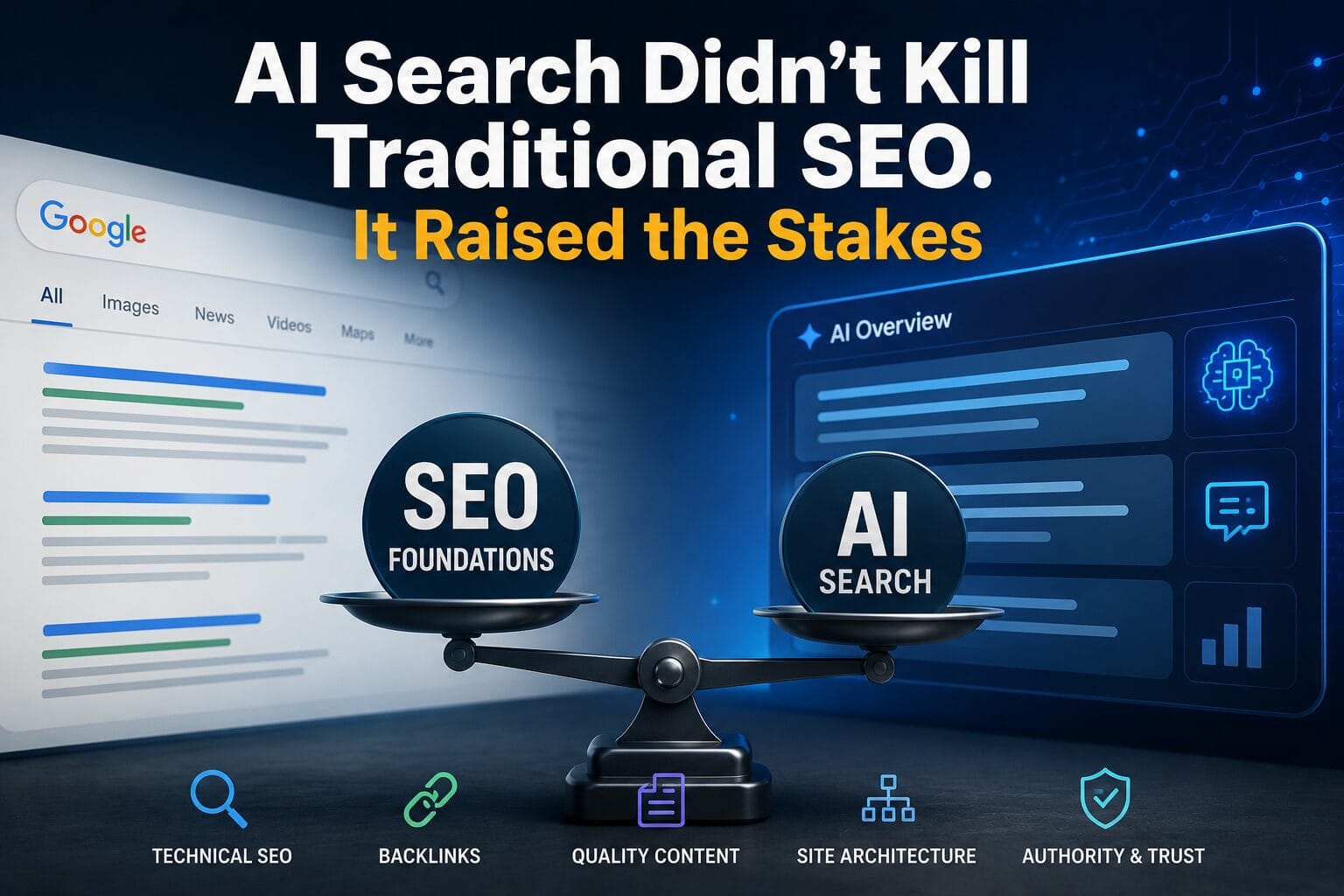
Traditional SEO is not dying. It is getting re-priced. It used to be a traffic faucet. Now it is the price of admission to AI visibility, and the businesses that treat it that way will own the answers their customers see.
So do not rip out your foundation to chase a trend. Build on it. Good SEO was always good marketing, and that has never been more true than today.
Author bio: Callum Gracie is the founder of Otto Media, a Canberra-based SEO and content agency that helps service businesses get found online. A former teacher, musician, and DJ, he now builds GiaAI, a lead-generation platform for service businesses. Callum writes about the practical side of SEO, GEO, and AI search, drawing on years of testing what works for real businesses rather than chasing trends. He is happiest translating complex search shifts into plain language that owners can act on tomorrow.
Related Reading: