
Hashtags in Social Media: Why They Matter and How I Manage Them
Share this article:
Hashtags may look like a small part of a social media post, but when you’re managing content consistently, they can play an important role in making your posts easier to discover and organize.
Over time, I’ve found that the challenge isn’t just finding hashtags. It’s maintaining relevant hashtags for different types of content without spending too much time on it.
That’s why I maintain hashtag groups.
What Are Hashtags?
A hashtag is a word or phrase preceded by the # symbol, such as #DigitalMarketing, #SEO, #ContentMarketing or #SocialMediaMarketing.
They help categorize content around specific topics and can make it easier for people interested in those topics to discover relevant posts.
But hashtags shouldn’t be treated as a magic formula for increasing reach.
The most important thing is relevance. The hashtags should reflect what your content is actually about and the audience you want to reach.
Why Are Hashtags Important?
Hashtags can help your content become part of a larger conversation.
For example, if I’m sharing a post about SEO, using relevant hashtags such as #SEO, #AEO, #GEO and #SearchMarketing helps signal the topic of the post.
They can also help businesses build consistency around particular content themes.
But I don’t believe that using more hashtags automatically means getting more visibility.
The right hashtags matter more than the maximum number of hashtags.
Why I Maintain Hashtag Groups
If you create social media content regularly, you quickly realize how many small repetitive tasks are involved.
Choosing hashtags is one of them.
Instead of starting from scratch for every post, I maintain different hashtag groups based on the subjects I regularly write about.
For example:
Digital Marketing:
#DigitalMarketing #MarketingStrategy #ContentMarketing #DigitalStrategy
SEO:
#SEO #SEOTips #AEO #GEO #SearchMarketing
Digital PR:
#DigitalPR #PublicRelations #PRStrategy #MediaRelations
AI & Marketing:
#AI #AISEO #AISearch #AIMarketing #GenerativeAI
These groups give me a starting point whenever I create a post.
I don’t necessarily use every hashtag from a group. I review them and select the ones that are most relevant to the particular post.
For a fashion client, I’d create a dedicated hashtag group that combines broad fashion discovery terms with more specific styling, apparel, and brand-related hashtags. This makes it easier to reuse a relevant set while still adjusting a few hashtags based on each post.
Hashtag Group Name:
Fashion & StyleHashtags:
#Fashion #FashionStyle #FashionTrends #StyleInspiration #FashionInspiration #OOTD #OutfitInspiration #StyleGuide #WomensFashion #MensFashion #FashionBrand #Apparel #ContemporaryFashion #EverydayStyle #PersonalStyle
How Hashtag Groups Save Me Time
The biggest advantage of maintaining groups is not having to repeat the same research and typing every time I publish something.
Without hashtag groups, I would have to remember which hashtags I used, search for them again, or copy them from previous posts.
With groups, I already have a structured collection ready to choose from.
I also use Publer’s hashtag group feature as part of my scheduling workflow. I can select the relevant group when preparing a post instead of manually entering the hashtags each time.
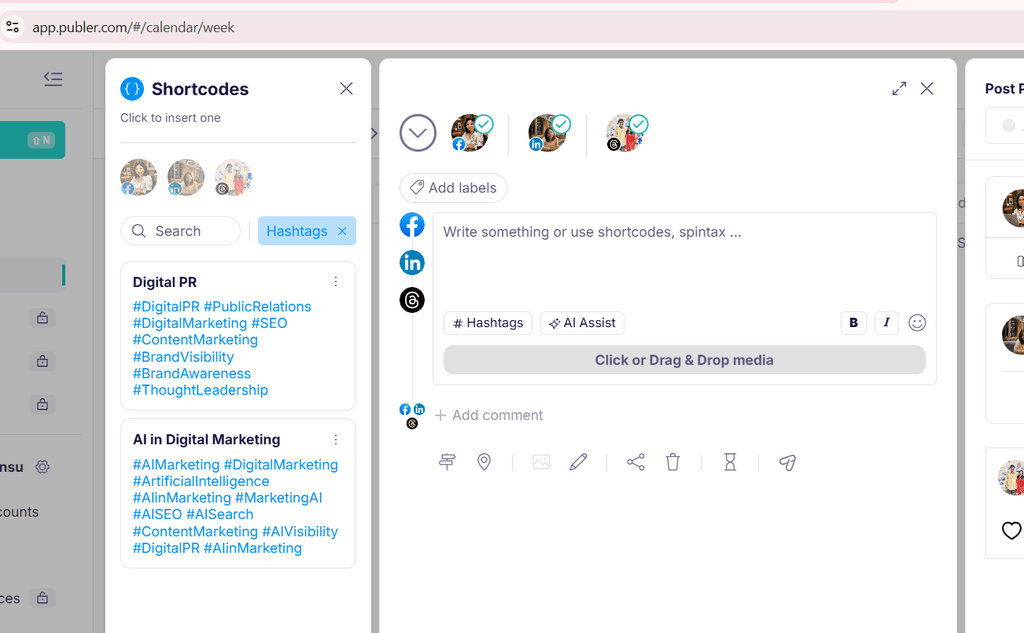
It’s a small productivity improvement, but when you’re publishing regularly, small improvements add up.
Don’t Use the Same Hashtags for Everything
One mistake I try to avoid is using the same hashtag set for every post.
If I’m talking about AI SEO, there’s little reason to use a hashtag set designed for a PR-related post.
Different content attracts different audiences, so my hashtag groups reflect the different subjects I cover.
This also makes me review my hashtag choices regularly. Some hashtags may become less relevant, while new topics and conversations emerge.
Hashtag Groups Are a Starting Point, Not a Shortcut to Strategy
Having saved hashtag groups doesn’t mean I blindly add them to every post.
Before publishing, I ask:
- Does this hashtag relate to the content?
- Is it relevant to the audience I’m trying to reach?
- Am I using too many broad hashtags?
- Would a more specific hashtag describe the topic better?
The tool can save time, but strategy still requires human judgment.
My Simple Approach
My approach to hashtags is quite simple:
Create relevant groups → Organize them by topic → Review them regularly → Select hashtags based on the individual post.
This keeps the process efficient without making it mechanical.
For me, hashtags aren’t about chasing reach at any cost. They’re one part of making content easier to categorize, discover, and connect with the right audience.
And by maintaining hashtag groups, I can spend less time repeating the same task and more time focusing on the content itself.