7 AI Visibility Tools to Track Your Brand in AI Search
SEO is no longer only about where your website ranks on Google.
People are increasingly asking ChatGPT, Gemini, Perplexity, and other AI platforms for recommendations, comparisons, and answers. So I have started looking at another question:
Does AI actually mention my brand?
That is what AI search visibility tools help you measure.
They can show whether your brand appears in AI-generated answers, how often it is mentioned, which pages are cited, which competitors appear instead, and sometimes how your brand is described.
Here are the tools I would consider.
1. Ahrefs Brand Radar
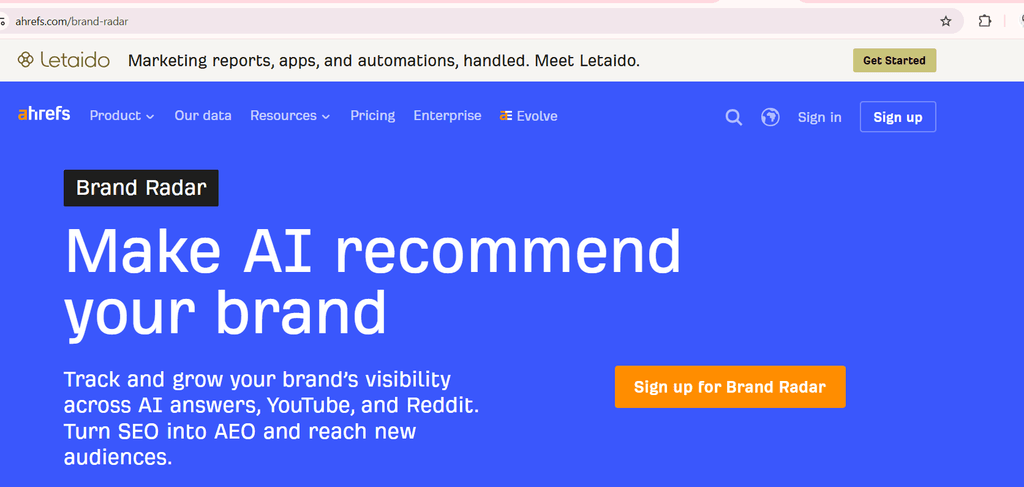
If you already work with SEO, Ahrefs Brand Radar is probably the first tool I would look at.
It tracks brand visibility across Google AI Overviews, Google AI Mode, ChatGPT, Perplexity, Gemini, and Microsoft Copilot. It can show mentions, citations, competitors, and other AI visibility data.
The feature I find particularly useful is Custom Prompts.
You can enter questions that your potential customers might actually ask and monitor how AI responds. You can also choose the AI platforms, location, and refresh frequency.
For example, I could track questions such as:
- Who are the best SEO consultants for small businesses?
- How can a business improve AI search visibility?
- What are the best Digital PR strategies for SEO?
- Who provides SEO and Digital PR services?
This is much more useful to me than simply checking whether someone mentioned “Simply Sansu” somewhere.
Ahrefs Brand Radar has three main options:
- All Platforms: $699/month, covering all AI platforms, 476M+ organic prompts, and 2,500 tracked-prompt checks per month.
- Individual Platforms: $199/month per platform, including ChatGPT, Gemini, Perplexity, Google AI Overviews & AI Mode, or Microsoft Copilot.
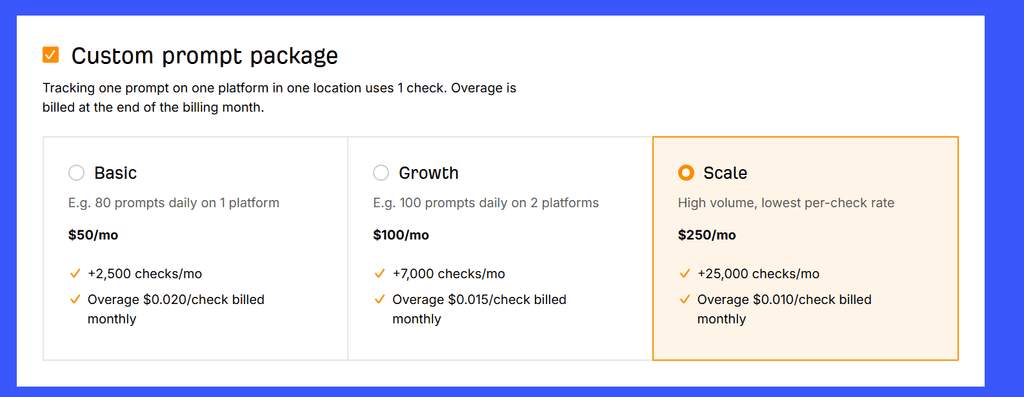
- Custom Prompts: Starts at $50/month for 2,500 checks. Higher plans offer 7,000 checks for $100/month or 25,000 checks for $250/month.
2. Semrush AI Visibility Toolkit
If you already use Semrush, its AI Visibility Toolkit is another strong option.
It provides an AI Visibility score from 0 to 100, along with metrics such as mentions, cited pages, citations, and competitor visibility. It also shows which AI models are mentioning your brand.
One feature I particularly like is the ability to identify visibility gaps.
For example, if competitors are appearing for a particular topic or prompt and Simply Sansu is not, that gives me something concrete to investigate.
Instead of asking, “How do I improve AI visibility?” I can ask:
“Why is my competitor appearing for this topic and I am not?”
That is a much better starting point for an SEO strategy.
Semrush AI Visibility Toolkit Pricing
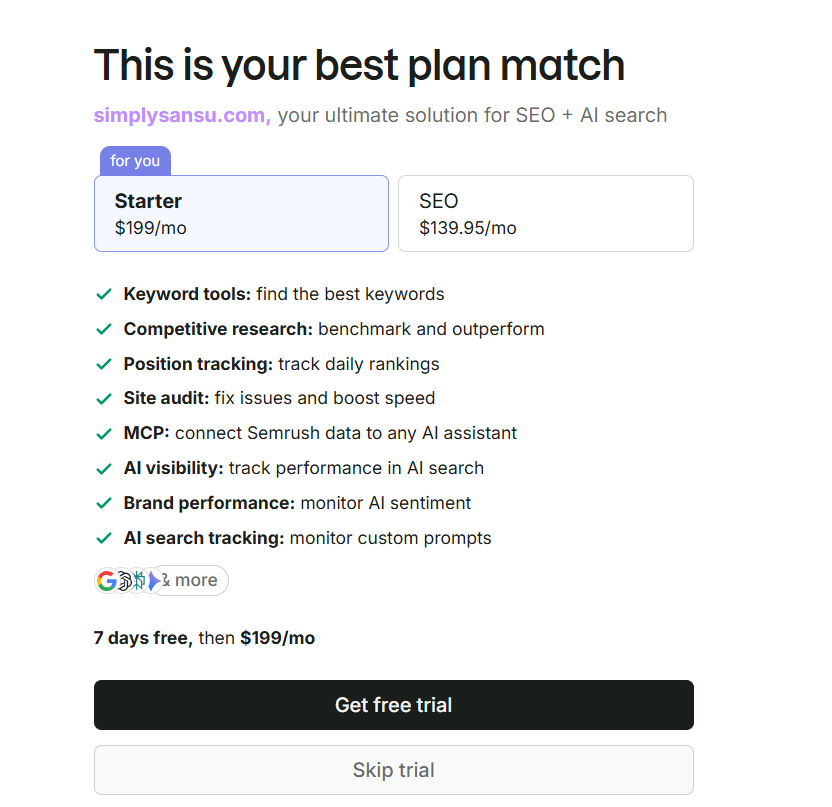
The recommended plan includes SEO, competitive research, rank tracking, site audits, and AI search visibility tracking across platforms such as Google AI Overviews, ChatGPT, Perplexity, and Gemini. It costs $199/month after a 7-day free trial.
3. OtterlyAI
OtterlyAI is another tool focused specifically on AI search monitoring. OtterlyAI, a 2025 Gartner Cool Vendor for AI in Marketing, is an AI search monitoring and optimization platform
It tracks AI-generated answers and measures things such as brand mentions, citations, sentiment, share of voice, and competitor performance. Its current AI Search Analytics covers ChatGPT, Perplexity, Google AI Overviews, Google AI Mode, Gemini, Copilot, and Claude.
I like the fact that it looks beyond simply counting mentions.
For example, you can see which pages are being cited and whether your competitors are being cited instead.
That can help connect AI visibility with your actual website content.
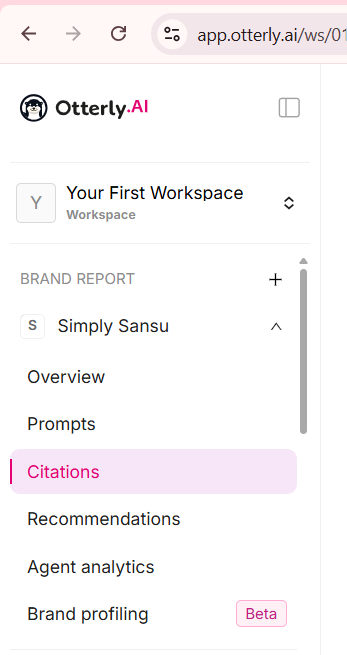
OtterlyAI offers a 7-day free trial with 50 search prompts, allowing you to test its AI visibility tracking before moving to a paid plan. Its paid Lite plan starts at $29/month.
Free AI visibility tools
You don’t necessarily need to subscribe to an expensive platform just to find out where your brand currently stands.
Ahrefs Free AI Visibility Checker
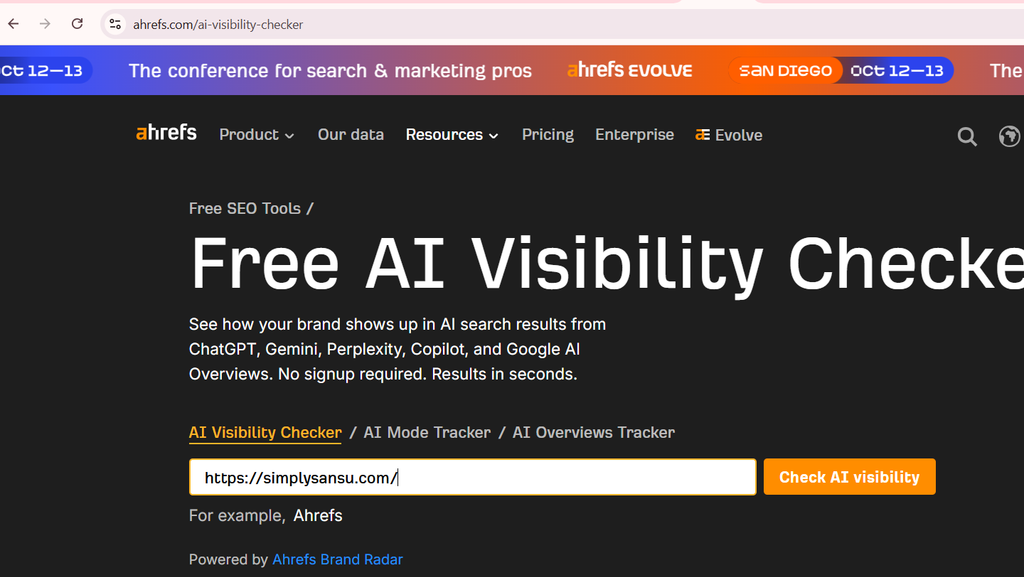
If you want a quick starting point, Ahrefs has a free AI visibility checker.
You can use it to get a snapshot of how your brand appears across AI search platforms. Ahrefs also offers a separate free Google AI Mode tracker that shows whether your brand appears in AI Mode and which pages are cited.
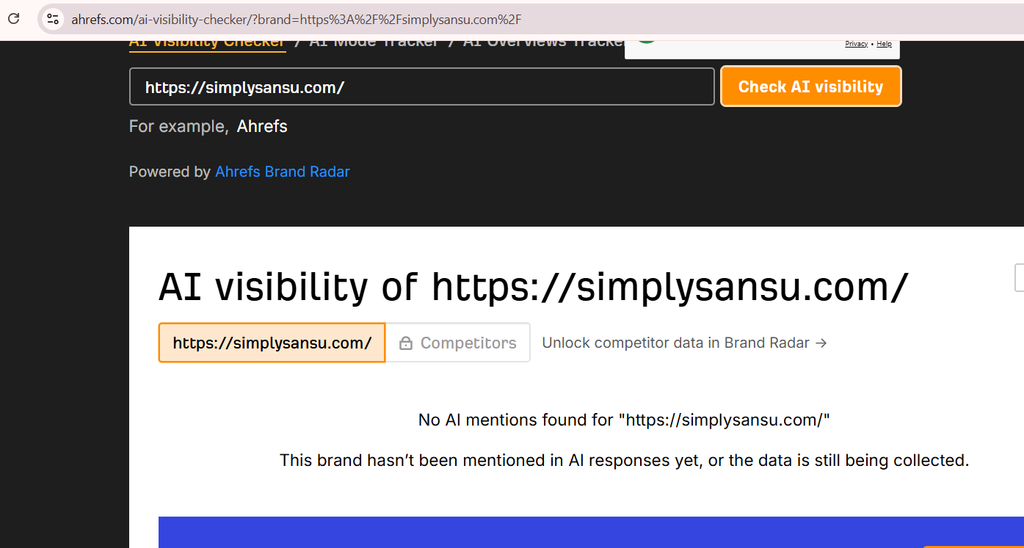
This is where I would start if I simply wanted to check “What does AI currently say about my brand?”
Trendos
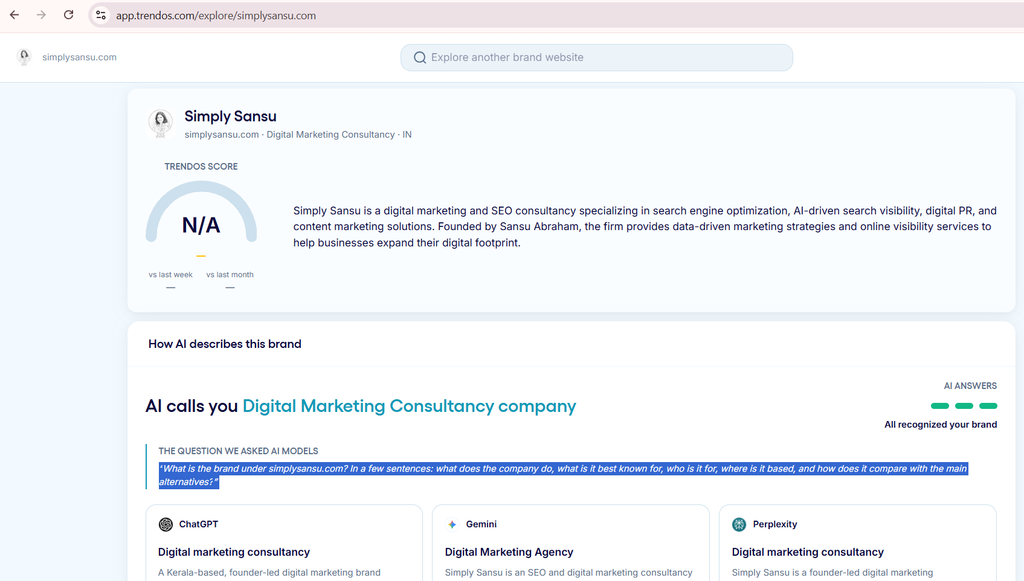
Trendos is particularly interesting if you want ongoing tracking without immediately paying for a platform.
It currently provides free AI visibility data and tracks how brands are mentioned, ranked, and described across ChatGPT, Gemini, Claude, Perplexity, and Google AI Overviews, with additional engines available in its tracking. It also provides historical data and competitor comparisons.
The free account currently allows tracking of up to 10 brands, including competitors.
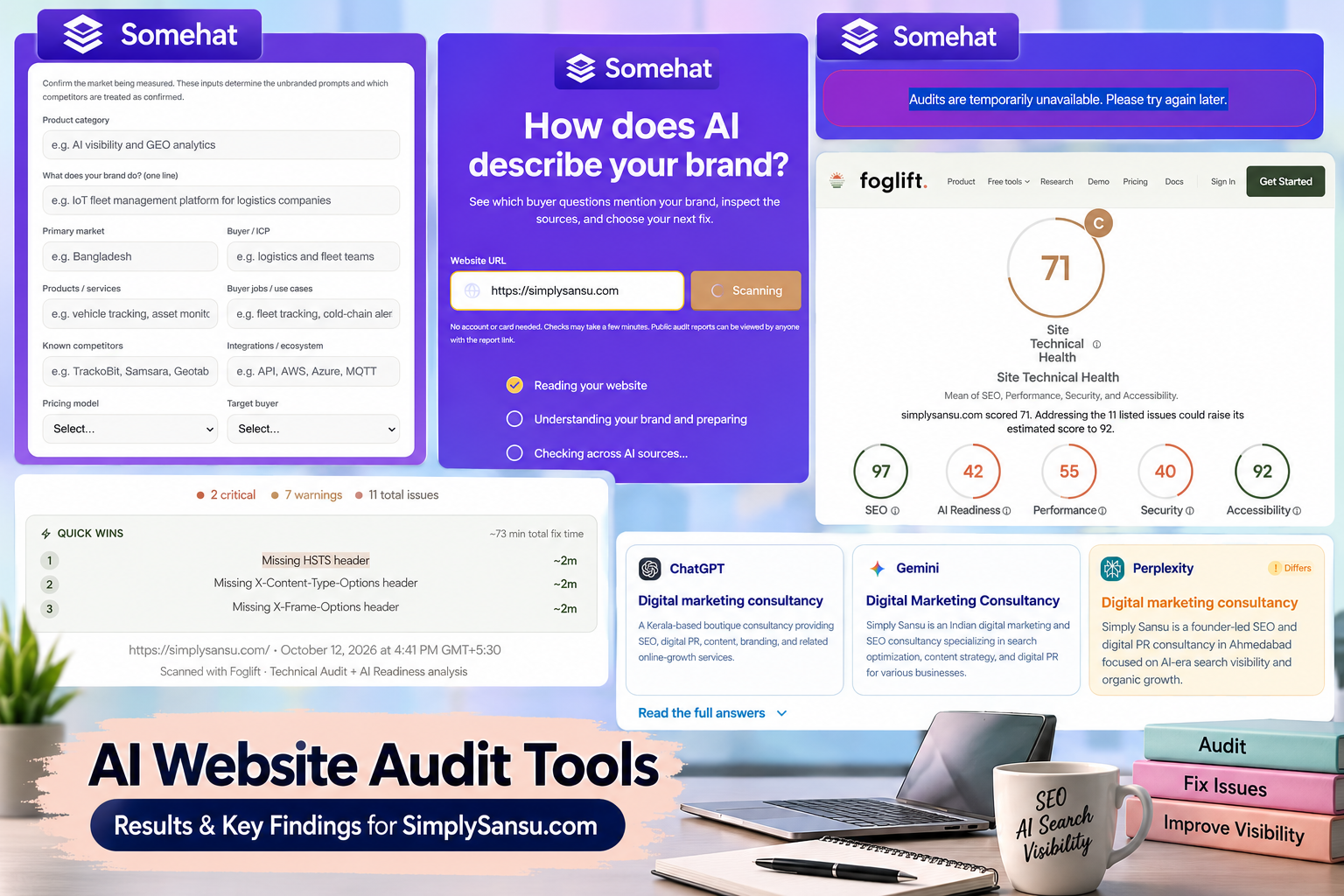
Perplexity differs from ChatGPT and Gemini in how it describes Simply Sansu, highlighting its founder-led SEO and digital PR positioning in Ahmedabad and its focus on AI-era search visibility.

For someone testing AI visibility for their own website, that makes it worth trying.
https://app.trendos.com/explore/simplysansu.com
Foglift
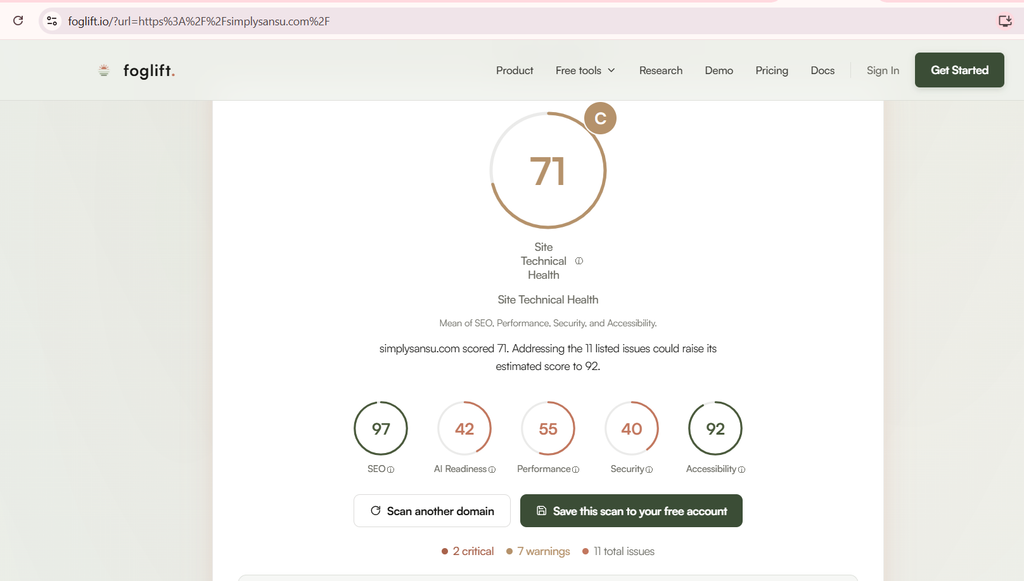
- SEO: how well your site ranks in traditional search engine like Google.
- AI Readiness: Weighted signal of combination of Technical and Authority signals.
- Performance: How fast your website loads. Core web vitals , page weight, and render speed.
- Security: How well your site protects against threats (https, headers, csp, HSTS)
- Accessibility – how good is your website with people with disabilities, including screen readers and keyboard navigation.4
Site Technical Health: SimplySansu.com scored 71/100 across SEO, performance, security, and accessibility. Fixing the 11 identified issues could potentially raise the estimated score to 92/100.
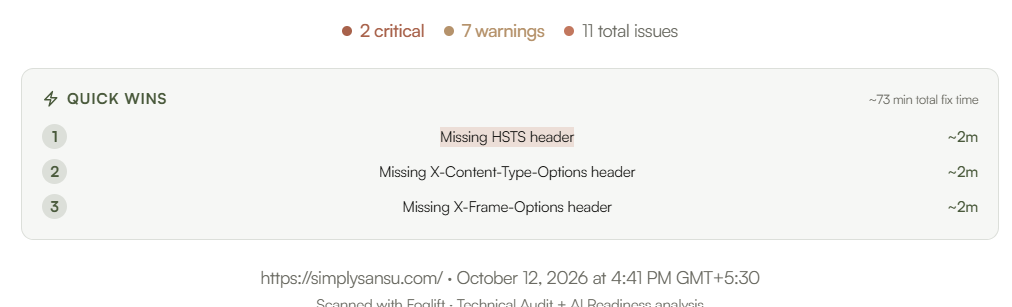
Security Headers
# Security Headers
<IfModule mod_headers.c>
    Header always set Strict-Transport-Security "max-age=31536000"
    Header always set X-Content-Type-Options "nosniff"
    Header always set X-Frame-Options "SAMEORIGIN"
</IfModule>
Foglift is another option if you want to experiment with AI search monitoring without immediately committing to a full paid platform.
Its free offering includes limited prompt monitoring, along with tools related to AI crawler activity and website audits.
This makes it useful if you want to start experimenting with both AI visibility and what AI crawlers are doing on your website.
https://foglift.io/?url=https%3A%2F%2Fsimplysansu.com%2F
DoneHat
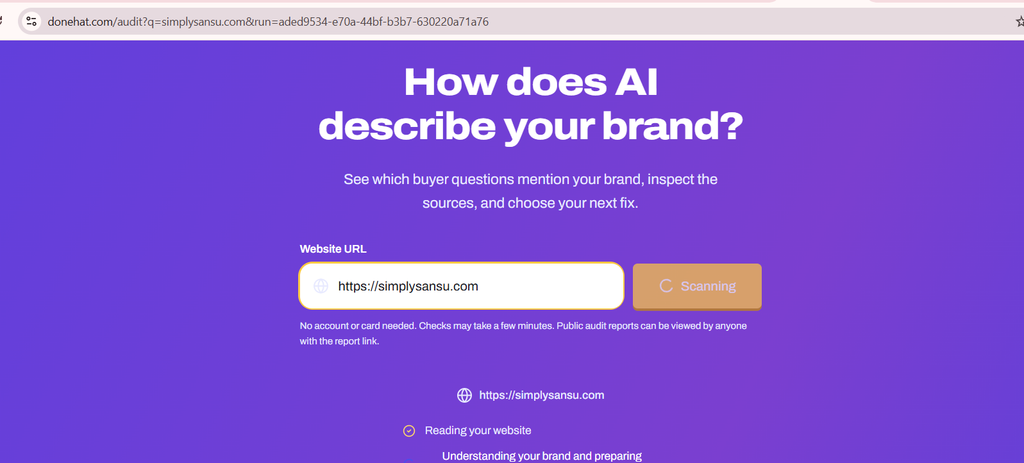
DoneHat also offers a free AI visibility checker.
I had to manually select the category, but the audit was ultimately unsuccessful because audits were not available at the time.
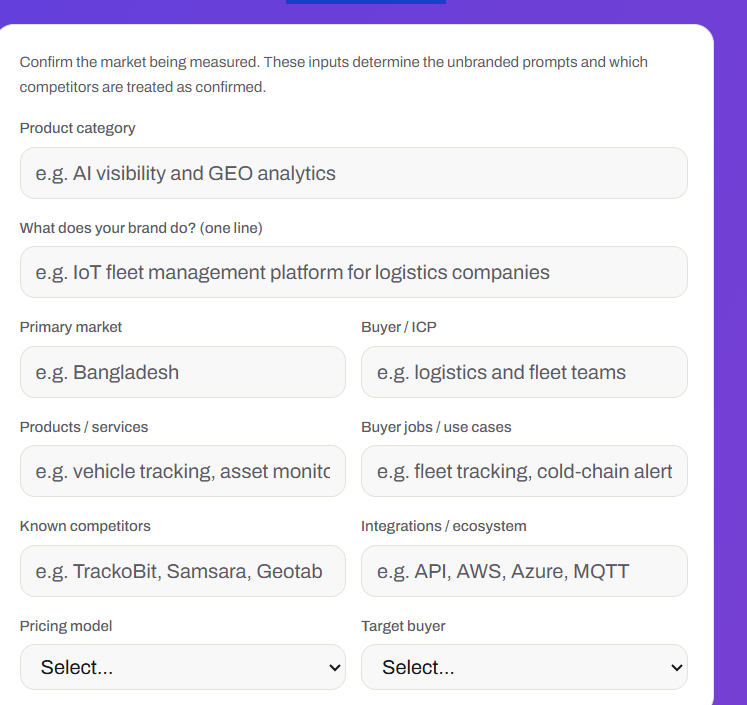
It focuses on buyer questions and can show things such as AI mentions, cited sources, competitors, and an AI visibility score.
That makes it useful for a quick competitor comparison rather than simply checking whether your brand name appears.

What I would use for Simply Sansu
I don’t think you need to start by paying for every AI visibility platform.
For Simply Sansu, I would first run the website through a free checker and establish a baseline.
Then I would create a list of questions that potential clients might ask.
For example:
“Who are the best SEO consultants for small businesses?”
“How can I improve my AI search visibility?”
“What is the best Digital PR strategy for building backlinks?”
“How can a business get mentioned in ChatGPT?”
I would then track those questions over time.
The important metrics for me would be:
- Is Simply Sansu mentioned?
- Is the website cited?
- Which page is cited?
- Which competitors are mentioned?
- Where does Simply Sansu appear in the answer?
- How is the brand described?
- Is the visibility improving over time?
That gives me something actionable.
A visibility score on its own doesn’t tell me what to do next.
The real value is finding the questions where my brand is missing, understanding which competitors are appearing, and figuring out what I need to improve.
AI search is still evolving quickly, so I don’t think there is one tool that tells you everything.
For now, I would test a few, find the one that gives you the data you actually use, and build your AI visibility tracking around that.