AI Marketing Statistics 2026: 40+ Data Points From Our Executive Survey
AI adoption is moving from experimentation to investment, but trust, accuracy, and human oversight remain major concerns.
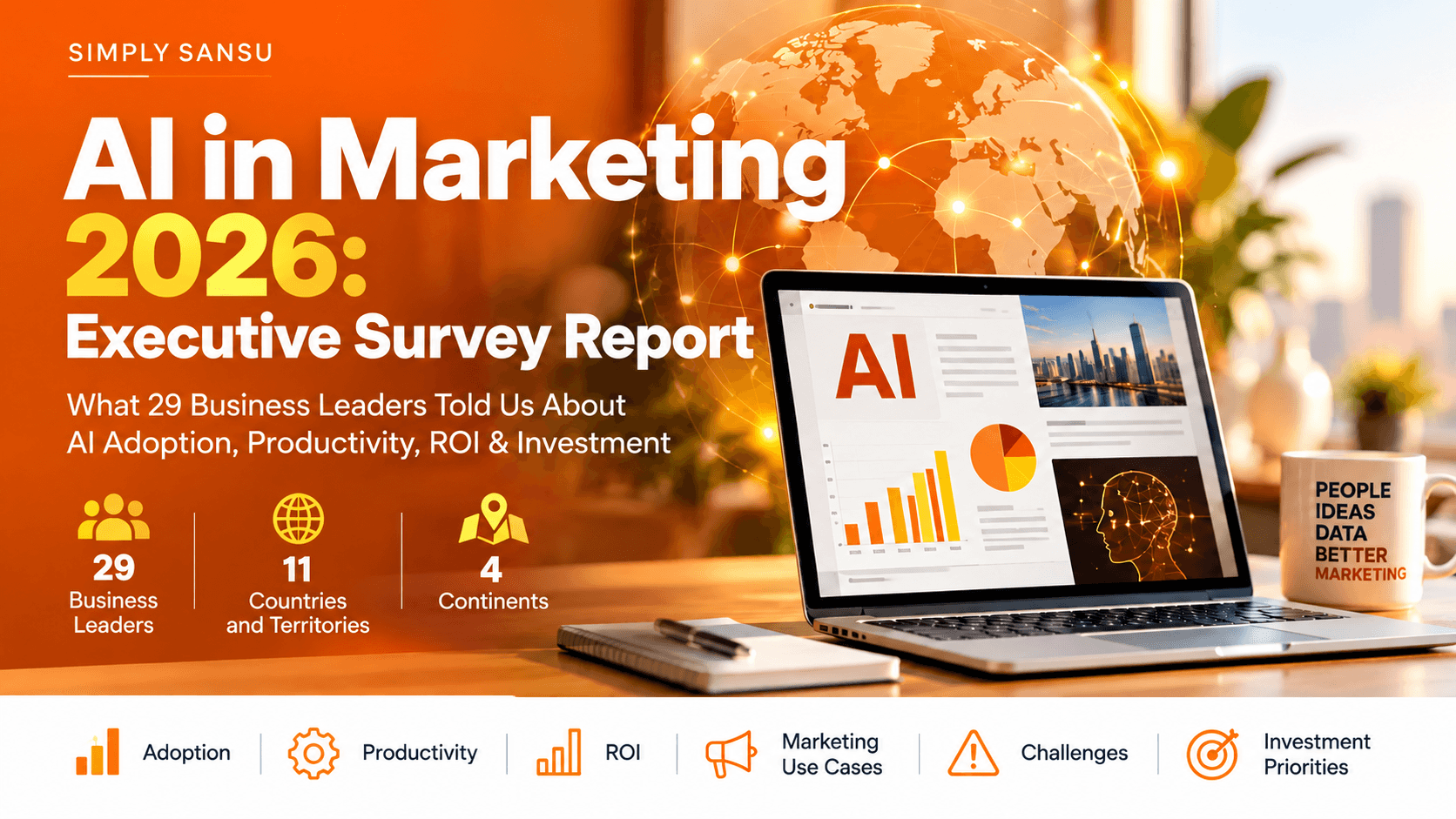
The AI in Marketing 2026 Executive Survey by Simply Sansu explores how businesses are adopting AI, where they are seeing value, what is driving investment, and the challenges they face.
The survey analyzed responses from 29 business leaders across 11 countries and territories spanning four continents. The respondent group was strongly leadership-oriented, with founders and CEOs making up the majority of respondents. The findings represent this survey group and are not intended to represent the entire marketing industry.
Source: Simply Sansu Executive Survey, n=29
Key AI Marketing Statistics for 2026
AI Adoption Statistics
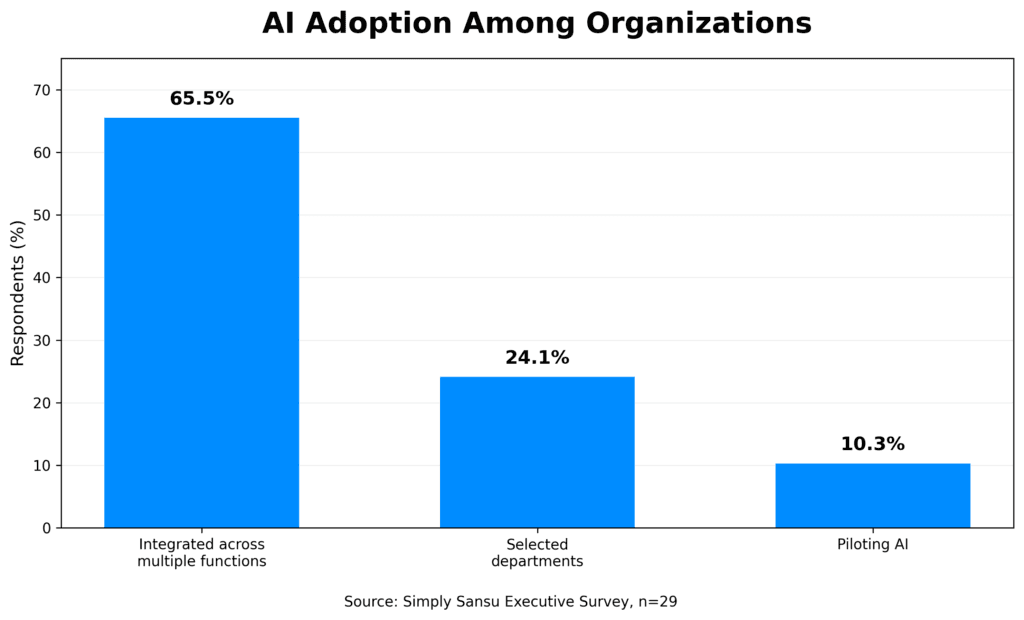
1. 65.5% of respondents have AI integrated across multiple functions.
19 of the 29 respondents said AI is integrated across multiple functions in their organizations.
AI Adoption Among Organizations in 2026
2. 24.1% use AI in selected departments.
Seven respondents reported using AI in selected departments.
3. 10.3% of respondents are currently piloting AI.
Three respondents said their organizations are still in the AI pilot stage.
4. 27.6% have organization-wide AI integration with a formal AI strategy.
Eight respondents reported both organization-wide AI integration and a formal AI strategy.
5. 37.9% use AI in selected departments while developing or implementing an AI strategy.
Eleven respondents reported this stage of AI adoption and strategy development.
6. Only 3.4% have neither adopted AI nor established a formal AI strategy.
One respondent reported having neither AI adoption nor a formal AI strategy.
Why Businesses Are Investing in AI
“AI has allowed us to scale expertise instead of simply scaling effort. We’ve transformed founder conversations, client knowledge, and business strategy into reusable AI systems that create content, improve visibility, qualify buyer intent, and support customer engagement without proportionally increasing headcount.”
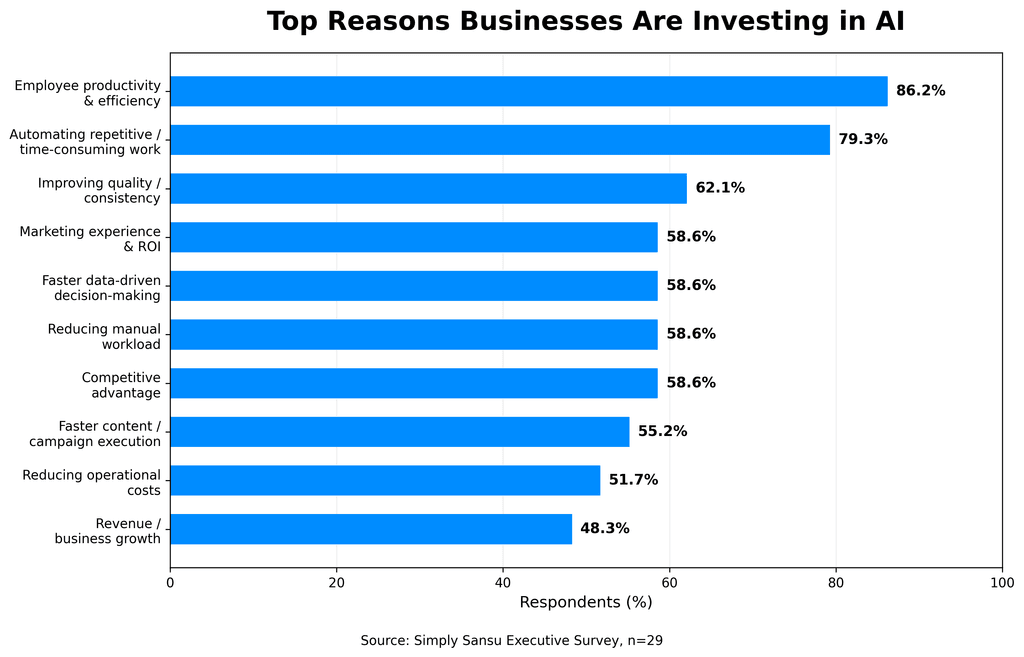
The survey shows that businesses are investing in AI primarily to improve productivity and efficiency. Employee productivity and efficiency was selected by 86.2% of respondents, followed by automating repetitive or time-consuming work at 79.3%. Improving quality and consistency ranked third at 62.1%.
Top reasons businesses are investing in AI based on responses from 29 business leaders. Source: Simply Sansu Executive Survey, n=29.
AI has improved efficiency by automating repetitive tasks and helping us make faster, data-driven decisions.”
7. 86.2% cite employee productivity and efficiency as a reason for investing in AI.
This was the most frequently selected reason for AI investment, with 25 respondents choosing it.
The biggest benefit has been removing the mechanical drag from our work. A lot of our team’s output now gets touched by AI and then reviewed by a human, which means people who might have spent hours formatting, researching, or rewriting can spend that time actually thinking.”
12. 58.6% cite reducing manual workload for employees.
Seventeen respondents identified reducing manual workload as a reason to invest in AI.
“AI has removed repetitive and mundane tasks and allowed our team to focus on strategy and creativity. This blend has driven better performance across the board for top KPIs.”
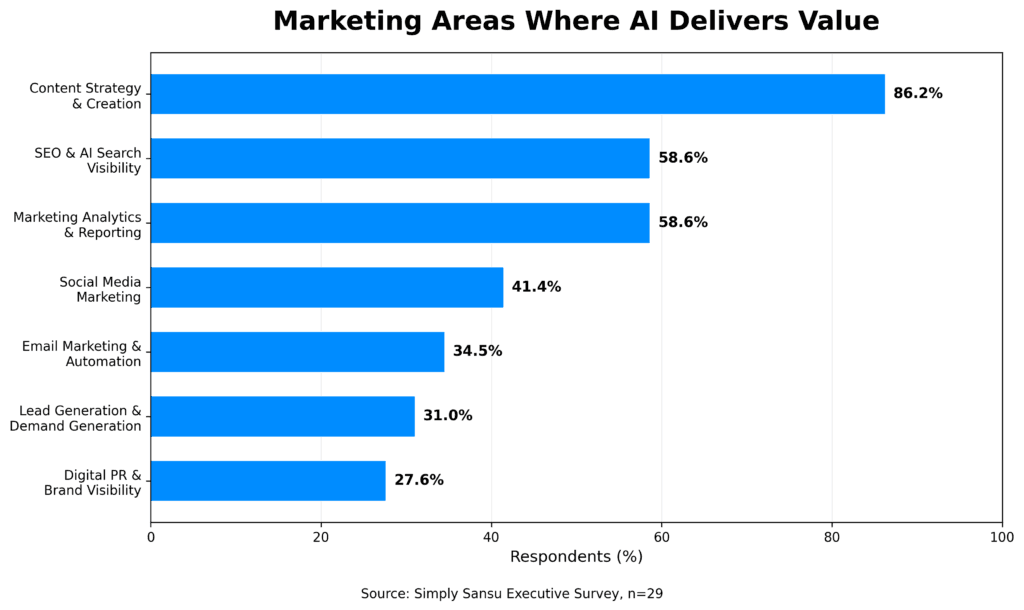
AI is delivering value across multiple areas of marketing, but content remains the strongest application. In our survey, 86.2% of respondents selected Content Strategy & Creation, while 58.6% identified both SEO & AI Search Visibility and Marketing Analytics & Reporting as areas where AI delivers value.
Marketing areas where AI delivers value based on responses from 29 business leaders. Source: Simply Sansu Executive Survey, n=29.
17. 86.2% say AI is delivering value in Content Strategy & Creation.
Content Strategy & Creation was the most frequently selected marketing area, with 25 respondents.
18. 58.6% say AI is delivering value in SEO & AI Search Visibility.
Seventeen respondents selected SEO & AI Search Visibility.
“Customers today are looking for more AI-native solutions. Being one of them has increased the number of conversations we have had with potential customers.”
Nine respondents reported significant measurable ROI.
29. 31.0% reported moderate ROI.
Nine respondents reported moderate measurable ROI.
30. 62.1% reported significant or moderate ROI.
Eighteen respondents reported either significant or moderate measurable ROI from AI.
31. 27.8% said it is too early to measure AI’s ROI.
Eight respondents said they needed more time before measuring ROI.
AI Trust, Confidence and Human Oversight
Rather than describing this finding simply as “trust in AI,” the survey specifically asked about confidence in AI-generated business insights.
32. 58.6% are generally confident in AI-generated business insights.
Seventeen respondents described themselves as generally confident.
33. 17.2% are highly confident in AI-generated business insights.
Five respondents reported high confidence.
34. 75.9% are either generally or highly confident in AI-generated business insights.
Twenty-two of the 29 respondents were either generally or highly confident in AI-generated business insights.
35. 20.7% always require human verification.
Six respondents said they always require human verification of AI-generated business insights.
This is an important finding for marketers: confidence in AI does not necessarily mean complete reliance on AI. Human review remains part of the decision-making process for many respondents.
AI Implementation Challenges
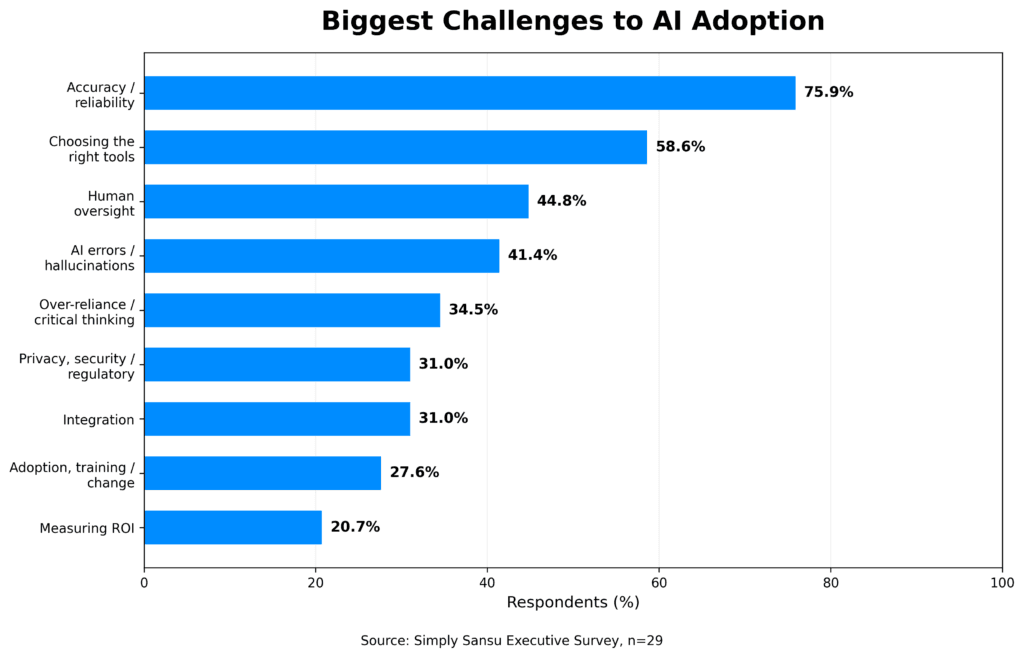
Despite growing AI adoption, businesses continue to face significant challenges. Accuracy and reliability ranked as the biggest challenge, selected by 75.9% of respondents, followed by choosing the right tools at 58.6% and human oversight at 44.8%.
Biggest challenges to AI adoption based on responses from 29 business leaders. Source: Simply Sansu Executive Survey, n=29.
36. 75.9% say accuracy and reliability of AI-generated outputs is their biggest challenge.
Twenty-two respondents selected accuracy and reliability, making it the leading implementation challenge.
37. 58.6% say choosing the right AI tools and solutions is a challenge.
Seventeen respondents selected this challenge.
38. 44.8% cite the need for human oversight.
Thirteen respondents identified maintaining human oversight to catch mistakes AI may overlook.
39. 41.4% are concerned about AI errors or hallucinations affecting business decisions.
Twelve respondents selected this concern.
40. 34.5% are concerned about over-reliance on AI reducing critical thinking and confidence.
Ten respondents selected this concern.
41. 31% cite data privacy, security and regulatory compliance as challenges.
Nine respondents selected this issue.
42. 31% cite difficulty integrating AI with existing systems and workflows.
Nine respondents selected integration as a challenge.
43. 27.6% cite employee adoption, training and change management.
Eight respondents selected this challenge.
44. 20.7% cite difficulty measuring AI’s return on investment.
Six respondents selected ROI measurement as a challenge.
Where Businesses Expect AI Investment to Grow
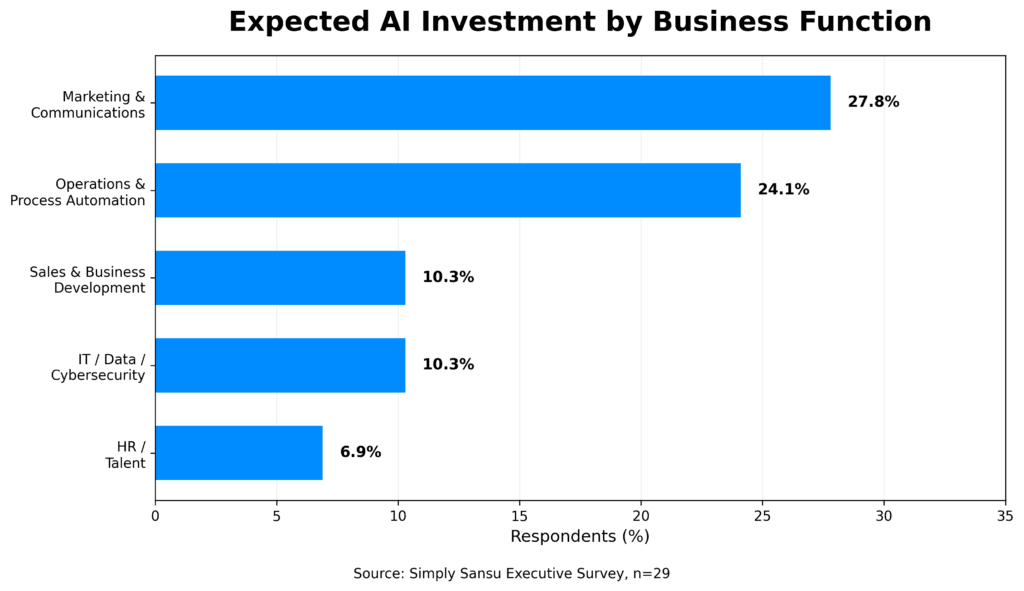
Business functions expected to receive greater AI investment based on responses from 29 business leaders. Source: Simply Sansu Executive Survey, n=29.
45. Marketing & Communications is the leading expected area for AI investment growth at 27.8%.
Eight respondents expect this area to receive the greatest AI investment over the next 12 months.
46. 24.1% expect Operations & Process Automation to receive the greatest AI investment.
Seven respondents selected this area.
47. 10.3% expect Sales & Business Development to receive the greatest AI investment.
Three respondents selected Sales & Business Development.
48. 10.3% expect IT, Data & Cybersecurity to receive the greatest AI investment.
Three respondents selected this area.
49. 6.9% expect Human Resources & Talent Management to receive the greatest AI investment.
Two respondents selected HR & Talent Management.
The Bigger Picture
The survey points to a clear transition in how businesses are approaching AI.
AI is no longer limited to experimentation. Organizations are integrating AI into multiple functions, using it to improve productivity, automate repetitive work, accelerate content creation, and support decision-making.
At the same time, accuracy and reliability remain the biggest barriers. The fact that 75.9% identified AI-generated output accuracy and reliability as a challenge shows that increased adoption does not eliminate the need for human judgment.
The investment outlook is also strong. In the detailed investment question, 48.3% expect a significant increase in AI investment over the next 12 months, while 44.8% expect a moderate increase. Only 6.9% expect investment to remain the same, and no respondent selected a decrease.
That means 93.1% of respondents expect AI investment to increase over the next 12 months.
Marketing & Communications emerged as the top expected area for AI investment growth, followed closely by Operations & Process Automation.
AI Marketing Statistics: What the Numbers Tell Us
The survey reveals an interesting contradiction: businesses are becoming more willing to invest in AI while remaining cautious about relying on AI-generated output without human review.
This suggests that AI is increasingly being treated as a productivity and marketing tool rather than a complete replacement for human expertise.
AI adoption is growing
65.5%
of respondents said AI is integrated across multiple functions in their organizations.
AI investment is increasing
93.1%
of respondents expect AI investment to increase over the next 12 months.
AI accuracy remains a challenge
75.9%
of respondents identified the accuracy and reliability of AI-generated outputs as a major implementation challenge.
Survey reach
29
business leaders participated in the survey.
Global participation
11
countries and territories were represented in the survey.
Geographic reach
4
continents were represented among respondents.
Why These AI Marketing Statistics Matter
The rapid growth of AI in marketing doesn’t necessarily mean businesses are ready to hand over decision-making to AI.
The survey data points toward a more cautious model:
AI adoption → AI-assisted workflows → human oversight → final decision
For marketers, this distinction matters.
AI can help with research, brainstorming, content production, data analysis, personalization, and workflow automation. However, marketers still need to evaluate accuracy, originality, brand alignment, factual claims, and the quality of the final output.
The combination of high AI investment and continued concern about accuracy and reliability may therefore be one of the defining characteristics of AI adoption in marketing in 2026.
AI Marketing Statistics FAQ
How many business leaders participated in the Simply Sansu AI marketing survey?
The AI in Marketing 2026 Executive Survey received responses from 29 business leaders across 11 countries and territories spanning four continents.
What percentage of businesses expect their AI investment to increase?
According to the Simply Sansu Executive Survey, 93.1% of respondents expect AI investment to increase over the next 12 months.
What is the biggest AI implementation challenge?
75.9% of respondents identified the accuracy and reliability of AI-generated outputs as a major challenge, making it the leading implementation challenge in the survey.
What percentage of respondents are confident in AI-generated business insights?
75.9% of respondents were either generally or highly confident in AI-generated business insights. The survey specifically measured confidence in AI-generated business insights rather than generic “trust in AI.”
What does the survey reveal about AI adoption?
The survey suggests that AI adoption is moving beyond experimentation. 65.5% of respondents said AI is integrated across multiple functions, while another 24.1% use AI in selected departments. At the same time, businesses remain cautious about accuracy, reliability, human oversight, and AI-related risks.
About the AI in Marketing 2026 Executive Survey
The AI in Marketing 2026 Executive Survey was conducted by Simply Sansu to understand how business leaders are adopting AI, where they are seeing value, what motivates investment, and what challenges remain.
The survey analyzed 29 responses from business leaders across 11 countries and territories spanning four continents. The survey was conducted using Google Forms, with responses collected between July and September 2026.
The findings represent the survey respondents and should not be interpreted as representative of the entire marketing industry.
Contains information related to marketing campaigns of the user. These are shared with Google AdWords / Google Ads when the Google Ads and Google Analytics accounts are linked together.
90 days
__utma
ID used to identify users and sessions
2 years after last activity
__utmt
Used to monitor number of Google Analytics server requests
10 minutes
__utmb
Used to distinguish new sessions and visits. This cookie is set when the GA.js javascript library is loaded and there is no existing __utmb cookie. The cookie is updated every time data is sent to the Google Analytics server.
30 minutes after last activity
__utmc
Used only with old Urchin versions of Google Analytics and not with GA.js. Was used to distinguish between new sessions and visits at the end of a session.
End of session (browser)
__utmz
Contains information about the traffic source or campaign that directed user to the website. The cookie is set when the GA.js javascript is loaded and updated when data is sent to the Google Anaytics server
6 months after last activity
__utmv
Contains custom information set by the web developer via the _setCustomVar method in Google Analytics. This cookie is updated every time new data is sent to the Google Analytics server.
2 years after last activity
__utmx
Used to determine whether a user is included in an A / B or Multivariate test.
18 months
_ga
ID used to identify users
2 years
_gali
Used by Google Analytics to determine which links on a page are being clicked
30 seconds
_ga_
ID used to identify users
2 years
_gid
ID used to identify users for 24 hours after last activity
24 hours
_gat
Used to monitor number of Google Analytics server requests when using Google Tag Manager
1 minute
Google reCAPTCHA helps protect websites from spam and abuse by verifying user interactions through challenges.
Name
Description
Duration
_GRECAPTCHA
Google reCAPTCHA sets a necessary cookie (_GRECAPTCHA) when executed for the purpose of providing its risk analysis.
179 days
Marketing cookies are used to follow visitors to websites. The intention is to show ads that are relevant and engaging to the individual user.
Name
Description
Duration
sbjs_udata
Session
sbjs_session
30 minutes
sbjs_migrations
Helps SourceBuster handle changes or migrations between versions of its tracking/attribution system.
Session
sbjs_first_add
Stores additional first-visit/source attribution information
Session
sbjs_first
Records the visitor's first traffic source for attribution
Session
sbjs_current_add
Traffic-source/visit attribution
Session
sbjs_current
Tracks the visitor's current traffic/source information, such as where the visit originated.