When Customers Ask AI About Your Business, Will You Be There? Here’s What Businesses Can Learn From My Experience
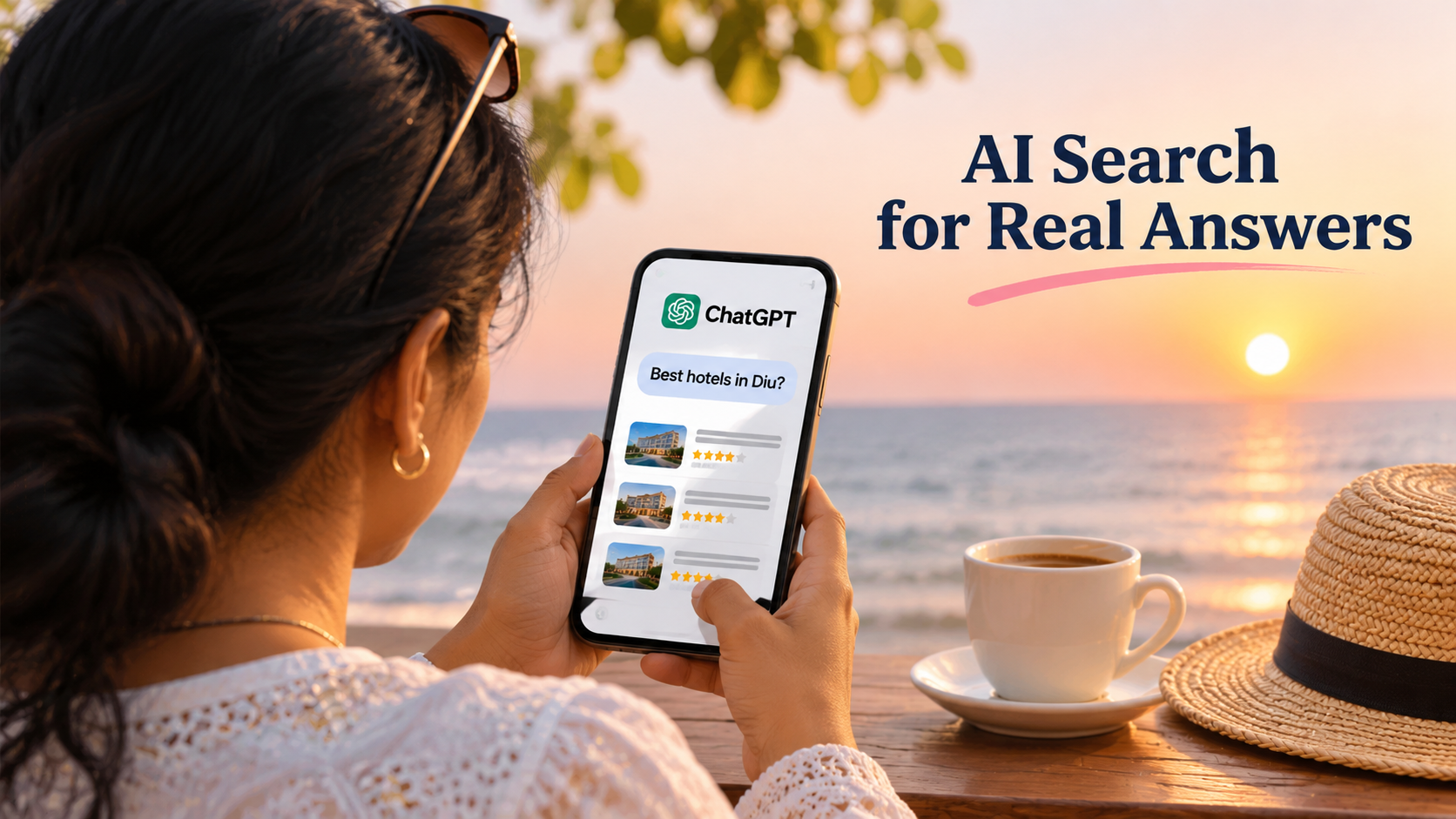
Just the other day, I wanted to find the best hotels in Diu.
Instead of starting by going through pages of search results, I started with ChatGPT.
I didn’t simply ask, “What are the best hotels in Diu?”
I gave it the criteria that actually mattered to me. I was looking for a hotel that had:
- Good customer ratings
- A swimming pool
- A sea-side view
- Breakfast included
- Within my budget
- Good cleanliness ratings
- Outdoor dining
- Non-vegetarian food options
There was another important factor. I was traveling with my baby, so cleanliness and the overall suitability of the hotel mattered to me more than simply finding the cheapest or most popular option.
ChatGPT made the search much easier.
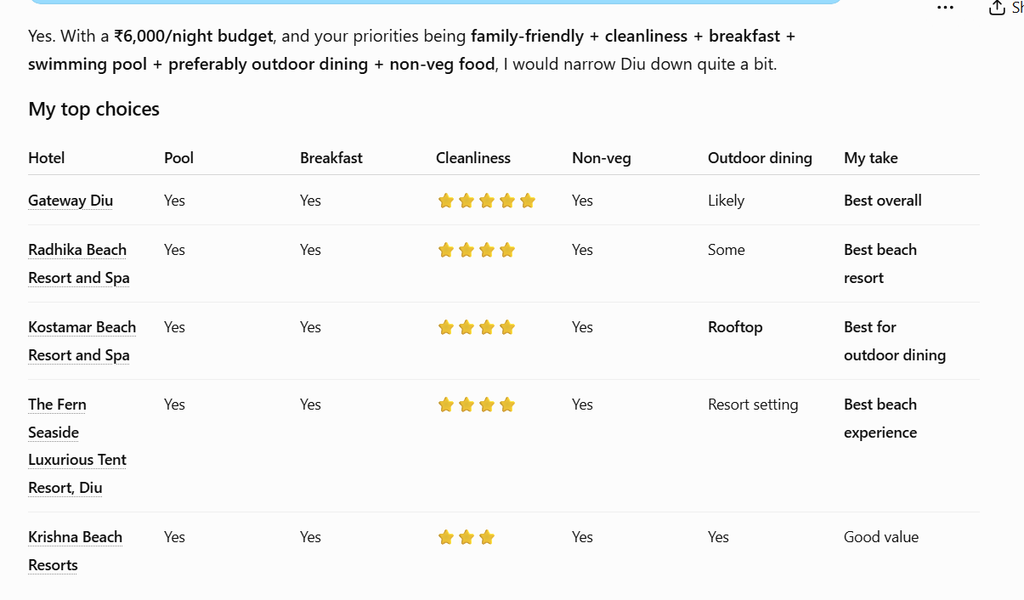
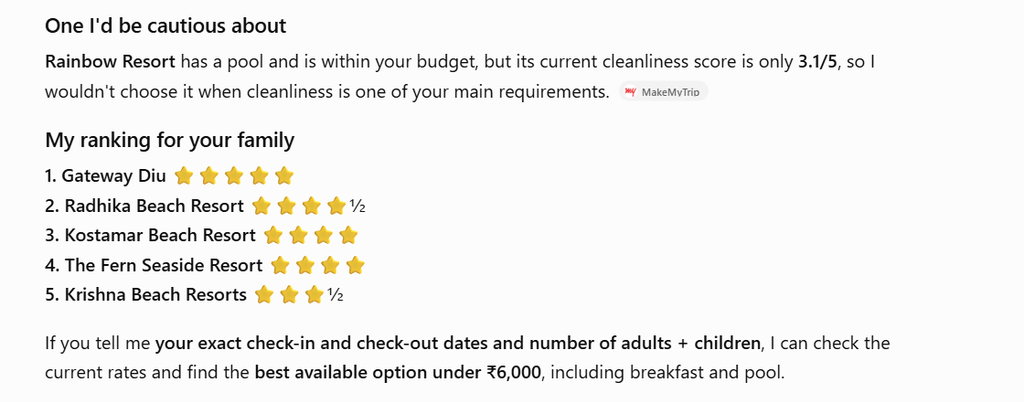
Instead of opening dozens of search results and trying to put the information together myself, I got a comparison that brought several of my requirements into one place. The “My Take” column was particularly useful because it helped me understand the differences between the options and narrow down my choices.
My experience with ChatGPT in this particular search was extremely useful. It saved me time and, more importantly, helped me make sense of the information. It was worth the search.
But there is an important part of this story that I don’t want to leave out.
My search did not end with ChatGPT because I don’t blindly trust AI.
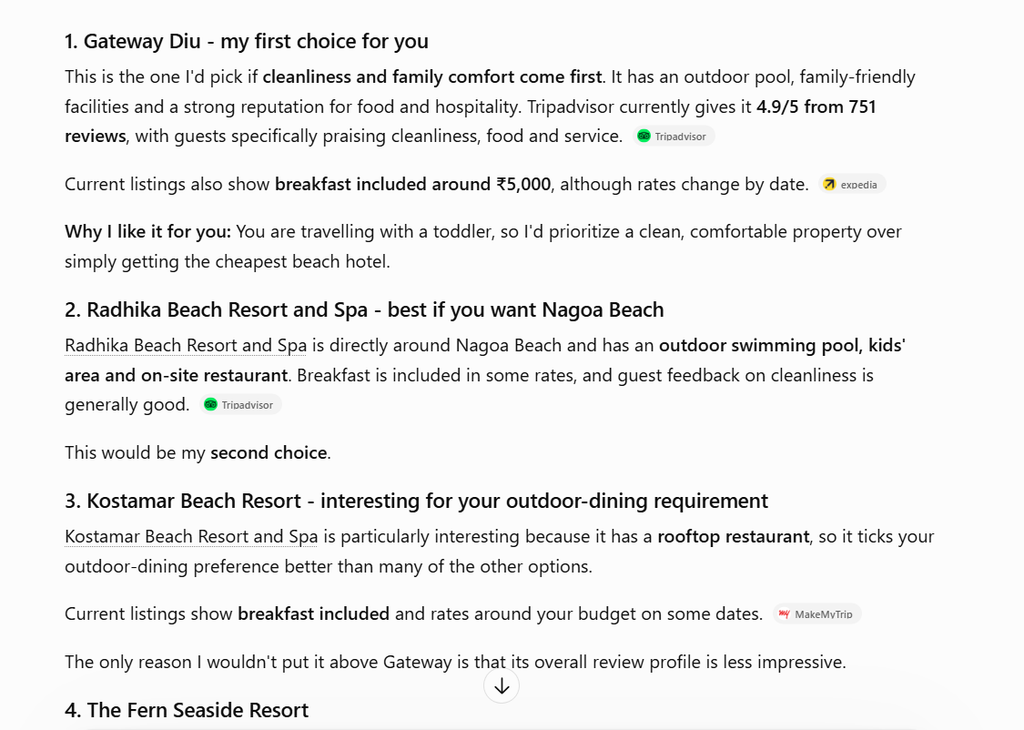
Every time ChatGPT mentioned a source, I went and checked it. Some of the sources were Tripadvisor, Expedia, and MakeMyTrip. I looked at those listings myself. I also went back to Google and did my own searches.
Why? Because an AI-generated comparison was helpful, but I was making a real decision.
When you’re traveling with a baby, you don’t necessarily want to rely on one answer, even if that answer is convenient. I wanted to check the information myself and make sure I was getting the best possible option.
One thing I particularly liked about the AI-generated comparison was the caution it gave me about the cleanliness rating of one of the resorts. It had a customer rating of only 3.1/5 for cleanliness, something that could easily have been overlooked if I had simply searched for “best hotels in Diu” and looked at a list of popular properties.
That is where I think the real change is happening.
In my case, the journey became a combination of AI search and traditional search.
ChatGPT helped me narrow down the options, compare them against my specific requirements, and identify things I might have missed.
Google and the sources cited by ChatGPT helped me verify the information.
And ultimately, I made the decision.
That experience made me think about what this means for websites, publishers, businesses, and SEO.
What happens when the first stage of the decision-making process happens inside an AI platform?
The user may never click your website.
Or they may click it later, after the AI has already introduced them to your brand. That is where the conversation around AI search becomes much more interesting.
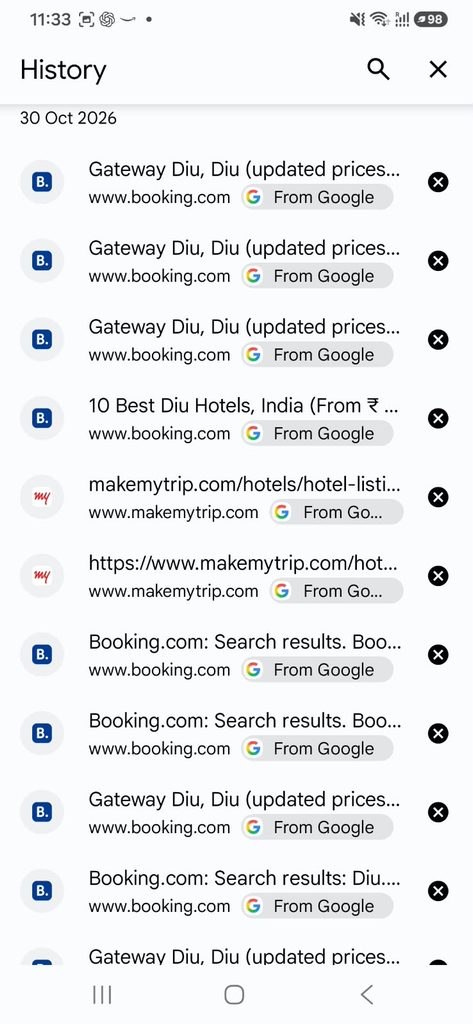
The search on Google and AI platforms spanned from October 29 to 30, and my decision-making process ultimately involved more research on Google, checking hotel photos, comparing sources, and then making my choice.
Search is becoming more conversational
Traditional search requires the user to do much of the work. You search, open several results, compare information, read reviews, make notes, eliminate options, and search again.
With AI search, I can describe what I actually want instead. I don’t have to think of the perfect keyword. I can say, “I need a clean hotel in Diu with a swimming pool, sea view, breakfast, outdoor dining, non-veg food, and a budget of ₹X. Which ones would you recommend?”
That is a different search experience. The search engine is no longer simply helping me find pages. It is helping me make a decision. For businesses that depend on organic visibility, that distinction matters.
But AI doesn’t replace the web
My own hotel search is a good example of why I don’t think traditional search is simply going to disappear. I used ChatGPT as my starting point, but I still wanted to see the underlying sources. I wanted to check the reviews, see the hotel photographs, compare the information, and make sure the details were current. And I wanted to use Google independently.
So my journey looked more like this:
AI search → comparison → source verification → Google search → final decision
rather than:
Google → website → decision
That difference is important.
AI may take a share of the initial search, but the web still plays a role in verification.
And for businesses, that means the question isn’t simply:
“Will AI replace Google?”
A much more useful question is:
“Where does my brand appear in the customer’s decision-making journey?”
The value of being mentioned may change
This is where I see a direct connection with my work in SEO and Digital PR. For a long time, we have measured the value of visibility through rankings, impressions, clicks, referral traffic, and conversions. Those metrics still matter. But AI introduces another layer. What if someone asks ChatGPT for the best Digital PR specialists? What if your name or business appears in the answer? The person may not click immediately, but you’ve still entered their consideration set. They now know your name. They may search for you on Google, check your website, look at your LinkedIn profile, or come back later when they’re ready to make a decision.
That is a form of visibility that doesn’t necessarily show up as a traditional organic click. And this is why I think AI visibility and traditional SEO need to be looked at together, rather than as competing disciplines.
My Dependence on AI Didn’t Stop With Hotel Research
During my Diu trip, I also used AI to check the temperature, sunset timing, and the best place to watch the sunset.
The temperature information was useful, direct, and saved me from going through multiple search results. The sunset recommendation was also correct, but the timing was different. AI suggested 6:00 to 6:15 PM, while haze and clouds meant the visible sunset had already occurred around 5:45 PM.
This highlighted an important limitation of AI search. Real-world conditions can change quickly, and neither AI nor traditional search can guarantee the exact outcome.
The information was still useful. AI gave me a good guide, but the real-world experience was different.
AI can make finding information easier, but it cannot always guarantee the outcome. That’s why I see AI as part of the search journey, not the final authority.
The click is no longer the entire story
The traditional SEO mindset has been heavily focused on getting the click, and understandably so. Clicks bring visitors, and visitors can become leads, customers, subscribers, or buyers. But AI search introduces a new possibility. A user can benefit from your content without ever visiting your website during that particular search. They may encounter your expertise through an AI-generated answer, see your brand mentioned, or use information originating from your website to make a decision. And then, perhaps later, they may come directly to you.
That means the value of content is no longer limited to the traffic it sends directly to your website. It can also contribute to visibility, credibility, consideration, and trust. For marketers, that requires a change in how we think about measurement. Not every valuable interaction will end with a click.
AI has taken a share of search. But the search hasn’t ended.
My Diu hotel search was a small, everyday example of a much bigger change. I used AI because it made the initial research easier, I used the sources it cited because I wanted to verify the information, and I used Google because I wanted another layer of research. And then I made the decision myself. That is probably how I see the future of search right now.
The search box is becoming a conversation. The search result is becoming an answer.

And the website is increasingly becoming the place where people go to verify, explore, trust, and ultimately act.
For businesses, that means being visible in search is no longer just about winning a position and getting a click.
It is about becoming a source that can influence the decision before the click, after the click, or even when there is no click at all.
What should businesses do now?
Imagine an adult-industry customer asking AI, “Which brands should I consider?” The answer could shape their shortlist before they ever visit a website.
If your customer asks AI about your industry, will your brand be part of the answer?
My Diu hotel search showed me why this matters. ChatGPT helped me narrow my options, but I still checked the sources, returned to Google, looked at the hotel listings and photos, and made the final decision myself.
For businesses, that means SEO alone is no longer the whole visibility story. Your website needs to be crawlable, indexable, useful, and easy for AI systems to understand. Your brand also needs credible information and mentions beyond your own website.
This is where SEO and Digital PR work together: technical SEO helps AI discover and understand your website, while first-hand content and credible third-party mentions can strengthen your authority.
Don’t just try to rank for the search. Build a brand that can become part of the answer.
This is where I help businesses improve their visibility across search and AI-driven discovery through SEO and Digital PR.
Want to improve your brand’s visibility in search and AI-driven discovery? Explore my AI SEO and Digital PR services.