AI Website Friendliness: What It Is, What to Check, and Tools to Measure It

AI search visibility is not only about whether ChatGPT, Gemini, Perplexity, or Google AI features mention your brand. Before an AI system can understand, retrieve, or potentially cite your content, it needs to be able to access and interpret your website.
That is where AI website friendliness comes in.
An AI-friendly website is not a completely new type of website. It is a website with solid technical foundations that make its content accessible, discoverable, structured, and understandable to automated systems.
Google itself says that the fundamentals still matter for its AI features, including allowing crawling, making important content available in text, using internal links, providing good page experience, and ensuring structured data matches the visible content. CCNews
What Does AI Website Friendliness Mean?
Think of AI website friendliness as answering one basic question:
Can AI systems reach my website, understand what is on it, and extract useful information from it?
This is different from AI visibility.
- AI website friendliness: Can AI systems access and understand my website?
- AI visibility: Does AI actually mention, cite, or recommend my website or brand?
A website can therefore be technically AI-friendly without being highly visible in AI answers. Foglift, for example, explicitly separates AI Readiness from AI Visibility because a technical audit does not guarantee that an AI engine will cite or recommend a page. Foglift
Why Does AI Website Friendliness Matter?
AI systems rely on automated retrieval and crawling to discover web content.
For example, OpenAI uses different crawlers for different purposes. OAI-SearchBot is used to surface websites in ChatGPT search, while GPTBot is associated with crawling for potential training use. These controls can be managed independently through robots.txt. OpenAI Developers
If your website accidentally blocks the relevant crawler, has poor technical structure, or hides important information behind inaccessible page elements, the quality of your content may not matter because the system may have difficulty retrieving it.
That makes technical SEO an important part of AI search readiness.
Technical SEO → AI Friendliness → AI Visibility
Technical SEO is the foundation. AI friendliness builds on that foundation to ensure your website can be accessed, understood, and potentially surfaced by AI-powered search and answer engines.
What Is Involved in Making a Website AI-Friendly?
There are several areas worth checking.
1. Robots.txt
Your robots.txt file provides crawling instructions to bots.
You should check whether important AI and search crawlers are being blocked unintentionally.
For example, OpenAI recommends allowing OAI-SearchBot if you want your website content to be discoverable in ChatGPT search. OpenAI Developers
However, robots.txt is not simply about allowing every bot. Different crawlers have different purposes, so website owners should decide which access they actually want to provide.
2. XML Sitemap
A sitemap helps crawlers discover important URLs on your website.
It should contain the pages you actually want discovered and should be kept free of unnecessary broken, redirected, or non-indexable URLs.
Your sitemap can also be referenced from robots.txt.
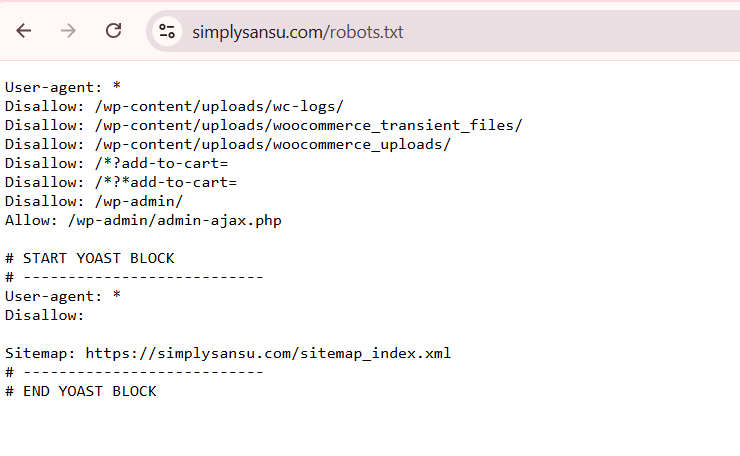
Robots.txt and Sitemap: The website’s robots.txt file does not broadly block crawlers and restricts only areas such as the WordPress admin, WooCommerce log files, temporary files, and cart-related URLs. It also includes a direct reference to the XML sitemap index, making the sitemap easy for crawlers to discover. This provides both crawl guidance and sitemap discovery, which are important foundations for an AI-friendly website.
3. Structured Data
Structured data, usually implemented using Schema.org vocabulary and JSON-LD, gives machines additional context about your content.
Depending on the website, this could include:
- Organization
- Person
- Article
- BreadcrumbList
- Product
- Service
- FAQPage
- LocalBusiness
Google explains that structured data helps it understand the content of a page. Google for Developers
But there is an important distinction here: there is no special “AI schema” that you need to add simply to appear in Google’s AI features. Google specifically says its AI features do not require special AI markup or machine-readable files. CCNews
The goal should therefore be accurate, relevant structured data that matches what users can actually see on the page.
For an AI-friendliness audit, check whether machine-readable Schema.org data is actually present and accessible in the page HTML, and whether it is valid.
What to check
Look for:
- Is structured data present?
- Is it Schema.org/JSON-LD?
- What types are present? For example, Organization, WebSite, Person, Article, Service, BreadcrumbList.
- Are there errors in the JSON-LD?
- Does the structured data accurately represent the visible content?
Structured data (Schema.org):
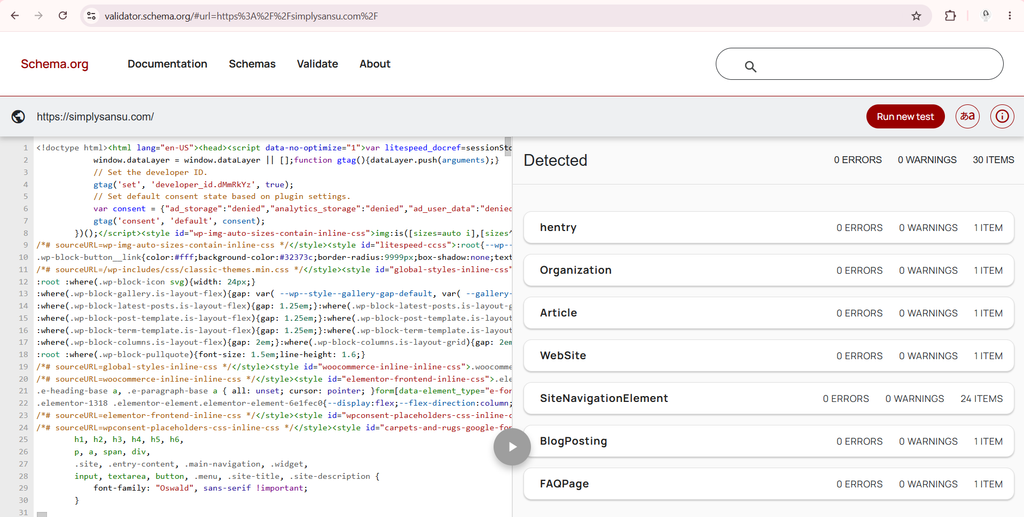
Passed. I checked SimplySansu.com using the Schema.org Markup Validator, which detected 30 structured data items with 0 errors and 0 warnings. The markup includes entities such as Organization, WebSite, Article, BlogPosting, SiteNavigationElement, and FAQPage. This provides machine-readable context that can help automated systems understand the website’s content and entities.
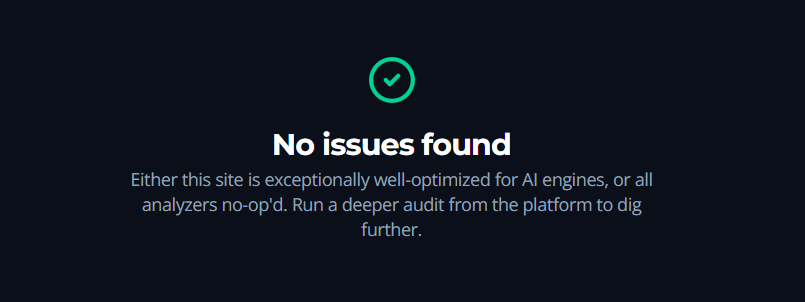
4. AI Crawlers Served (Live Request)
It is not enough to look at robots.txt theoretically.
A stronger test is to determine whether AI crawlers can actually reach your website.
4. AI Crawlers Served (Live Request)
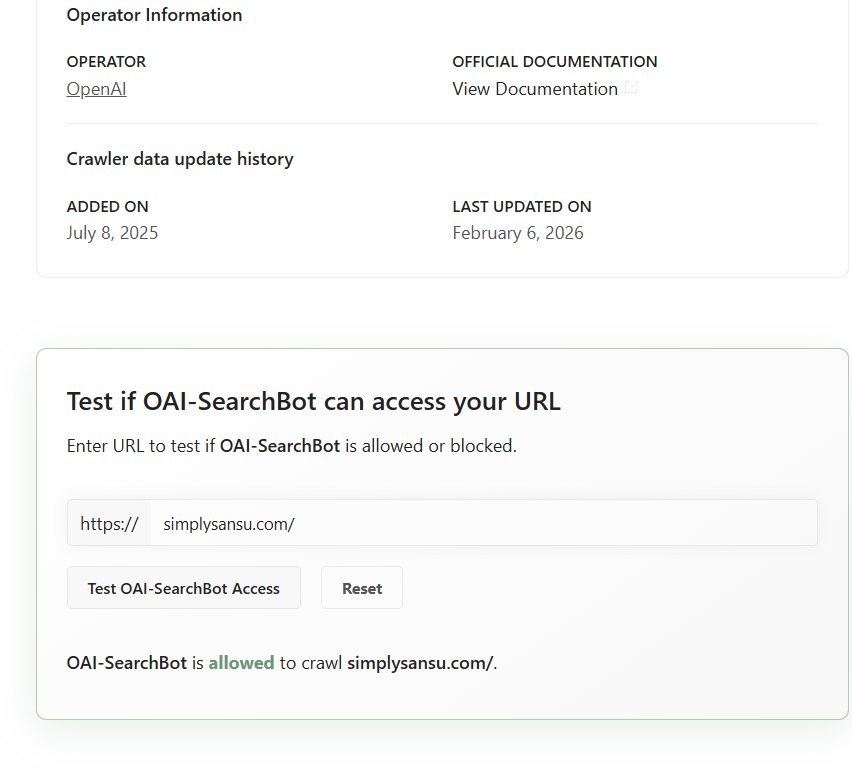
The next check was to see whether an AI crawler could actually access the website. I used CrawlerCheck’s OAI-SearchBot Access Test to test whether OpenAI’s search crawler was allowed to crawl SimplySansu.com.
CrawlerCheck: OAI-SearchBot Access Test
I entered:
URL tested: https://simplysansu.com/
The tool returned:
“OAI-SearchBot is allowed to crawl simplysansu.com/.”
Result: Passed
This confirms that OAI-SearchBot is permitted to crawl the SimplySansu.com homepage.
OAI-SearchBot is OpenAI’s crawler for search. OpenAI states that it is used to surface websites in ChatGPT search results and recommends allowing OAI-SearchBot if a website wants to be eligible for inclusion in those search results.
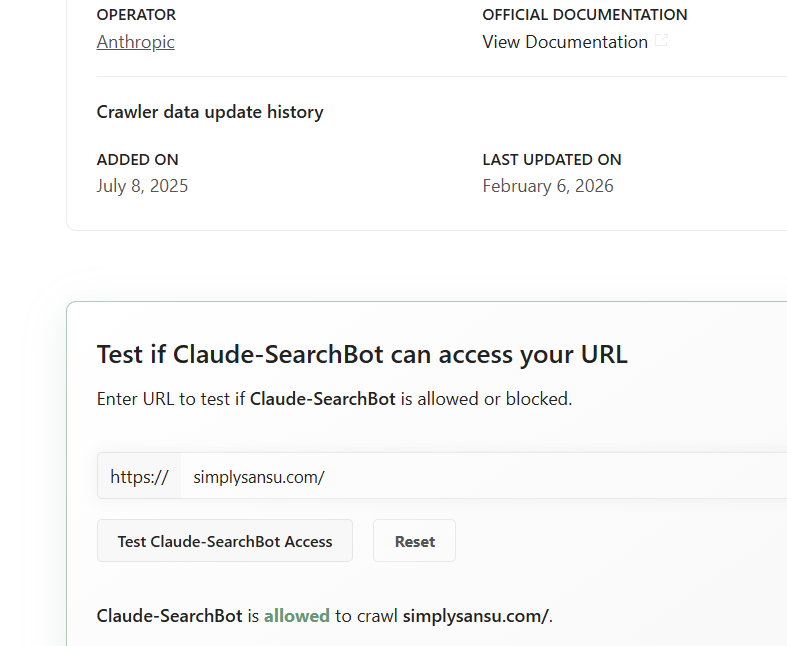
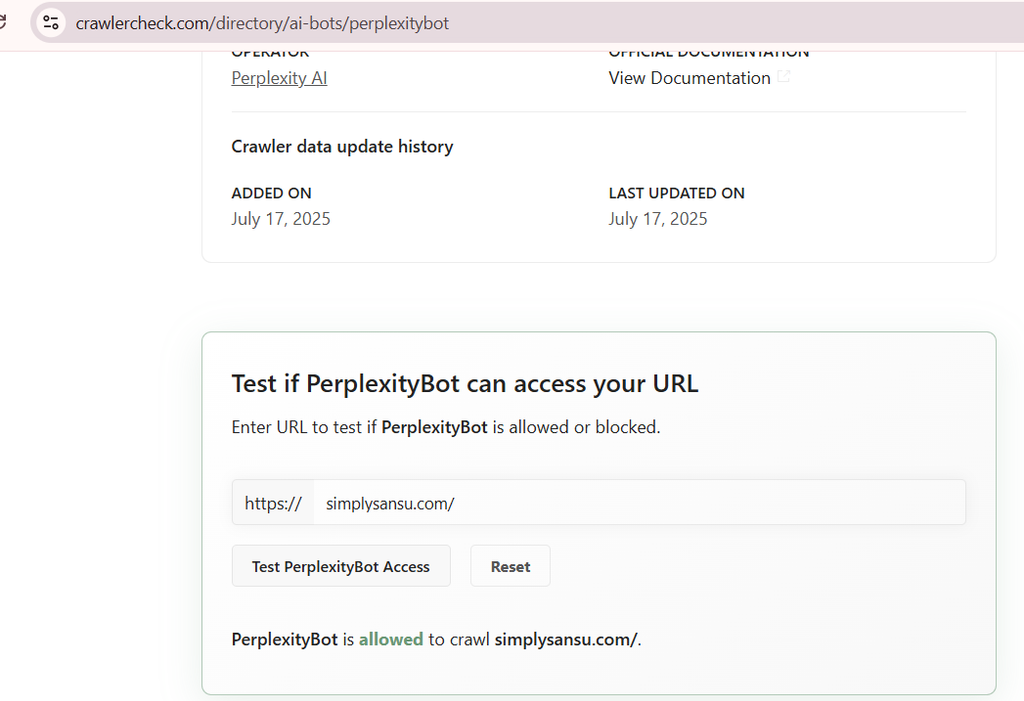
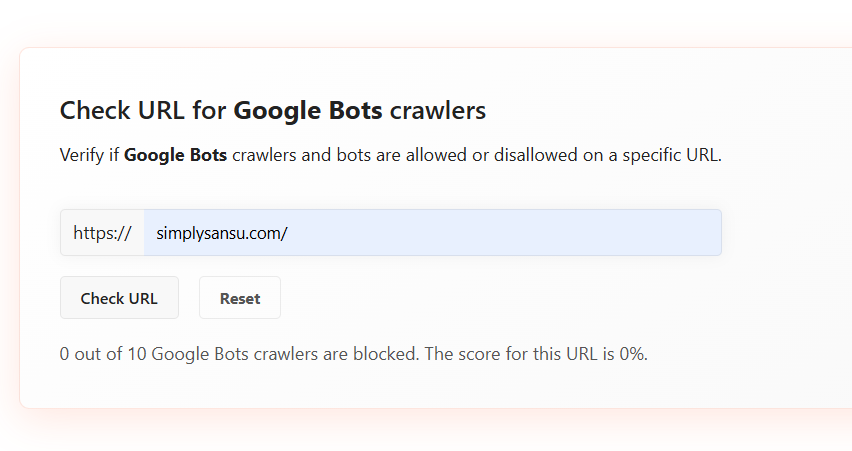
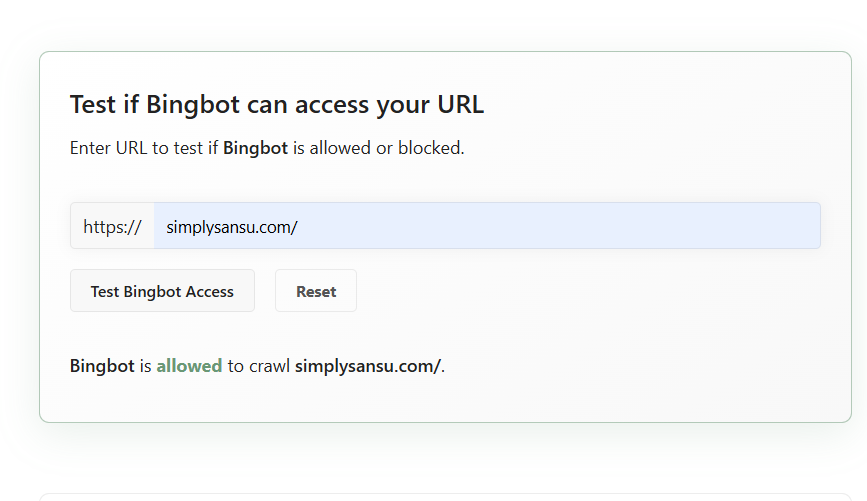
| Crawler | Test | Result |
|---|---|---|
| OAI-SearchBot | Live access test | Passed |
| Googlebot | Google crawler test | Passed |
| Bingbot | Bing Live URL test | Passed |
| Claude-SearchBot | AI crawler test | Passed |
| PerplexityBot | AI crawler test | Passed |
This is particularly important because a crawler can be blocked at other layers, such as:
- CDN
- Firewall
- Bot protection
- Authentication
- CAPTCHA
- Rate limiting
OpenAI notes that these systems can prevent its crawlers from accessing otherwise public pages. OpenAI Help Center
5. Meta Title and Meta Description
Your title and meta description help communicate what a page is about.
They are not an AI-specific ranking trick, but they are part of a well-structured website.
A page titled clearly around its subject is easier to interpret than one with a generic title such as “Home” or “Page 1.”
6. Clear Content Structure
The actual content still matters.
Important information should be presented in readable HTML with:
- Clear headings
- Short paragraphs
- Lists and tables where appropriate
- Direct answers to questions
- Descriptive links
- Clearly defined entities
- Relevant internal links
Google’s AI search guidance also emphasizes making important content available in textual form and ensuring that structured data matches visible content. CCNews
7. FAQ Content
FAQs can make important questions and answers explicit.
A good FAQ should contain real questions and useful answers, rather than adding questions simply to create an FAQ schema block.
For example:
What services does Simply Sansu offer?
A direct answer makes the information easier for both humans and machines to understand.
What I Check
For my AI website friendliness audit, I focused on a specific set of checks rather than treating every AI-related SEO concept as a requirement.
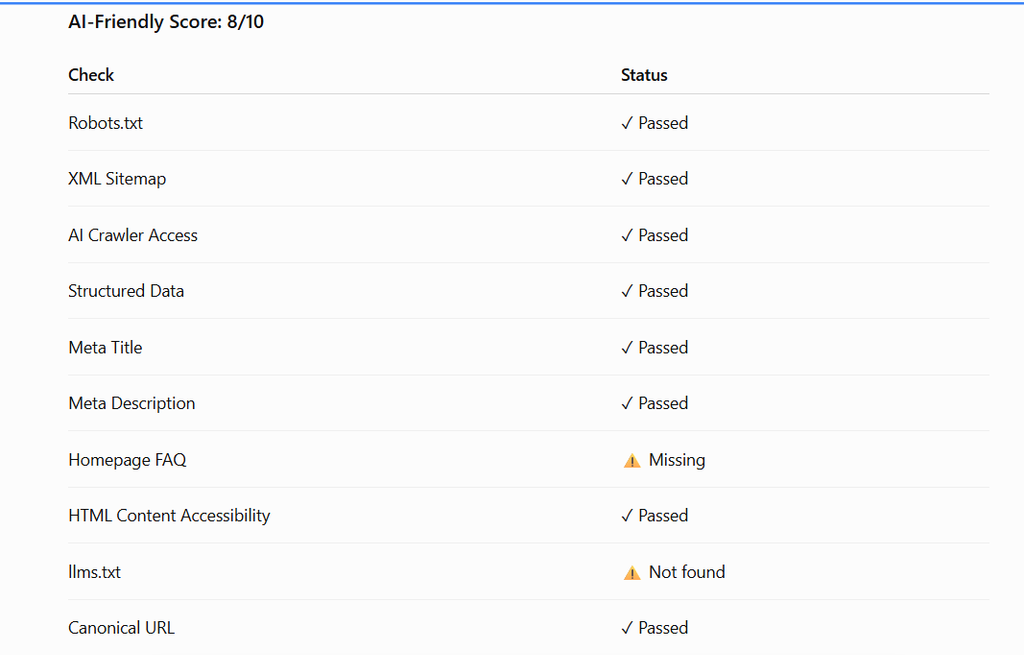
Robots.txt
Does the website have a robots.txt file, and does it contain rules that could prevent relevant crawlers from accessing important content?
Sitemap
Is an XML sitemap available and discoverable?
Structured data (schema.org)
Does the website use structured data to provide machine-readable information about its content?
AI crawlers served (live request)
Can an AI crawler actually make a request to the website and receive a response?
This is particularly useful because it goes beyond simply reading robots.txt.
Meta title and meta description
Does the page have clear and useful metadata describing its content?
Homepage contains FAQ section
Does the homepage provide a visible FAQ section that answers relevant questions about the business, product, or service?
These checks provide a practical starting point for evaluating whether a website has the basic technical and content signals needed to be more accessible to AI systems.
Tools to Measure AI Website Friendliness
I tested several tools that approach the problem differently. Some concentrate specifically on AI readiness, while others combine AI checks with traditional technical SEO.
1. Trendos
Trendos has an AI website crawlability test designed to check whether search engine and AI crawlers can reach your pages. Its broader platform focuses on AI search visibility, but the crawlability test is useful when your question is specifically about website accessibility. Trendos
The checks I found particularly useful for this type of audit include:
- Robots.txt
- Sitemap
- Structured data
- AI crawlers
- Metadata
- Homepage FAQ
This makes Trendos useful for a quick AI-friendliness snapshot before moving into a deeper technical audit.
2. Foglift
Foglift takes a broader technical-audit approach.
Its free Technical Audit evaluates five areas:
- SEO
- AI Readiness
- Performance
- Security
- Accessibility
Its AI Readiness analysis includes structured data, heading structure, FAQ presence, entity information, content depth, citation-friendly formatting, topical authority, and AI crawler accessibility. Foglift
One thing I particularly like about this approach is the separation between AI Readiness and AI Visibility.
A technical score tells you what may need fixing on the website. It does not tell you that ChatGPT or another AI engine will definitely cite you.
3. ScanSiteAI
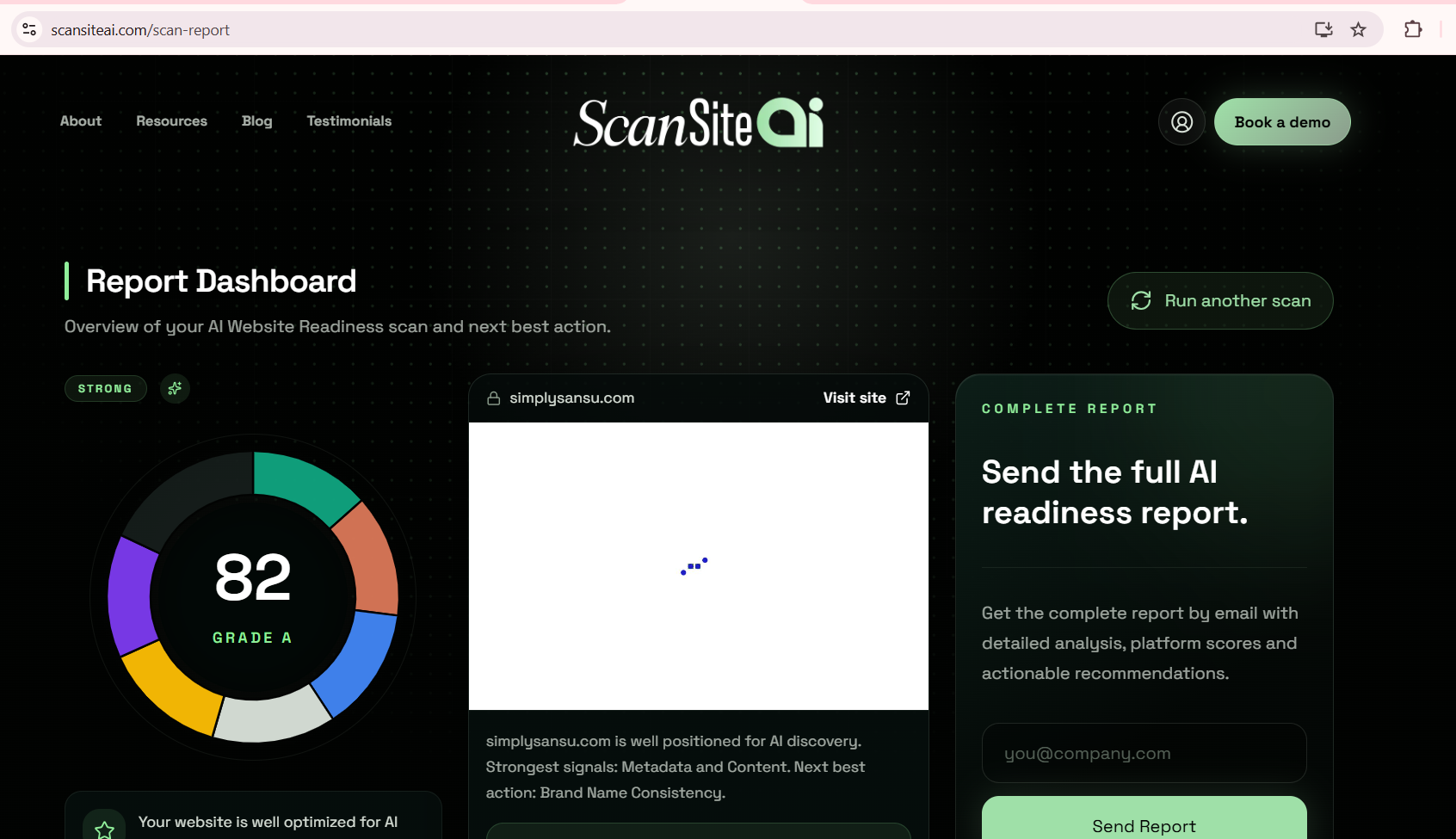
Simplysansu.com is well positioned for AI discovery.
ScanSite ai
Strongest signals: Metadata and Content.
Next best action: Brand Name Consistency.
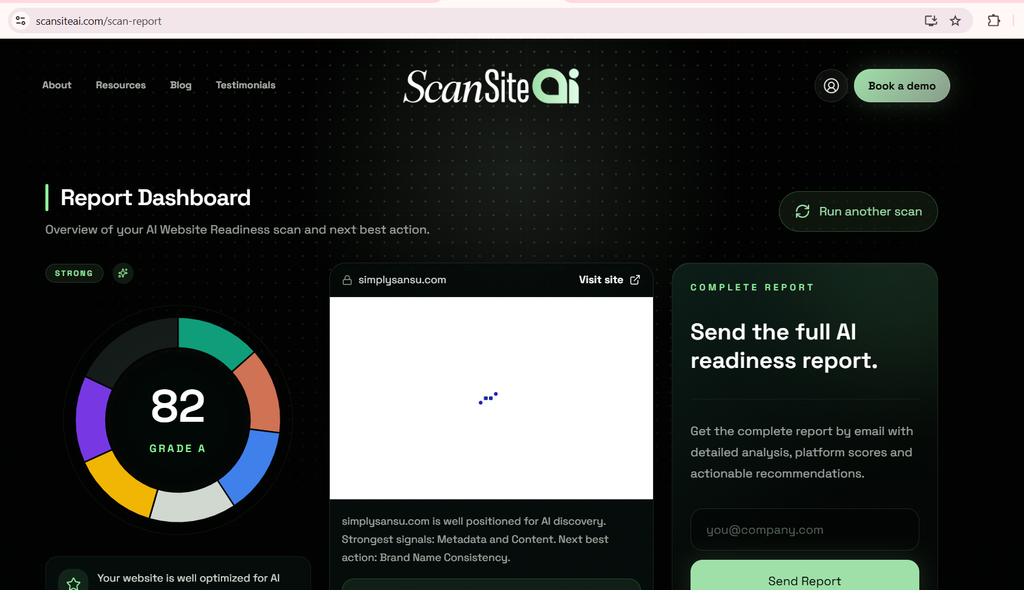
ScanSiteAI is another option specifically positioned as an AI website readiness checker.
Its audit looks at areas including:
- Robots.txt
- Sitemap
- Metadata
- Structured data
- Content structure
- FAQs
- Entity information
- Performance
- AI crawler access
It also produces an AI readiness score based on the signals it analyzes. ScanSiteAI
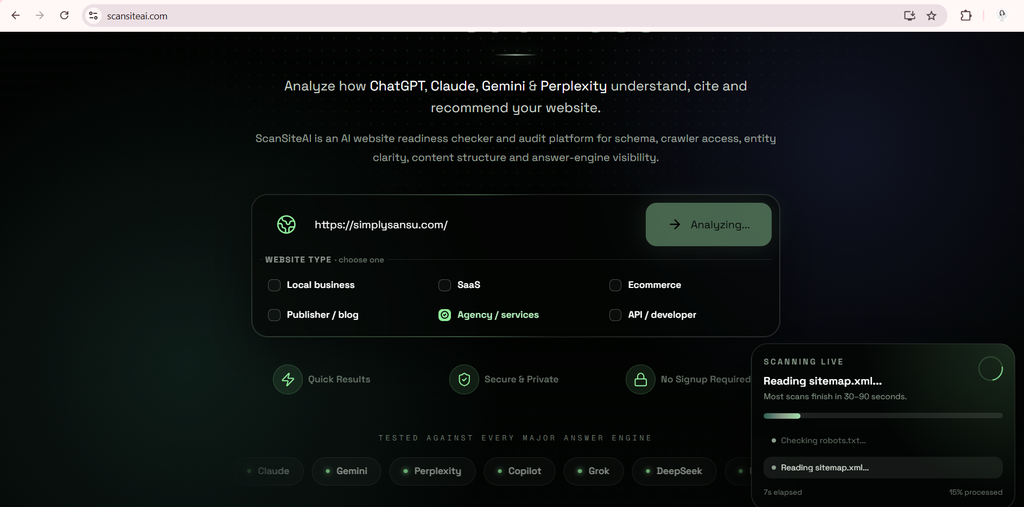
This type of tool is useful if you want something closer to an AI-specific website audit rather than a conventional SEO crawler.
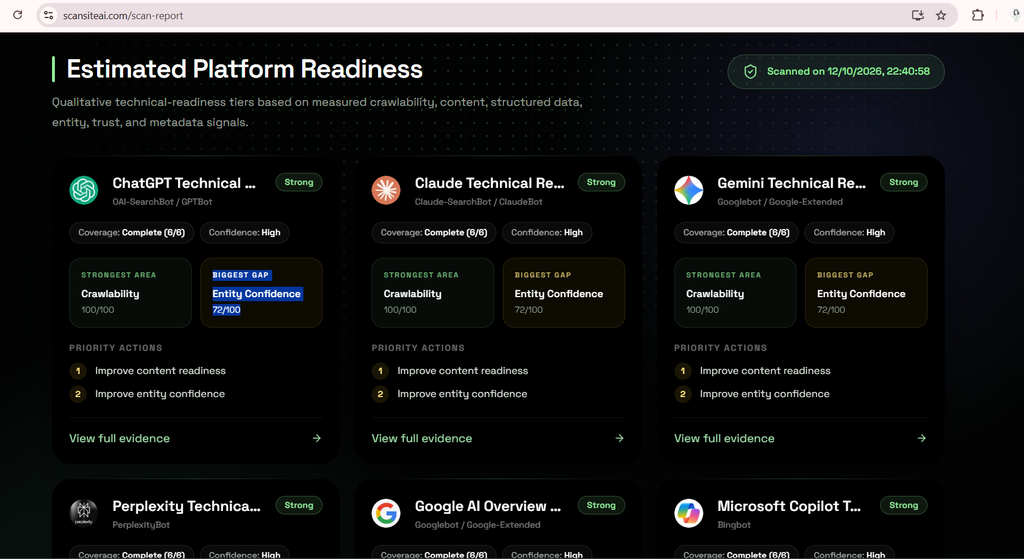
Entity Confidence (72/100) measures how clearly a website establishes its brand identity, expertise, services, and relationships through consistent on-site and off-site signals.
A score of 72/100 should be understood as the tool’s assessment, not a standardized score used by Google or any AI platform. It also does not necessarily indicate weak technical SEO, as entity confidence can be influenced by factors beyond technical implementation, including brand mentions, authoritative references, structured data, consistent business information, and topical associations.
For a fairly new brand, a 72/100 score is a valuable starting point, showing that the brand already has a meaningful level of recognition and identifiable signals while leaving room to strengthen its authority and visibility across search and AI platforms.
AI Website Friendliness Is Not the Same as AI Visibility
This distinction is important.
Suppose your website:
- Has a clean robots.txt
- Has a valid sitemap
- Uses structured data
- Allows AI crawlers
- Has good metadata
- Has clear content
- Has a useful FAQ
That means you have improved the technical conditions for AI systems to access and understand your website.
It does not automatically mean:
“ChatGPT will recommend my business.”
AI visibility is a separate measurement.
That requires testing actual AI responses for your target questions and tracking things such as:
- Brand mentions
- Citations
- Competitors
- Position in AI answers
- Sentiment
- Share of voice
- Which pages are being cited
Tools such as Trendos and Foglift can bridge these two areas, but the measurements should not be confused. Foglift, for example, explicitly treats crawler activity, technical readiness, AI answers, and AI referrals as separate evidence layers. Foglift
Final Thoughts
You don’t need to rebuild your website just because AI search has become important.
Start with the fundamentals.
Make sure crawlers can access your important pages. Keep your sitemap clean. Use accurate Schema.org structured data. Make your titles and descriptions meaningful. Structure your content clearly. Add useful FAQs where they genuinely help visitors.
Then test the site.
My preferred starting point would be Trendos for a quick AI-friendliness check and Foglift for a broader technical and AI-readiness audit. If you want a more specialized AI website readiness report, ScanSiteAI is another option.
Most importantly, don’t confuse a high AI-readiness score with AI visibility. First make the website accessible and understandable. Then measure whether AI systems actually use it.
Sources
OpenAI crawler documentation
Google Search Central: AI Features and Your Website
Foglift AI Readiness Website Grader
Trendos AI Search Visibility and Crawlability Tools