What 29 Business Leaders Really Think About AI in Marketing
Executive perspectives on AI adoption, productivity, ROI, human oversight, and the future of marketing
AI in marketing has moved well beyond experimentation.
But what do business leaders actually think about its role?
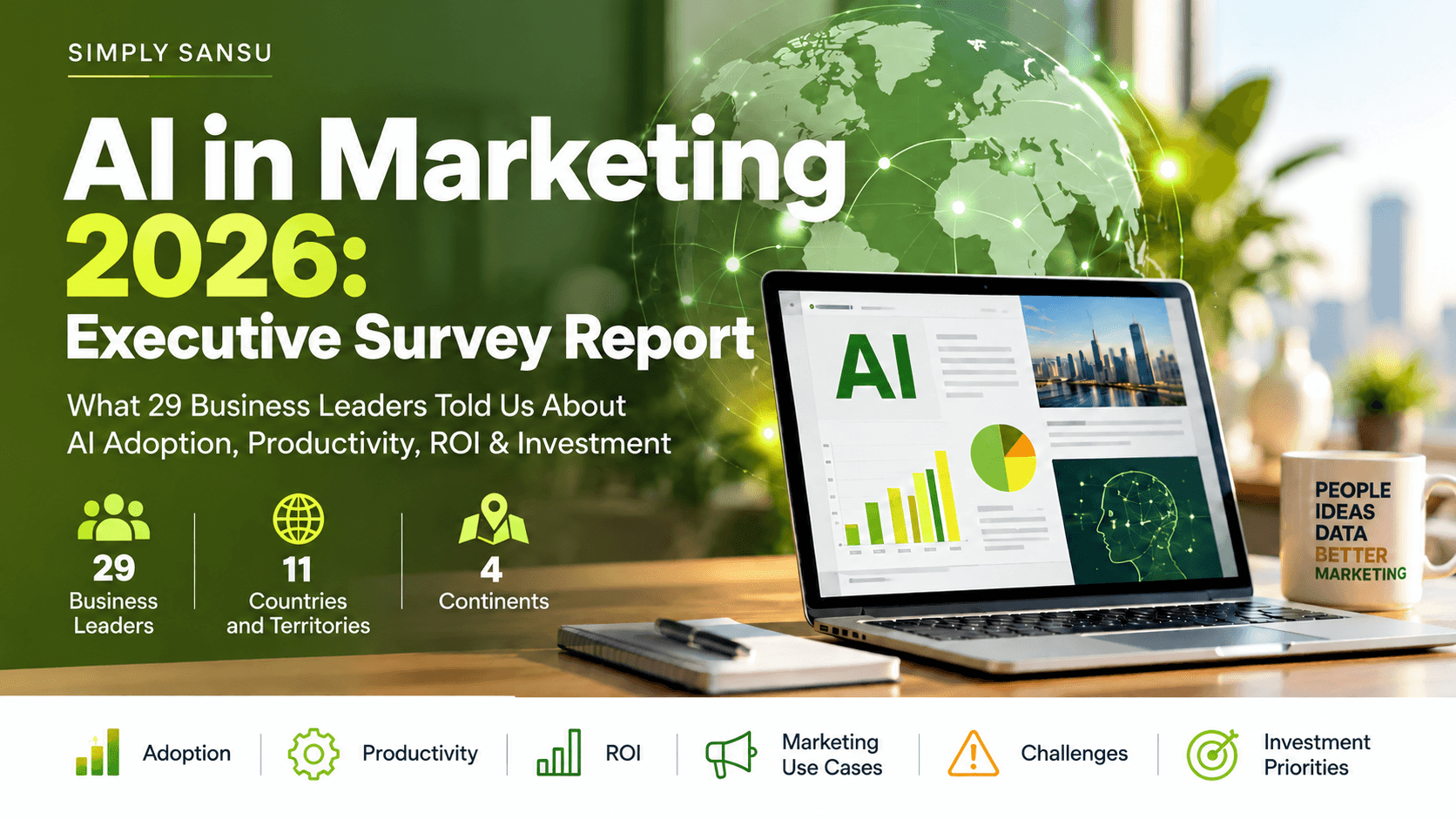
The AI in Marketing 2026 Executive Survey by Simply Sansu asked 29 business leaders across 11 countries and territories spanning four continents about how they are adopting AI, where they are seeing value, what challenges they face, and where they expect investment to go next. The findings represent this survey group and are not intended to represent the entire marketing industry. Pasted markdown(20261005-054650)
The numbers tell one story. The open-ended responses add another.
Taken together, they reveal a business environment where AI is increasingly embedded in everyday work, but executives are not treating it as a replacement for human expertise.
The recurring message is simple:
Businesses want AI to help people work better, but they still want people to remain responsible for the work.
“AI has allowed me to build and operate GetMarketing with a much smaller team than would traditionally be needed. I use AI almost like a partner or peer reviewer. I can challenge ideas, get a second perspective and iterate much faster than I could working completely on my own.”
Darya Kablash, Founder & CEO, GetMarketing, Germany
Source: AI in Marketing 2026: Executive Survey
AI Is Moving From Experimentation to Everyday Work
One of the clearest themes from the survey is that AI is becoming part of normal business operations.
In the survey, 65.5% of respondents reported that AI is integrated across multiple functions, while 24.1% said they use AI in selected departments. Only 10.3% were still piloting AI. Pasted markdown(20261005-054650)
The qualitative responses reinforce this shift.
Respondents described AI being used for research, content creation, SEO, analysis, automation, customer service, sales, and internal workflows. Looking ahead, they generally expect AI to become even more deeply embedded across business operations. AI IN MARKETING 2026 Executive …
This suggests that the executive conversation is changing.
The question is increasingly less about “Should we try AI?” and more about “How do we integrate AI effectively into the way we already work?”
1. Productivity Is the Biggest Immediate Opportunity
When executives described the practical benefits of AI, productivity and efficiency appeared repeatedly.
The strongest reason businesses are investing in AI was employee productivity and efficiency, selected by 86.2% of respondents. Automation of repetitive and time-consuming tasks followed at 79.3%. Pasted markdown(20261005-054650)
The open-ended responses provide more context.
Respondents mentioned:
- Saving time
- Reducing repetitive work
- Increasing output
- Faster delivery
- Automating processes
- Scaling without proportionally increasing headcount
- Spending more time on analysis and higher-value work
One respondent described the shift particularly clearly:
“My team spends less time on basic research and drafting, and more time on deep analysis and editing.”
Another emphasized a broader automation mindset, describing a preference for reducing manual work wherever AI or automation can handle the process. AI IN MARKETING 2026 Executive …
This is important because it shows how executives are framing AI.
For many, the immediate value is not autonomous decision-making. It is leverage.
AI helps teams accomplish more with the resources they already have.
2. Productivity Is Arriving Before Full Transformation
The survey also suggests that businesses are seeing productivity gains before they have completely transformed their operations around AI.
The report’s qualitative findings describe AI as helping teams research, create, analyze, and execute faster, while noting that deeper automation requires human expertise, sustained investment, and time. AI IN MARKETING 2026 Executive …
That distinction matters.
Adding an AI tool to an existing workflow is relatively easy.
Redesigning an entire workflow around AI is much harder.
It requires organizations to determine:
- Which tasks should be automated
- Where human review is required
- Which AI tools are appropriate
- How AI connects with existing systems
- How employees should be trained
- How performance should be measured
This is why AI adoption should not be measured only by how many tools a company has purchased.
The deeper question is whether AI has become part of a repeatable, reliable business process.
3. Content Is the Strongest Marketing Use Case
Among specific marketing activities, Content Strategy & Creation emerged as the strongest area where respondents said AI delivers value, selected by 86.2% of participants.
SEO & AI Search Visibility and Marketing Analytics & Reporting followed at 58.6% each. Pasted markdown(20261005-054650)
That makes sense when viewed alongside the qualitative responses.
Marketing teams can use AI across multiple stages of the content process:
Research → ideation → drafting → editing → repurposing → analysis
But the responses also point toward an important limitation.
AI can accelerate production without necessarily replacing the people responsible for quality.
That distinction becomes particularly important for content that requires:
- Original thinking
- Brand understanding
- Factual accuracy
- Subject-matter expertise
- Editorial judgment
- Strategic context
The executives’ perspective therefore appears to be less “AI can create our content for us” and more “AI can help our teams create and improve content faster.”
4. Executives See AI as a Tool, Not a Complete Replacement for People
This may be the most important theme in the survey.
The respondents generally expect AI to play a significant role in business over the next two to three years. They anticipate greater automation across marketing, research, SEO, customer service, data analysis, content, sales, and internal workflows.
At the same time, they expect human judgment, relationships, creativity, and strategic decision-making to remain important. AI IN MARKETING 2026 Executive …
One respondent described AI as a tool that can accelerate production and improve creativity and iteration, while pointing out that AI cannot replace the human relationship at the other end of a business interaction. Another expected AI to contribute significantly to business scalability across continents. AI IN MARKETING 2026 Executive …
That distinction is worth paying attention to.
Executives are not necessarily choosing between AI or humans.
They are increasingly considering AI and humans working together.
5. Confidence in AI Does Not Mean Blind Reliance
The survey specifically asked about confidence in AI-generated business insights, rather than simply asking whether respondents “trust AI.” Pasted markdown(20261005-054650)
The results show that 58.6% of respondents were generally confident and 17.2% were highly confident in AI-generated business insights.
At the same time, 20.7% said they always require human verification. Pasted markdown(20261005-054650)
This creates an important distinction:
Confidence and human oversight can exist at the same time.
A business leader can believe that AI is useful and generally reliable while still requiring a person to verify important information before it influences a business decision.
For marketing teams, this is particularly relevant.
AI-generated content, analysis, recommendations, and research still need to be evaluated for:
- Accuracy
- Context
- Originality
- Brand alignment
- Factual claims
- Business relevance
The emerging model is therefore not simply:
AI → decision
It is closer to:
AI → human review → decision
6. Accuracy Is the Biggest Executive Concern
The strongest challenge identified by respondents was accuracy and reliability of AI-generated outputs, selected by 75.9% of participants.
Choosing the right AI tools followed at 58.6%, while human oversight was identified by 44.8%. AI errors and hallucinations were another significant concern at 41.4%. Pasted markdown(20261005-054650)
The qualitative responses tell a similar story.
Respondents repeatedly highlighted:
- Accuracy and quality control
- Fact-checking
- Human review
- AI errors
- Critical thinking
- Employee adoption
- Workflow integration
The report summarizes the recurring concern as a need to maintain accurate, useful, original, and consistent AI output, with human fact-checking and review still required. AI IN MARKETING 2026 Executive …
This is perhaps the biggest gap between AI capability and AI readiness.
A tool can generate an answer quickly.
That does not automatically make the answer reliable.
7. The Challenge Is No Longer Just Adoption
Another recurring theme was the difficulty of moving from individual experimentation to reliable organization-wide systems.
Respondents identified workflow integration, employee adoption, training, tool selection, human oversight, and the rapidly changing AI landscape as ongoing challenges. AI IN MARKETING 2026 Executive …
This changes how businesses should think about AI adoption.
Having employees experiment with ChatGPT or another AI platform is one thing.
Building a repeatable AI-enabled workflow is another.
A mature AI workflow needs clear answers to questions such as:
What can AI do?
What must a person review?
Who is accountable for the final output?
How will accuracy be checked?
How will success be measured?
The survey suggests that these questions are becoming increasingly important as AI moves deeper into business operations.
8. ROI Is More Complicated Than Productivity
The survey also reveals an interesting difference between productivity and financial returns.
Productivity improvements can be relatively easy for teams to notice. A task takes less time. A campaign moves faster. A team produces more content. Research becomes quicker.
ROI is more complicated.
Some respondents reported measurable financial returns, while others said it was still too early to measure AI’s ROI. The survey also identified ROI measurement itself as an implementation challenge for 20.7% of respondents. Pasted markdown(20261005-054650) Pasted markdown(20261005-054650)
This creates an important executive distinction:
AI can demonstrate productivity before it demonstrates profitability.
That may explain why businesses can remain enthusiastic about AI investment while still asking difficult questions about its financial impact.
9. Businesses Are Continuing to Invest
Despite these concerns, the investment outlook remains strong.
In the detailed investment question, 48.3% expected a significant increase in AI investment over the next 12 months, while 44.8% expected a moderate increase. Only 6.9% expected investment to remain unchanged, and no respondent selected a decrease. Pasted markdown(20261005-054650)
Marketing & Communications emerged as the leading expected area for AI investment growth at 27.8%, followed by Operations & Process Automation at 24.1%. Pasted markdown(20261005-054650)
This is one of the most interesting findings from an executive perspective.
Businesses are not waiting for every uncertainty around AI to disappear.
They are investing while simultaneously figuring out how to manage the risks.
10. What Executives Expect From AI Over the Next 2–3 Years
The survey responses suggest that AI’s role will continue expanding.
Respondents expect AI to move from an individual productivity tool toward a more deeply embedded operating layer across functions.
Expected applications include:
- Marketing
- Research
- SEO
- Customer service
- Data analysis
- Content
- Sales
- Internal workflows
But the expected expansion of AI does not mean the disappearance of human expertise.
Respondents still highlighted judgment, relationships, creativity, and strategic decision-making as areas where people will remain important. AI IN MARKETING 2026 Executive …
One respondent summed up the future role of AI simply:
“A significant role.”
Another described AI’s potential to increase business scalability across continents. AI IN MARKETING 2026 Executive …
What 29 Business Leaders Really Think About AI
Looking beyond the percentages, five themes stand out.
1. AI is primarily a productivity and efficiency tool
Executives are using AI to save time, automate repetitive work, increase output, and help teams focus on higher-value activities.
2. Adoption is becoming embedded
AI is moving from isolated experiments toward broader integration across departments and workflows.
3. Human oversight remains essential
Even respondents who are confident in AI-generated insights still recognize the need for human verification and judgment.
4. Accuracy is the biggest obstacle
The challenge is no longer simply getting AI to produce something. It is ensuring that what it produces is accurate, useful, original, and appropriate for the business.
5. Investment is continuing despite uncertainty
Businesses appear willing to increase AI investment while simultaneously developing better processes for governance, verification, integration, and measurement.
The Emerging Model: AI-Assisted, Human-Led
The strongest conclusion from these executive perspectives is not that AI will replace marketers.
It is that the role of AI is becoming increasingly integrated into how marketers work.
The survey points toward a model that looks like this:
AI adoption → AI-assisted workflows → human oversight → final decision
AI provides speed, scale, automation, research, analysis, and production support.
People remain responsible for context, judgment, relationships, creativity, accuracy, and strategic decisions.
The report’s qualitative findings make this distinction particularly clear: the challenge for marketers is no longer simply adopting AI, but integrating it without sacrificing accuracy, originality, trust, or human judgment. AI IN MARKETING 2026 Executive …
That may be the most useful takeaway for businesses planning their next phase of AI adoption.
The future may not belong to companies that use the most AI. It may belong to companies that build the most effective human-AI workflows.
About the Survey
The AI in Marketing 2026 Executive Survey was conducted by Simply Sansu to understand how business leaders are adopting AI, where they are seeing value, what is driving investment, and what challenges remain.
The survey received 29 responses from business leaders across 11 countries and territories spanning four continents. The findings describe the survey respondents and are not intended to represent the entire marketing industry. Pasted markdown(20261005-054650)
Research by: Sansu Abraham, Founder, Simply Sansu
Original survey: AI in Marketing 2026 Executive Survey