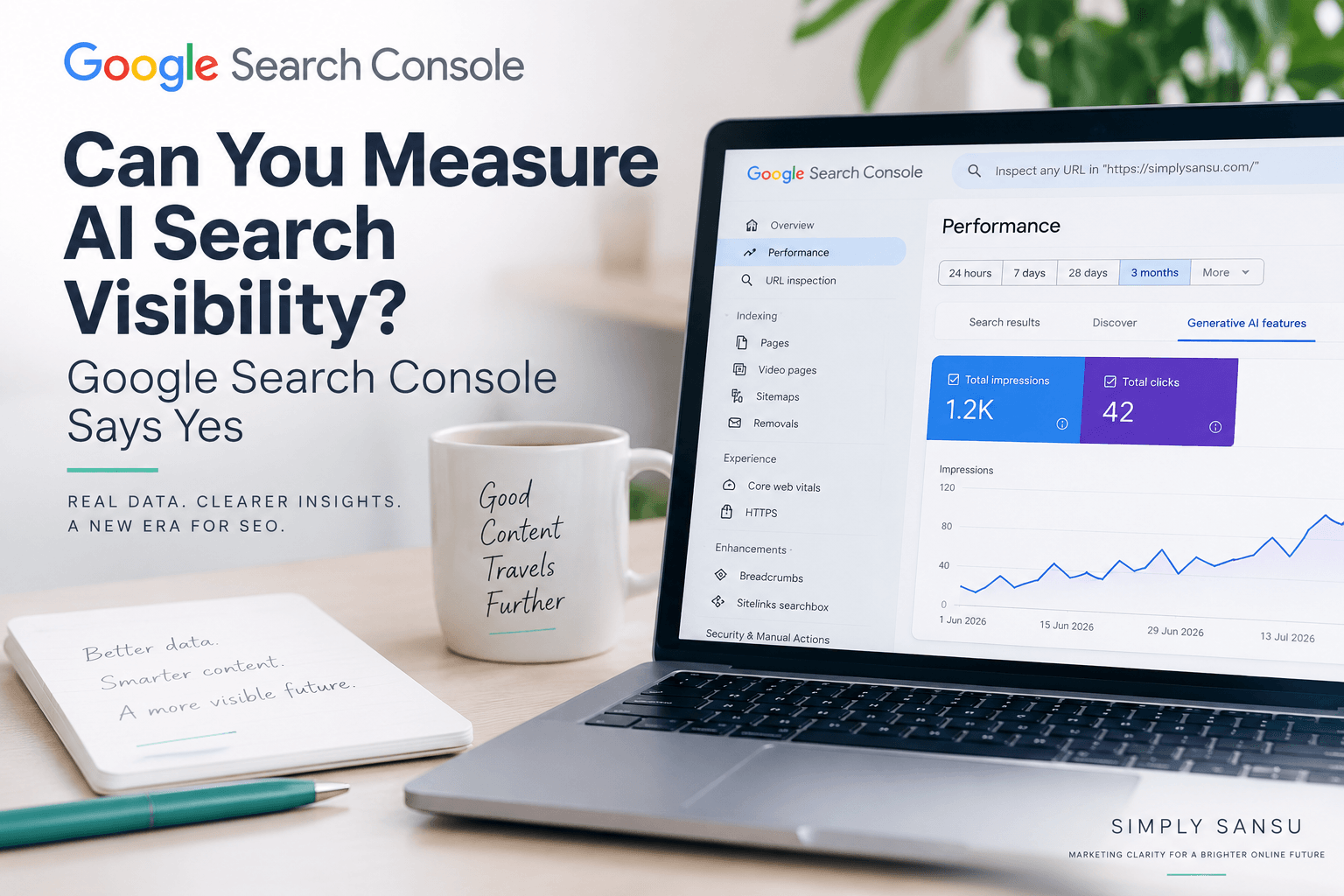
Can You Measure AI Search Visibility? Google Search Console Says Yes
For months, one question has come up repeatedly around AI SEO:
How do we know whether our content is actually appearing in AI-powered search?
Until now, the answer was largely manual. You could search for relevant questions, look at AI-generated results, and see whether your website was cited. But there was no simple way to measure that visibility inside Google Search Console.
That changed on June 3, 2026, when Google introduced Generative AI performance reporting in Search Console. The feature provides reporting on visibility in Google’s generative AI search experiences, including AI Overviews and AI Mode.
My First Experience With It
Before noticing the new report, I had already been testing searches related to topics I had written about.
While searching Google, I noticed that Simply Sansu and some of my content were being cited in AI-generated responses.
That was encouraging, but it raised another question:
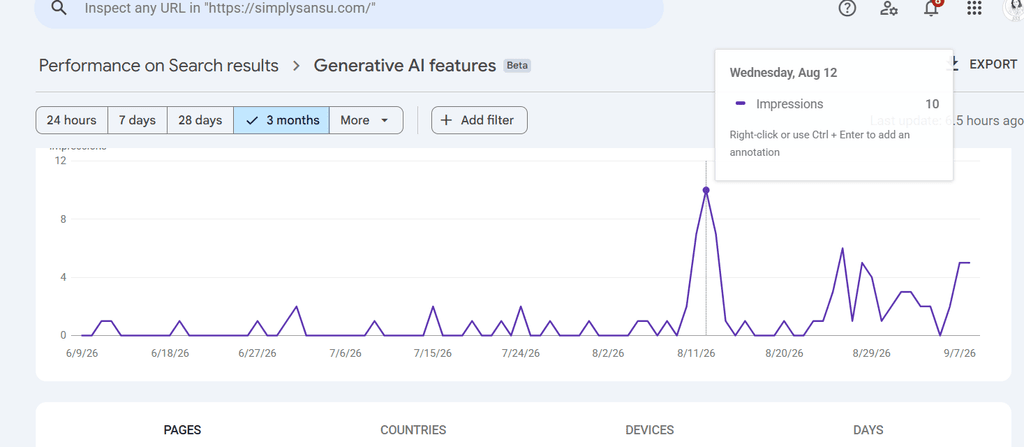
How often was this happening?
Manual searches can only tell you so much. You cannot test every query or monitor AI visibility consistently at scale.
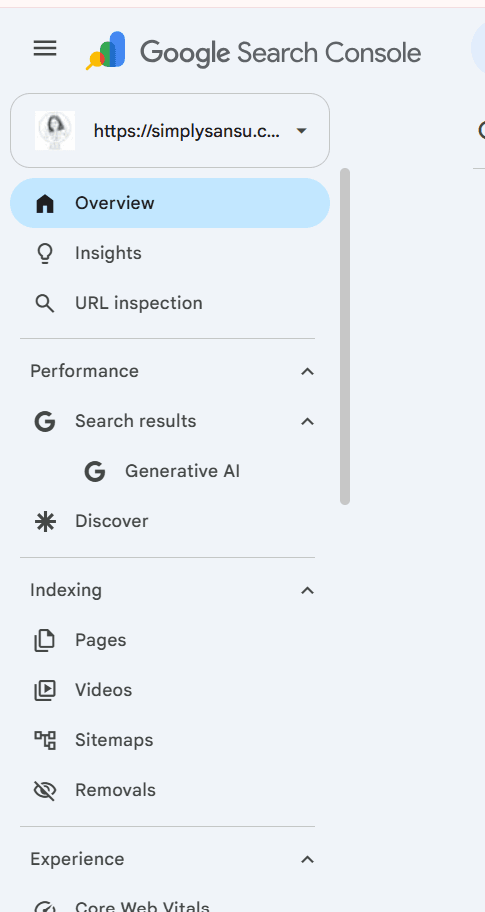
Then I noticed the new Generative AI Features section in Google Search Console.
My website had started receiving impressions there.
One impression does not mean massive AI visibility. But it does mean something important: a URL from my website appeared in a Google generative AI search experience.
For me, that is where this report becomes useful.
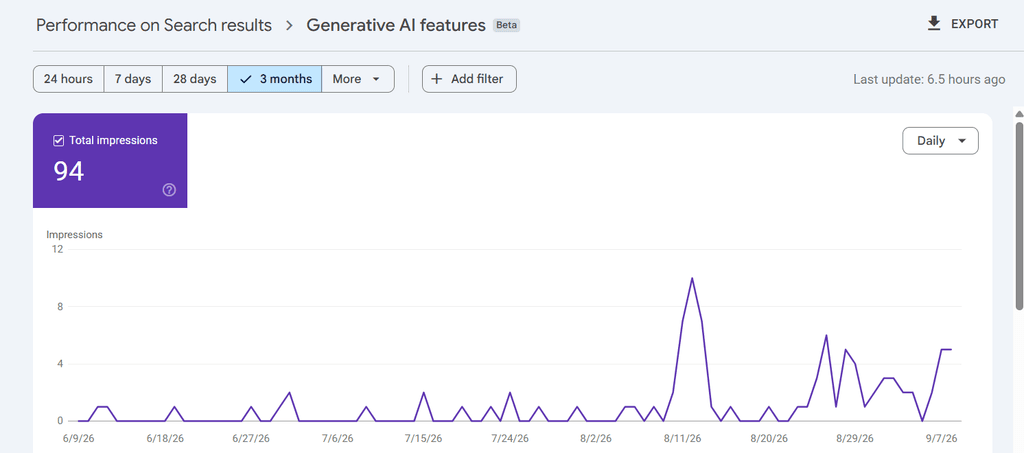
What Is the Generative AI Features Report?
The report gives website owners another way to understand how their websites perform in Google’s generative AI search features.
You can analyze data such as:
- Impressions
- Clicks, where applicable
- Pages
- Countries
- Devices
- Performance over time

This gives us something we previously lacked: first-party data from Google about visibility in its AI-powered search experiences.
Why This Matters for AI SEO
AI visibility has been difficult to measure.
Most marketers have relied on:
- Manual searches
- Screenshots
- Third-party tools
- Brand monitoring
- Guesswork
You could search a question and discover that your website was cited in an AI response. But that did not tell you how often it happened or which other pages were appearing.
Now we can start asking better questions:
- Which pages are appearing in AI features?
- Is AI visibility increasing?
- Which topics are gaining visibility?
- Are certain types of content performing better?
That makes AI SEO more measurable.
What Does One Generative AI Impression Mean?
If you see one impression in the Generative AI Features report, it means a URL from your website appeared once in a Google generative AI search experience.
However, it does not necessarily mean Google copied or quoted your content directly.
The important point is that your website gained measurable visibility.
That is why I would not obsess over a single impression.
Instead, watch what happens over time.
The Pages Report Could Be the Most Useful Part
For me, the Pages section is particularly interesting.
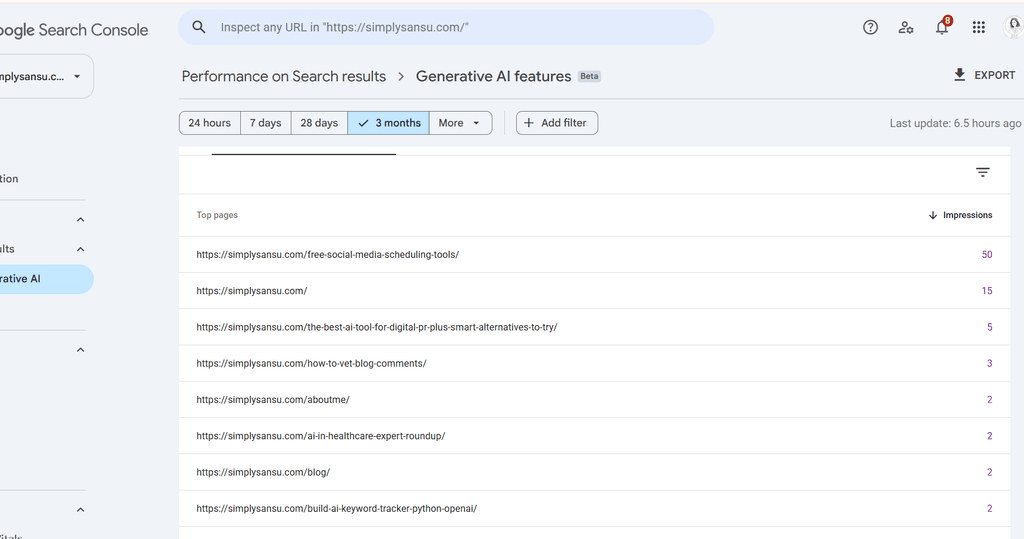
Imagine discovering that certain pages consistently receive Generative AI impressions.
You might find that:
- A detailed guide appears frequently
- A particular blog gains visibility
- An FAQ-based page performs well
- A service page starts appearing in AI features
The next step is to study those pages.
Ask:
What do they have in common?
Are they:
- Detailed?
- Well structured?
- Focused on specific questions?
- Based on first-hand experience?
- Covering a topic in depth?
- Providing original information?
The report does not tell us exactly why Google selected a page.
But it can show us which pages are gaining visibility, giving us something to analyze.
How Can You Use This Data?
1. Identify Content Already Gaining AI Visibility
Start with the Pages report.
Find the URLs receiving Generative AI impressions and study them.
Look for patterns in:
- Topics
- Content format
- Depth
- Structure
- Expertise
These pages may provide useful clues about what is already working.
2. Find Content Opportunities
If one topic is gaining AI visibility, there may be an opportunity to expand your coverage.
For example:
AI SEO Guide
↓
Supporting articles
↓
FAQs
↓
Case studies
↓
Expert commentary
Instead of creating content randomly, you can use existing AI visibility as one signal when planning future content.
3. Track Visibility Over Time
One impression is interesting.
A trend is more useful.
Monitor whether your Generative AI visibility is:
- Growing
- Stable
- Declining
- Increasing around specific topics
Over time, this can become another metric alongside organic traffic, impressions, clicks, and keyword performance.
4. Improve AI SEO Reporting
Until now, much AI SEO reporting has depended heavily on third-party platforms.
Google Search Console adds something different:
Data directly from Google.
That does not replace other tools or traditional SEO reporting. But it gives website owners another useful source of information.
Seeing Your Website Cited Is Different From Measuring Visibility
This was the biggest takeaway for me.
I had already seen my website cited while manually searching relevant questions.
That showed me that my content could appear in AI-generated responses.
But manual checking has limits.
You cannot search every possible query.
You cannot consistently monitor everything.
And seeing one citation does not show you the bigger picture.
The Generative AI Features report helps bridge that gap by providing measurable performance data.
Does This Change Traditional SEO?
No.
AI SEO does not mean traditional SEO suddenly stops mattering.
The fundamentals remain important:
- Useful content
- Original information
- Clear website structure
- Crawlable pages
- Technical SEO
- Strong topical coverage
- Trust and authority
Google’s guidance continues to emphasize that the fundamentals of creating helpful, accessible content remain relevant for AI-powered search experiences.
AI search is another way people may discover your content—not a reason to abandon SEO fundamentals.
What the Report Cannot Tell You
The report is useful, but it does not answer everything.
It does not tell you:
- Every exact query that triggered an AI appearance
- Exactly why Google selected your page
- Whether your content was quoted directly
- The complete AI response where your page appeared
So this is not a magic tool for ranking in AI search.
But it gives us something important:
Visibility data.
My Take
I think this is an important development for SEO and AI SEO.
Not because one report tells us how to rank in AI search.
It doesn’t.
But because we can move beyond simply saying:
I think my content is appearing in AI search.
And start saying:
These pages are receiving measurable visibility in Google’s generative AI features.
That gives us data to study.
And over time, that data may help us understand:
- Which content performs well
- Which topics gain visibility
- How AI visibility changes
- Where future content opportunities exist
What Should You Do Now?
If you can see Generative AI Features in Google Search Console:
- Check your overall impressions.
- Look at the Pages receiving visibility.
- Monitor performance over time.
- Identify patterns in the content appearing.
- Use those insights when planning future SEO and content.
My advice?
Don’t focus too much on one impression. Focus on the trend.
The real value of this report will become clearer as more data accumulates.
For now, it gives website owners something we have been missing:
A way to start measuring AI search visibility.
And for anyone working in SEO today, that is worth paying attention to.