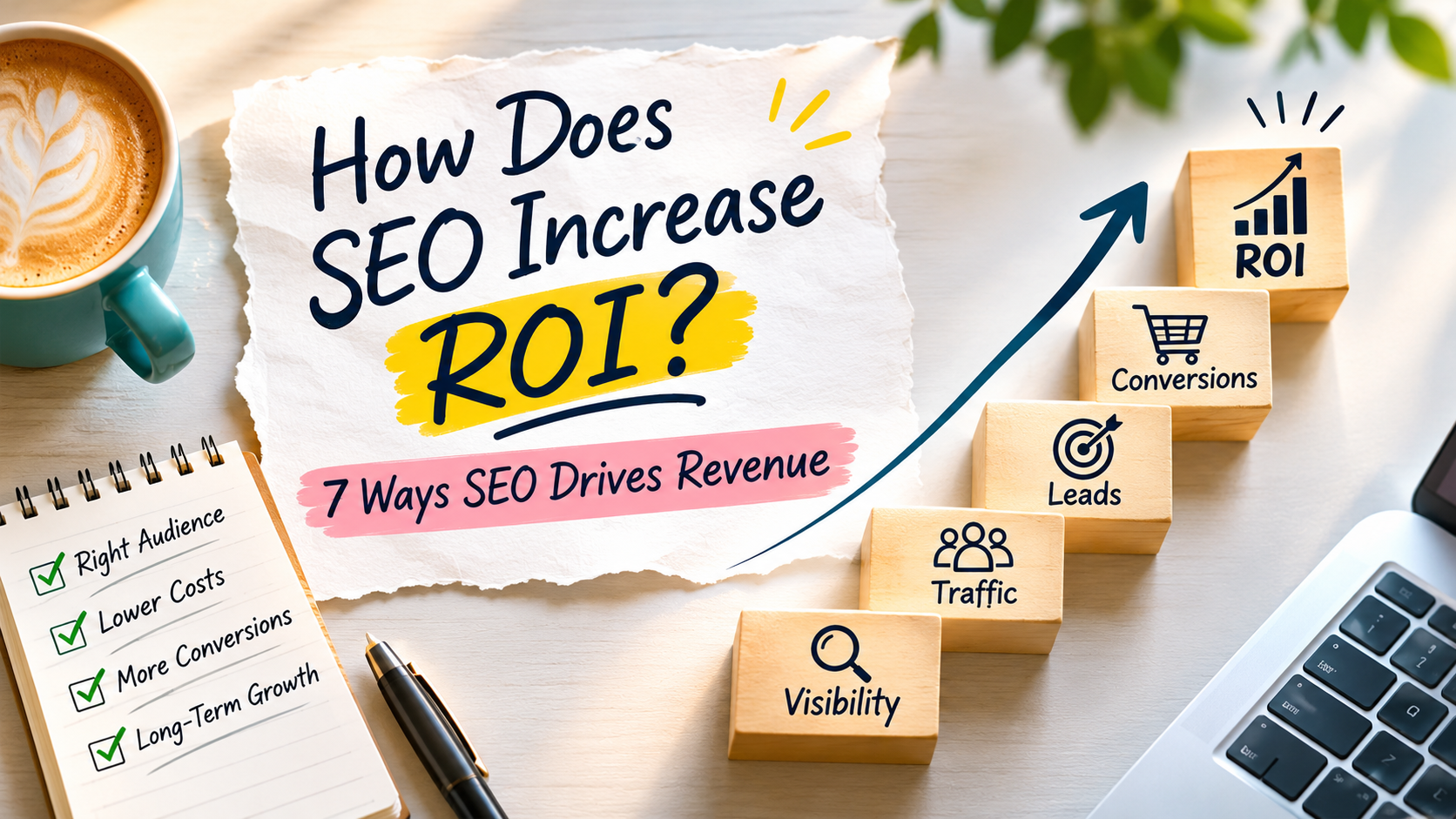
How Does SEO Increase ROI? 7 Ways SEO Turns Search Traffic Into Revenue
Share this article:
SEO is often measured by rankings, impressions, and organic traffic.
But those numbers alone don’t pay the bills.
The more important question is:
How does SEO actually contribute to revenue and ROI?
The answer is not simply “more traffic.” Good SEO can reduce customer acquisition costs, attract higher-intent visitors, improve conversions, build brand visibility, and continue generating value long after the initial optimization work is done.
Here are seven ways SEO can improve your return on investment, with practical examples.
1. SEO Brings in High-Intent Customers
Not all website visitors are equally valuable.
Someone searching for “what is digital marketing?” is probably still learning. Someone searching for “digital marketing agency for small business” is much closer to making a buying decision.
SEO helps businesses target these different stages of the customer journey.
Example
Imagine a company selling accounting software.
Ranking for:
“What is accounting software?”
could bring a lot of informational traffic.
But ranking for:
“Best accounting software for small businesses”
or
“Accounting software pricing”
can attract visitors who are much closer to choosing a product.
ROI impact: SEO services can bring in traffic with stronger purchase intent, increasing the likelihood that organic visitors become leads or customers.
2. SEO Can Reduce Your Cost Per Acquisition
Paid advertising stops producing traffic when you stop paying for clicks.
SEO works differently.
Once a page earns strong organic visibility, it can continue attracting visitors without paying for every individual click.
Example
Suppose a business spends $2,000 per month on paid search and generates 100 leads.
That’s a $20 cost per lead.
Now imagine SEO generates another 50 qualified leads from organic search without a separate cost for each click.
The SEO investment still has a cost, of course, but the incremental cost of each additional organic visitor can become much lower as visibility grows.
ROI impact: A successful organic search strategy can reduce dependence on continuously paying for every visitor.
3. SEO Captures Customers Before Your Competitors Do
People often search for a solution before they search for a specific brand.
That creates an opportunity.
If your business appears when someone searches for a problem, comparison, solution, or product category, you can enter the customer’s consideration set before they have chosen a competitor.
Example
A person searches:
“Best CRM for a small sales team”
If your CRM company appears with a useful comparison guide, the customer may consider your product alongside established competitors.
You haven’t just captured a click.
You’ve entered the decision-making process.
ROI impact: SEO can influence customers earlier in the buying journey, potentially increasing the number of people who eventually choose your brand.
4. SEO Improves Conversion by Matching Content to Search Intent
Getting visitors to your website is only half the job.
If the page doesn’t match what they were looking for, traffic won’t necessarily produce revenue.
Good SEO connects the search query with the right page and the right next step.
Example
Someone searches:
“How much does professional SEO cost?”
Sending them to a generic homepage creates friction.
A dedicated page explaining SEO pricing, what affects cost, what is included, and how to get started is much more relevant.
The visitor doesn’t have to search your website for the answer.
ROI impact: Better search intent matching can improve engagement and conversion rates, allowing the same amount of traffic to generate more leads or sales.
5. SEO Creates Assets That Keep Working
One of the biggest differences between SEO and many short-term marketing tactics is that SEO can create long-term digital assets.
A useful article, service page, comparison guide, or case study can continue attracting search visibility months or even years after publication.
Example
A business publishes a detailed guide targeting:
“How to choose accounting software for a small business”
If the page ranks well, it may continue bringing relevant visitors long after the original content investment.
The business can update the page as products, prices, and customer needs change.
ROI impact: A well-performing organic page can continue generating traffic, leads, and sales without requiring a new campaign every time someone visits it.
6. SEO Builds Brand Visibility Before the Customer Is Ready to Buy
SEO isn’t only about immediate conversions.
Sometimes the first interaction happens months before the purchase.
A customer may discover your brand through an informational article, see your name again in a comparison search, and eventually visit your service page when they’re ready to buy.
Example
Someone searching:
“How to improve website visibility”
finds your article.
Later, they search:
“SEO consultant for small business”
and see your brand again.
That repeated exposure can make your business more familiar when the customer is finally ready to make a decision.
ROI impact: SEO can contribute to brand awareness and consideration, even when the first organic visit doesn’t result in an immediate conversion.
7. SEO Can Strengthen Other Marketing Channels
SEO doesn’t have to operate in isolation.
The content and authority you build through SEO can support email marketing, social media, Digital PR, sales outreach, and even paid campaigns.
Example
You publish a data-driven industry report.
It ranks in search, gets shared on LinkedIn, becomes a reference for journalists, earns backlinks, and gives your sales team something valuable to share with prospects.
One piece of content can therefore support several marketing activities.
ROI impact: SEO investment can create value across multiple channels instead of producing value only through organic search traffic.
So, How Do You Actually Measure SEO ROI?
This is where many businesses go wrong.
They look at:
- Rankings
- Impressions
- Organic traffic
Those metrics are useful, but they aren’t ROI.
To understand the financial impact of SEO, connect organic performance to business outcomes.
For example:
Organic traffic → Leads → Qualified leads → Customers → Revenue
Then compare that revenue with your SEO investment.
The important question isn’t simply:
“Did organic traffic increase?”
It’s:
“How much revenue did organic search contribute compared with what we invested?”
That is where SEO becomes a business investment rather than just a marketing activity.
SEO ROI Isn’t Just About Traffic
The biggest misconception about SEO is that more traffic automatically means better ROI.
It doesn’t.
1,000 visitors looking for information may be less valuable than 100 visitors actively looking to buy.
The real value comes from attracting the right people, with the right intent, to the right page, at the right stage of the buying journey.
That is why effective SEO focuses on more than rankings.
It focuses on visibility, relevance, intent, conversion, and revenue.
Final Takeaway
SEO can increase ROI by helping businesses:
- Attract high-intent customers
- Reduce dependence on paid acquisition
- Reach customers earlier in the buying journey
- Improve conversion opportunities
- Build long-term organic assets
- Strengthen brand visibility
- Support other marketing channels
The goal of SEO isn’t to get more traffic. It’s to get more business from the right traffic.
And that’s the metric that matters when you’re asking whether SEO is actually worth the investment
Ready to turn organic search into a stronger source of revenue?
I help businesses improve their search visibility, attract the right audience, and build SEO strategies focused on long-term growth.
To discuss how SEO can work for your business
or