
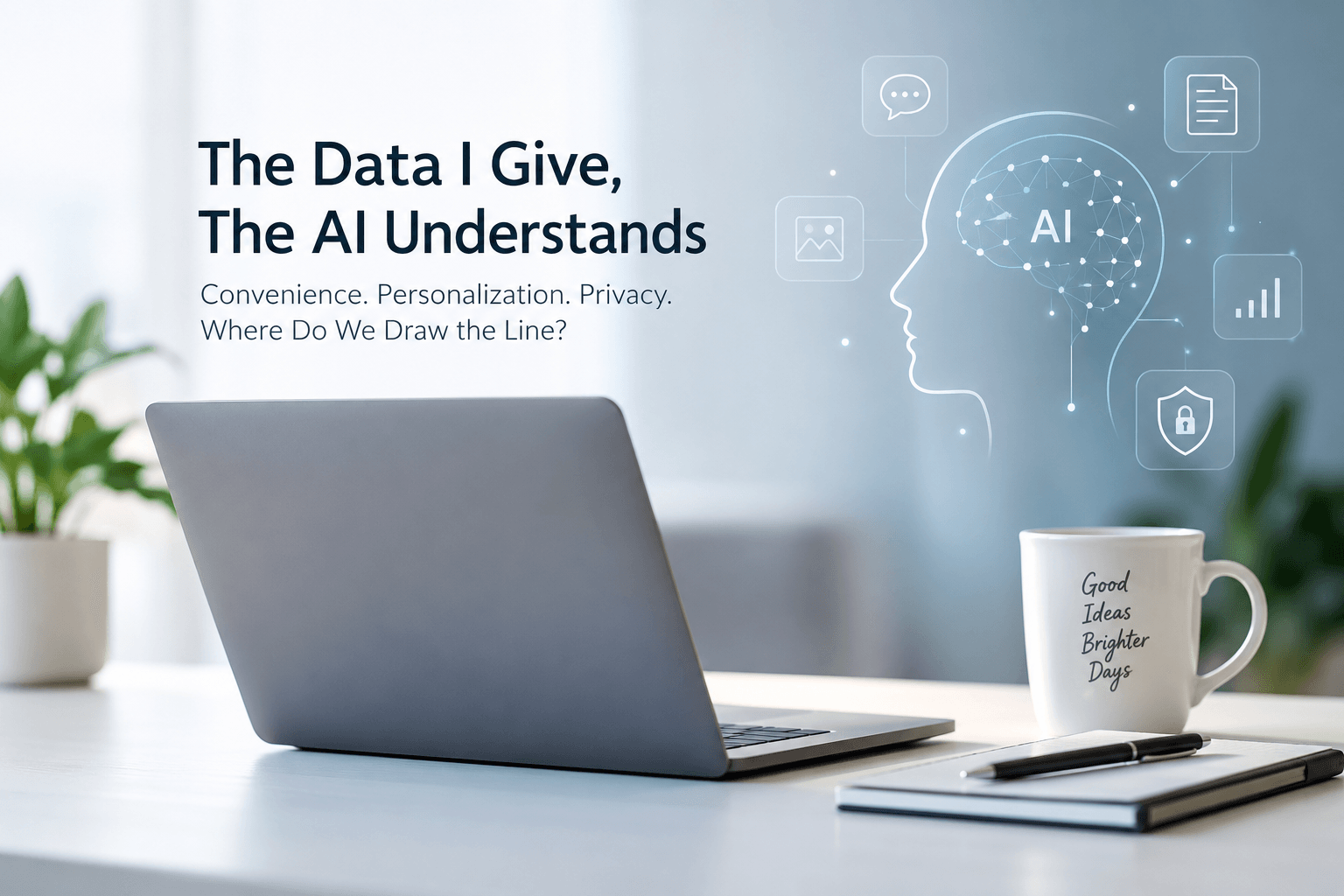
Does AI Really Know Us? What Does It Do With Our Data?
These days, I use AI tools for almost all my monotonous tasks.
If something is repetitive, takes too much time, or needs a little brainstorming, I usually turn to AI. ChatGPT, Gemini, Claude and a few other tools have slowly become part of my everyday work.
And sometimes I wonder how much these tools actually know about me.
Think about it.
Every time I ask ChatGPT to rate my blog, I am giving it a little bit of information about what I am doing.
When I ask it about SEO, it knows I’m working on SEO.
When I ask about Digital PR, it knows that’s part of my work.
When I discuss an idea for my website, a blog, a project or a problem I’m trying to solve, I’m giving it more context.
Do this every day for months and years, and there is suddenly a lot of information available.
There is enough data to understand the kind of customer I am, the things I work on, the subjects I am interested in, the type of answers I prefer and perhaps even how I think about certain problems.
That made me curious.
But what exactly happens to all this information?
So, How Does AI Get All That Information About Us?
The simplest answer is: we give it to them.
Every prompt we type is information.
Every document we upload is information.
Every question we ask is information.
Depending on the tool and the features we use, there can also be information from connected services, devices or other sources.
And we don’t always realize how much we are sharing.
I might start with something as simple as:
“Rate my blog.”
A few messages later, I may have explained what the blog is about, who my audience is, what my business does, what tone I prefer and what I want to achieve.
One conversation may not reveal much.
But hundreds of conversations can reveal quite a lot.
So, What Does AI Do With All That Data?
For me, one of the simplest examples is something I experience myself: AI can remember previous conversations and tasks.
Take ChatGPT. If I worked on something a month ago, I can search my chat history and find that conversation again. When Memory is enabled, ChatGPT can also use useful information from previous conversations to personalize future chats. OpenAI: ChatGPT Memory FAQ
I might ask it to rate my blog today, discuss SEO tomorrow, and return to a website project weeks later. Over time, all these interactions create a lot of context about me.
This doesn’t mean every conversation is automatically used to train the AI. Chat history, Memory, and model training are different things. OpenAI provides separate controls for these. OpenAI: Data Controls FAQ
But it does make me realize something:
The more I use AI, the more information I leave behind.
And that information can reveal what I do, what I’m interested in, what I work on, and even how I prefer to work.
That’s a lot of data, one prompt at a time.
Do AI Tools Sell Our Data to Brands?
This is probably the question most of us have when we think about AI and privacy. Are AI companies collecting all this information and then selling it to brands? The answer is not that simple. Companies have different privacy policies, so we cannot assume they all handle our data in the same way. For example, OpenAI says it does not sell personal data to advertisers or share our conversations with them. It can, however, use information we provide to operate and improve its services and, depending on our settings, personalize our experience. So there is an important difference between selling our data to brands and using our data internally to make a service more relevant to us.
And Now ChatGPT Has Ads. So Is Our Data Being Used?
This is where things get interesting. ChatGPT has started introducing ads for eligible Free and Go users in some markets. OpenAI says advertisers do not get access to our chats, chat history, memories, or personal details, and that our data is not sold to advertisers. But OpenAI also says that, when ad personalization is enabled, ChatGPT may use selected signals from our broader ChatGPT experience, including the current conversation, past chats, memory, and interactions with ads, to decide which ads may be more relevant to us. And honestly, this is the part that makes me stop and think. If I spend months telling ChatGPT what I work on, what I search for, what I am interested in, and what I need help with, it can build a much better picture of what might be relevant to me. OpenAI says that information stays within its advertising system rather than being handed over to advertisers. So, technically, the brand may not know who I am or see my conversations, but the system can still use signals from my interactions to make the ads more relevant. We may not be selling our data, but our data can still have value.
What Does AI Get From Us? What Does It Use It For?
We get convenience, and AI gets data. That data can help AI tools understand how we use them and, where features such as memory are enabled, give us more personalized and refined answers. The more context the AI has about our work, preferences, and previous conversations, the less we have to explain every time. At the same time, depending on the service and our settings, our interactions may also be used to improve the product, develop features, analyze usage, or improve AI models. So there is a trade-off: the more we share, the more personalized the experience can become.
We get convenience. AI gets data.
The Interesting Part? AI Starts Learning Your Way of Asking
What I find most interesting is that I don’t always have to explain what I want anymore. After using AI repeatedly, I can give a short instruction and get something much closer to what I had in mind. It can pick up the context from the conversation, the way I like things written, and the kind of answer I’m looking for. That is incredibly convenient for me. But it also makes me realize that the same information making AI more useful to me is information about me.
The better AI gets to know how I work, the less I have to explain. But how much do I actually want it to know?
So, Can We Really Trust AI With Our Data?
I use AI almost every day, so clearly, I trust it to a certain extent. But I don’t think trust should mean sharing everything.
Different AI tools have different privacy policies and controls. So before using one, it is worth understanding what happens to your conversations and what settings are available.
I wouldn’t share passwords, banking information, highly sensitive personal details, or confidential client information just because an AI tool makes the conversation feel private.
So, What Should We Be Careful About?
For me, it comes down to being conscious of what I type and upload.
AI is incredibly useful, especially for repetitive tasks. But convenience can make us forget how much information we are giving away.
Before I hit Send, I think it’s worth asking:
“Am I comfortable with this information being stored or processed by an AI tool?”
Conclusion
I’m not going to stop using AI. In fact, I use it more than ever.
But I am becoming more aware of the data I leave behind.
AI can learn a lot from what we tell it, the questions we ask, and the tasks we repeatedly bring to it.
We don’t have to fear AI. We just need to be more conscious users of it.
Because every prompt may seem small, but over time, those prompts can tell a surprisingly detailed story about us.