
I love blogging.
Over the past few months, I’ve been busy drafting blogs on various topics—writing consistently, experimenting, and trying to find my voice. I’ve been actively publishing on platforms like Medium and similar spaces, and somewhere along the way, I realized something important:
AI can be a big help in my blogging journey.
I was very particular from the beginning that it would be me blogging for myself and not AI for me.
I am a person who has so much to say. And because of that, I wanted every blog to carry my thoughts, not the AI’s. I didn’t want to become someone who just copies and pastes generated content. That never felt right to me.
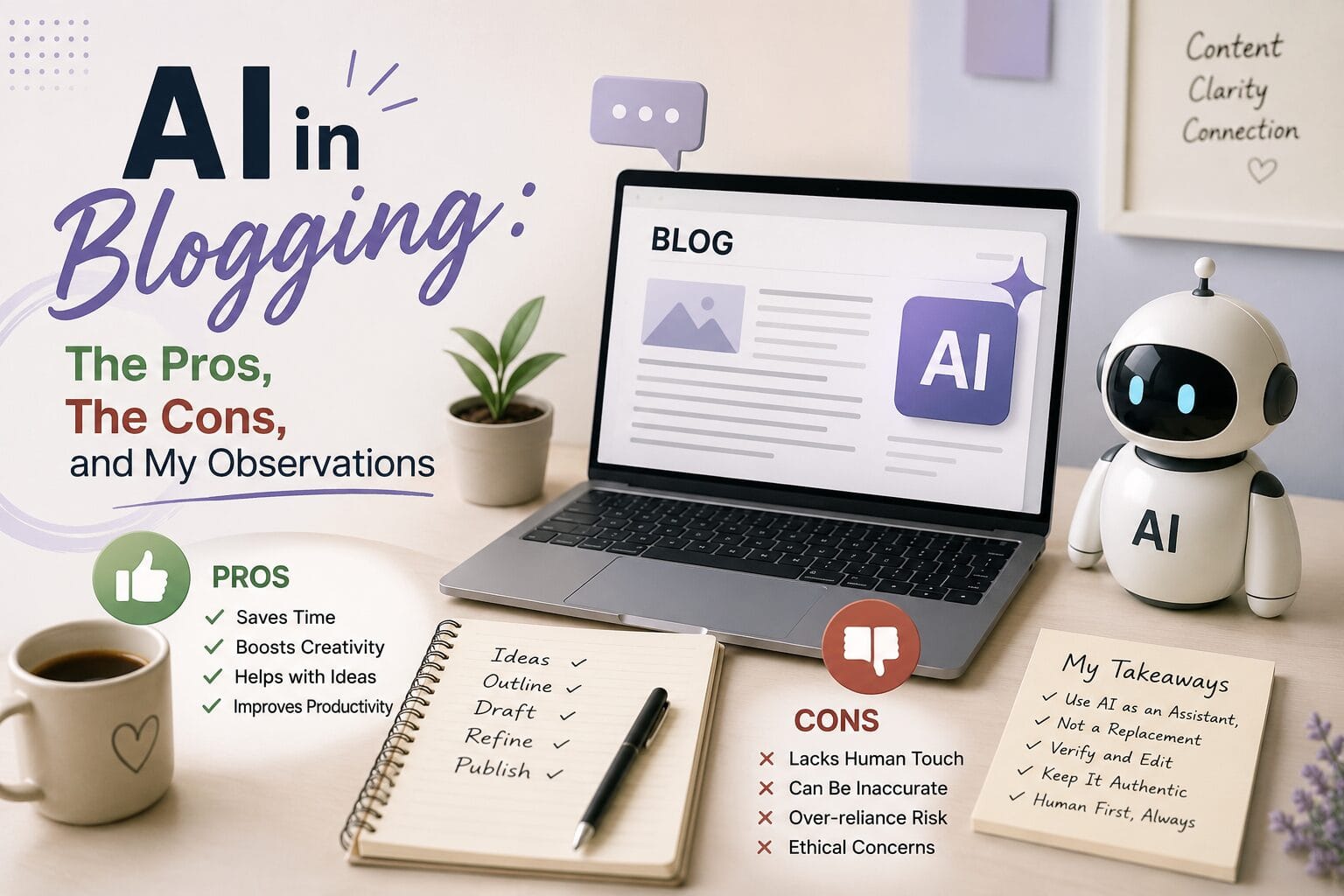
However, as I kept writing, I also realized that AI has its own place in this journey. It comes with both pros and cons.
The Upside of Using AI in Blogging
One of the biggest advantages was how AI helped with framing catchy title suggestions. Based on my prompts and the direction I give, it comes up with titles that are more engaging.
- It also listens—surprisingly well. When I clearly tell it to keep my tone, style, and language intact, it does. That was important to me from the beginning. I didn’t want my writing to suddenly sound different or artificial.
- Another thing I appreciate is how it helps in keeping the content original while still improving clarity. I give it my thoughts, and it works around them rather than replacing them. In a way, it feels like I am still the one writing, just with a bit of assistance to make things structured.
- Another plus has been using ChatGPT over time. It remembers my history, and that has made a difference. The more I use it, the more it understands how I write, how I think, and the kind of tone I prefer. Because of that, the output feels more aligned with me. It helps me stay real.
Another attractive feature has been how it helps me with symbolic featured images. Based on my prompts, it comes up with ideas that are creative and engaging.
The Downside of Using AI in Blogging
- At times, the output sounds very stereotypical. Nothing new. It feels like it’s just repeating what is already out there. That gets boring for me, and most of the time, I end up discarding such drafts completely.
- I also don’t like it when it adds unnecessary fluff in between to beef up the content.
- Another thing that bothers me is how it handles sensitive or political topics. When I try to speak boldly, it often becomes overly cautious. But that’s not who I am. I am here to sound like myself, come what may.
The art of prompting
Prompts play a big role in getting AI to draft the kind of content you actually want. A generic prompt that lacks specifics is an effort in vain. It leads to vague, predictable output that doesn’t really match your intent.
Instead, I’ve learned to focus on what truly matters—my style, my tone, my language, and the kind of content I want to create. The clearer I am, the better the result.
I also try to be honest and direct in my instructions. There’s no need to overcomplicate it.
At the same time, I keep reminding myself of one thing:
AI is still a machine at work.
It can assist, but it is not always right. I don’t take everything it gives me at face value. I check for facts, I question the output, and I make sure it aligns with what I truly want to say.
And if you are trying to get better at prompting, I found this ebook to be genuinely helpful: https://promptblueprint.gumroad.com/l/cwhctu — it focuses on practical prompts and making AI work the way you want it to, rather than the other way around. ()
Not as a shortcut, but as a guide to understand the process better.
Because in the end, the responsibility of what gets published is still mine.